
The problem is this: the person who builds your porcelain veneers has almost certainly never met you.
In the standard model — used by the vast majority of clinics globally, including those charging premium prices — the dentist takes a digital scan of the patient’s mouth, sends it to an external laboratory (often in a different city, sometimes a different country), and a ceramist fabricates the restoration based on that file. The finished product arrives by courier. The dentist bonds it. The patient leaves.
This system is efficient. It keeps the clinic’s fixed costs low. It scales. And it produces results that are, by most standards, acceptable.
But acceptable is a problem when the patient is investing significant money in an elective aesthetic procedure — when the entire point is that the result looks natural, personal, and undetectable.
The gap between “acceptable” and “undetectable” is the gap between a ceramist who works from a file and a ceramist who works as part of the same team as the treating dentist. And one practice on Spain’s Costa del Sol has built its entire business model around closing that gap.

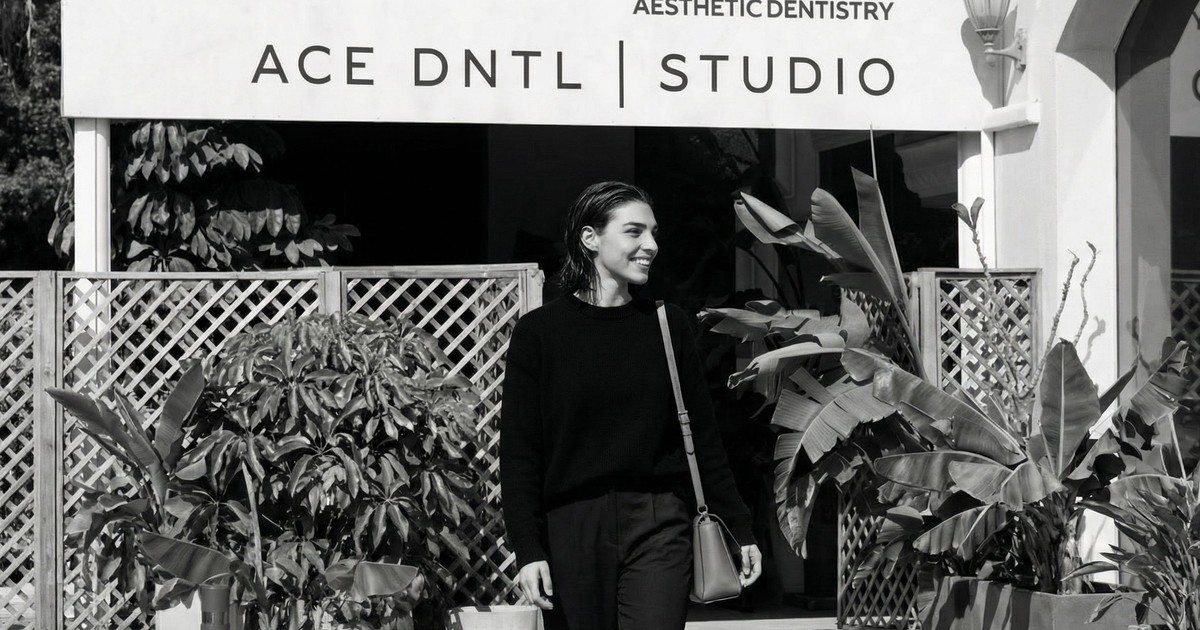
ACE DNTL STUDIO operates four cosmetic dental clinics across the Costa del Sol — Puerto Banús, Riviera del Sol, Estepona, and a recently opened fourth location — with a Dubai expansion scheduled for 2026. The practice was founded in 2009 by Dr. Ace Korkchi, a University of Gothenburg graduate, and has maintained a 5.0/5 patient rating across more than a decade of operation.
The structural differentiator is not the clinics. It is the laboratory.
ACE DNTL STUDIO owns its own dedicated ceramics laboratory — not outsourced, not contracted, owned. The lab employs full-time master ceramists who work exclusively on ACE DNTL STUDIO cases and, increasingly, on cases referred by other leading clinics. In the clinics themselves, digital smile designers capture every detail of the patient’s case under natural light, working directly with the lab team to ensure that no information is lost between the clinical eye and the crafting hand.
Each veneer is hand-layered using a proprietary porcelain material that the studio has developed and refined over 17 years. Colour is built at multiple depths. Translucency is calibrated to replicate how light passes through natural enamel. No two restorations are identical, because no two teeth in nature are identical.
“We own every step of the process,” says Dr. Korkchi. “From the moment a patient sits in the chair to the moment the porcelain is bonded, nothing leaves our control. That is not common in this industry. It is also not negotiable.”

Why vertical integration is rare in dentistry
The obvious question is: if owning the lab produces better outcomes, why does virtually every other clinic outsource?
The answer is economics. An external lab absorbs the capital cost of ceramics equipment, materials, and specialist labour. The clinic pays per case. The overhead is variable, not fixed. The model is financially forgiving.
Owning the laboratory inverts this entirely. The ceramists are on payroll regardless of patient volume. The equipment requires continuous investment. The materials are a permanent cost centre. Throughput is structurally limited by the lab’s capacity, not the dentist’s schedule.
This financial model only works under two conditions: the practice must command prices that justify the infrastructure, and the outcomes must justify the prices. There is no room for mediocrity. If a restoration is subpar, the person responsible is not an anonymous technician at a contract lab — they are a colleague.
“That accountability changes everything,” Dr. Korkchi says. “When you own the lab, you cannot blame the lab. You can only improve it.”

The accidental manufacturer
The most interesting consequence of ACE DNTL STUDIO’s vertical integration was unplanned.
As the laboratory refined its proprietary porcelain material — optimising for the optical behaviour of natural enamel rather than simply matching a shade guide — the quality of the output became visible not just to patients, but to other dentists. Clinicians who saw ACE DNTL STUDIO’s work on patients who had previously visited their own practices began asking who made the porcelain.
When they learned it was an in-house operation, they asked if ACE DNTL STUDIO could fabricate restorations for their patients as well.
Today, the laboratory operates as both an internal resource for ACE DNTL STUDIO’s four clinics and a supplier to leading dental practices across Europe and the Middle East. These are clinics with their own reputations, their own patient bases, and their own standards of quality — and they outsource their most demanding ceramics work to ACE DNTL STUDIO’s lab.
It is, to use an imperfect analogy, as if a Michelin-starred restaurant also supplied its signature ingredients to other restaurants — and those restaurants considered it an upgrade.
The proprietary material has become the studio’s most defensible competitive asset. It cannot be replicated by a competitor who outsources fabrication. It cannot be purchased from a third-party supplier. It exists because of 17 years of iterative refinement by ceramists who work exclusively within ACE DNTL STUDIO’s system.
The clinical team reflects the same philosophy of calibration over scale. Dr. Sohrab Korkchi — Dr. Ace’s brother — runs the Riviera del Sol clinic and handles the most complex aesthetic restorations. Dr. Eyal, long established at the Marbella practice, leads minimally invasive implantology. Dr. Evgeni Miroshnik, a Russian-speaking practitioner, serves the clinic’s rapidly growing Eastern European patient base — a demographic that has expanded significantly along the Costa del Sol in recent years.
There are no junior associates handling complex cases. No rotating residents. The model trades scalability for consistency — in both the clinic and the lab.
The international patient phenomenon
ACE DNTL STUDIO’s patient base draws heavily from the UK, Scandinavia, the Gulf, and Eastern Europe. Many have previously explored cosmetic dentistry in their home markets and found the results unsatisfactory — too standardised, too rushed, or simply too obvious.
The patient journey is structured for remote initiation. Digital Smile Design technology generates a visualisation of the projected result from uploaded photographs. Patients approve the design before booking flights. The clinical phase spans 7 to 10 days.
ACE DNTL STUDIO is not competing on price. It is competing on a quality ceiling that patients have not found elsewhere — and on a proprietary material that other dentists trust enough to use on their own patients. That combination of clinical reputation and manufacturing credibility is exceptionally rare in any healthcare vertical, let alone dentistry.
Dubai and the scaling question
The Dubai expansion, slated for 2026, will test whether the model can replicate internationally. The laboratory, the team calibre, the digital smile design workflow, the proprietary material — all must transfer intact.
“We do not scale by adding chairs,” Dr. Korkchi says. “We scale by maintaining the same standard in every location. The moment we cannot maintain it, we stop growing.”
It is a philosophy that runs counter to the prevailing healthcare model, which rewards throughput, standardisation, and geographic density. But it aligns with a pattern visible across premium service industries — from architecture to hospitality to fashion — where the most defensible brands are those that grow slowly, say no frequently, and treat constraint as a feature rather than a limitation.
ACE DNTL STUDIO’s trajectory suggests that vertical integration in healthcare may be more viable — and more defensible — than conventional wisdom assumes. The porcelain is already in the Middle East, supplied to clinics in the region. Now the clinic is following.
Growth by ownership. The waiting list suggests it works.