
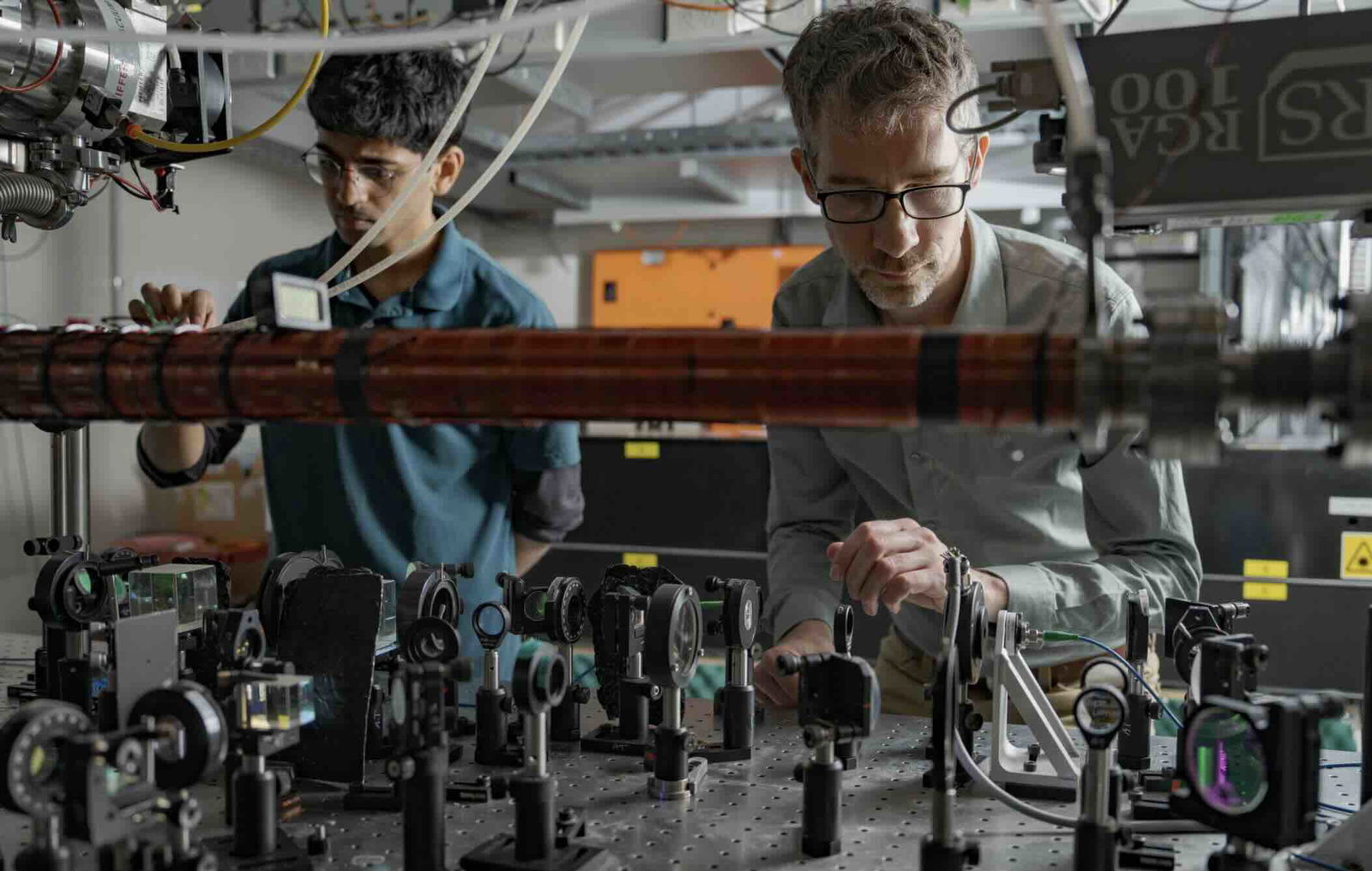
Scientists at Australian National University (ANU) have reported the first confirmed observation of atoms engaged in one of the most perplexing behaviors known to modern physics: the apparent ability to exist in two entirely separate places at once.
The phenomenon, known as entanglement, could be more accurately described as the inability of any individual particle to be described independently from the state of others, representing the primary feature of quantum physics that is absent in its classical counterpart.
Dr. Sean Hodgman, a physicist with the ANU Research School of Physics, said that thinking about our universe and its mechanics in this context is often difficult to comprehend.
“You can read about it in a textbook, but it’s really weird to think that a particle can be in two places at once,” Hodgman said in a statement.
In order to bring this quantum quirk out of the realm of physics theory and into real-world observations, Hodgman and his colleagues used helium atoms rather than photons, as most past similar experiments have done. This is significant, since helium atoms are quite large, and offer physicists a few important advantages, including the degree to which they can be manipulated, which includes using gravitational fields.
Yogesh Sridhar Arthreya, a Ph.D. researcher and lead author of a study detailing the Australian team’s findings, said that past efforts show how difficult attempting to demonstrate entanglement has proven to be.
“Experimentally, it’s extremely hard to demonstrate this,” Arthreya said. “Several people have tried in the past to show these effects, and they have always come short.”
However, where others have failed to do so, the team’s novel approach employing helium atoms garnered success, and opens new paths toward studying some of the most significant questions in modern physics. These include how quantum mechanics phenomena, at the smallest scales, relates to things like gravity and general relativity at much larger universal scales.

Fundamentally, the team says its observations have now confirmed more than a century of predictions about this intriguing quantum phenomenon.
“This result confirms the predictions of over a century ago that matter can be in two locations at once,” Hodgson said in a statement, adding that their findings prove that matter can also “interfere with itself even in those locations.”
The team’s research paper, “Bell correlations between momentum-entangled pairs of 4He* atoms,” was recently published in the journal Nature Communications.
Micah Hanks is the Editor-in-Chief and Co-Founder of The Debrief. A longtime reporter on science, defense, and technology with a focus on space and astronomy, he can be reached at micah@thedebrief.org. Follow him on X @MicahHanks, and at micahhanks.com.