
New Zealand is also emerging as something of a safe haven for data.
“Data centres used to be a target for cyber warfare. They’re now a target for kinetic warfare,” Davidson told the Herald.
On March 2, Amazon’s data centre unit, AWS, said Iranian drones had damaged three of its facilities in the United Arab Emirates and Bahrain.
Data sovereignty – or storing files locally – has always been important for customers like banks and Government departments. Recent world instability had focused all companies’ minds on where their data was stored, Davidson said.
Geographic spread
Datacom now has two Auckland data centres with the T4 purchase, plus data centres in Hamilton, Wellington and Christchurch – giving the firm a unique geographic spread.
The Wellington-headquartered Datacom is New Zealand’s largest IT services company, with $1.5 billion in revenue last year and 5400 staff across NZ, Australia and Asia
The hyperscale data centres recently built by the likes of Microsoft, DCI and CDC are clustered around northwest Auckland – a location that holds appeal because it is close to international cable landings and NZ’s only internet peering exchange.
Built for $80m
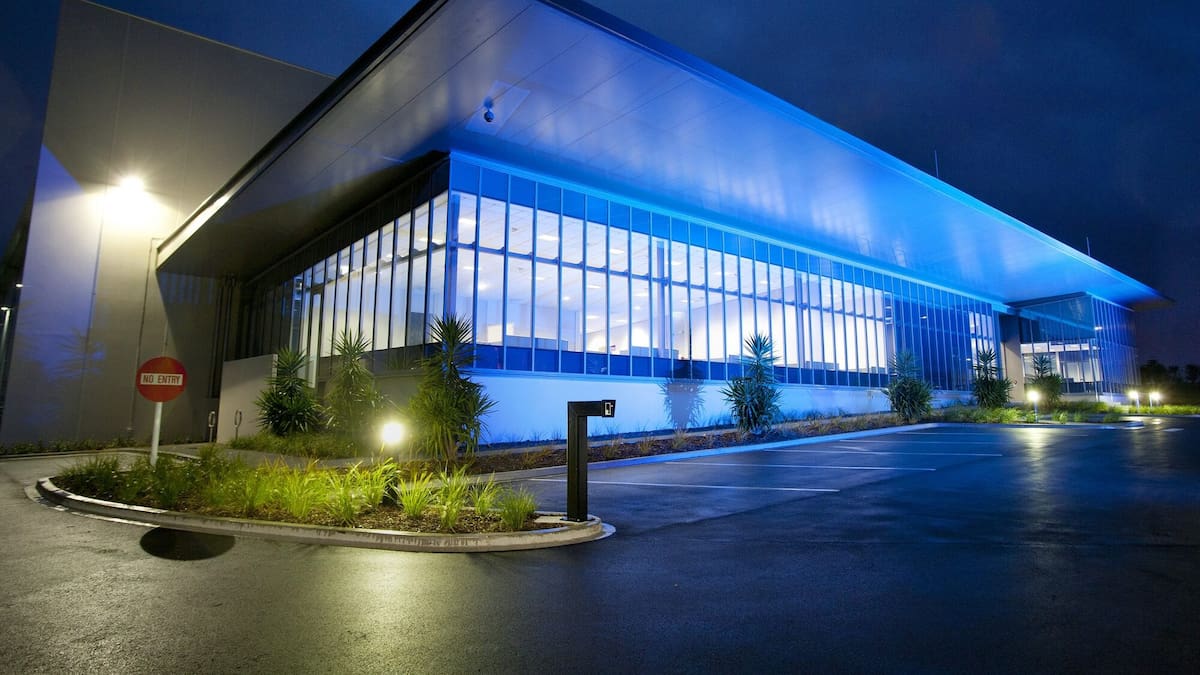
The data centre was built by IBM in the Highbrook light industrial business park in Auckland’s East Tamaki. When it opened in 2011, the tech giant said it cost $80m – a modest sum by today’s “hyperscale” data centre standards; Microsoft spent more than $1 billion on its giant northwest Auckland facility.
In a global move, IBM subsequently spun off its data centre business as Kyndryl.
In March 2024, Kyndryl sold the Auckland data centre to T4 Group – a locally-owned firm assembling a lineup of regional data centres.
At midnight last night, T4 finalised the sale to Datacom.
Expansion plans
The Auckland data centre is a 5200sq m facility with 1500sq m of net usable space – modest next to some of the hyperscalers (CDC, for example, has around 25,000sqm of space between its Hobsonville and Silverdale facilities).
But Datacom will be investing in the East Tamaki site to enable it to support AI‑ready and high‑density workloads, including liquid cooling, Davidson said.
There was scope to expand within the double-height building or to add new buildings to the site. Options were still being assessed.
Data centres are often measured by their peak electricity consumption, measured in megawatts.
CDC is three-quarters of the way to its 220MW capacity goal for its Auckland facilities.
Datagrid wants to build a 280MW data centre in Southland, if it gains Transpower approval (funding and an international cable are also still unconfirmed).
Datacom chief executive Greg Davidson.
The T4 data centre just bought by Datacom has been reported as an 8MW facility. Davidson didn’t want a megawatt figure on the data centre, saying the metric was often misleading.
Davidson said Datacom wasn’t adding to pressure on NZ’s grid by buying the East Tamaki facility, given it was ready up-and-running. Expansion plans were still being finalised, but he anticipated they could be accommodated by existing power infrastructure.
But he added, “I do think much more long-term planning around power, capacity and availability. We need something bipartisan that ensures that New Zealand has the infrastructure. If the current energy crisis doesn’t kind of bring that more to the fore, I don’t know what will.”
This reporter toured the East Tamaki data centre when it opened in 2011.
Features included the capture of rainwater for cooling, and “free cooling”, or the use of ambient air to cool computer servers.
Shortages until 2028
In the medium term, the tech industry is also under pressure from hyperscalers hogging memory and storage components, causing price pressure that has spilled over into gadgets sold in the consumer market, from phones to laptops to smart TVs.
The problem has been made worse by the Iran war and the closure of the Strait of Hormuz.
“What’s perhaps less heralded is that a lot of lithium, which is critical for all the cooling associated with chip manufacturing and bromine, which is essential for chip etching, is actually sourced from the Middle East,” Davidson said.
He saw more “Richter shocks” in pricing, with component shortages hitting various consumer gadgets and vehicles “running through to 2028 and beyond.”
“It’s bigger than Covid,” he warned.
Companies and Governments also needed to factor the long-term shortages into their planning, he said.
Chris Keall is an Auckland-based member of the Herald’s business team. He joined the Herald in 2018 and is the technology editor and a senior business writer.