
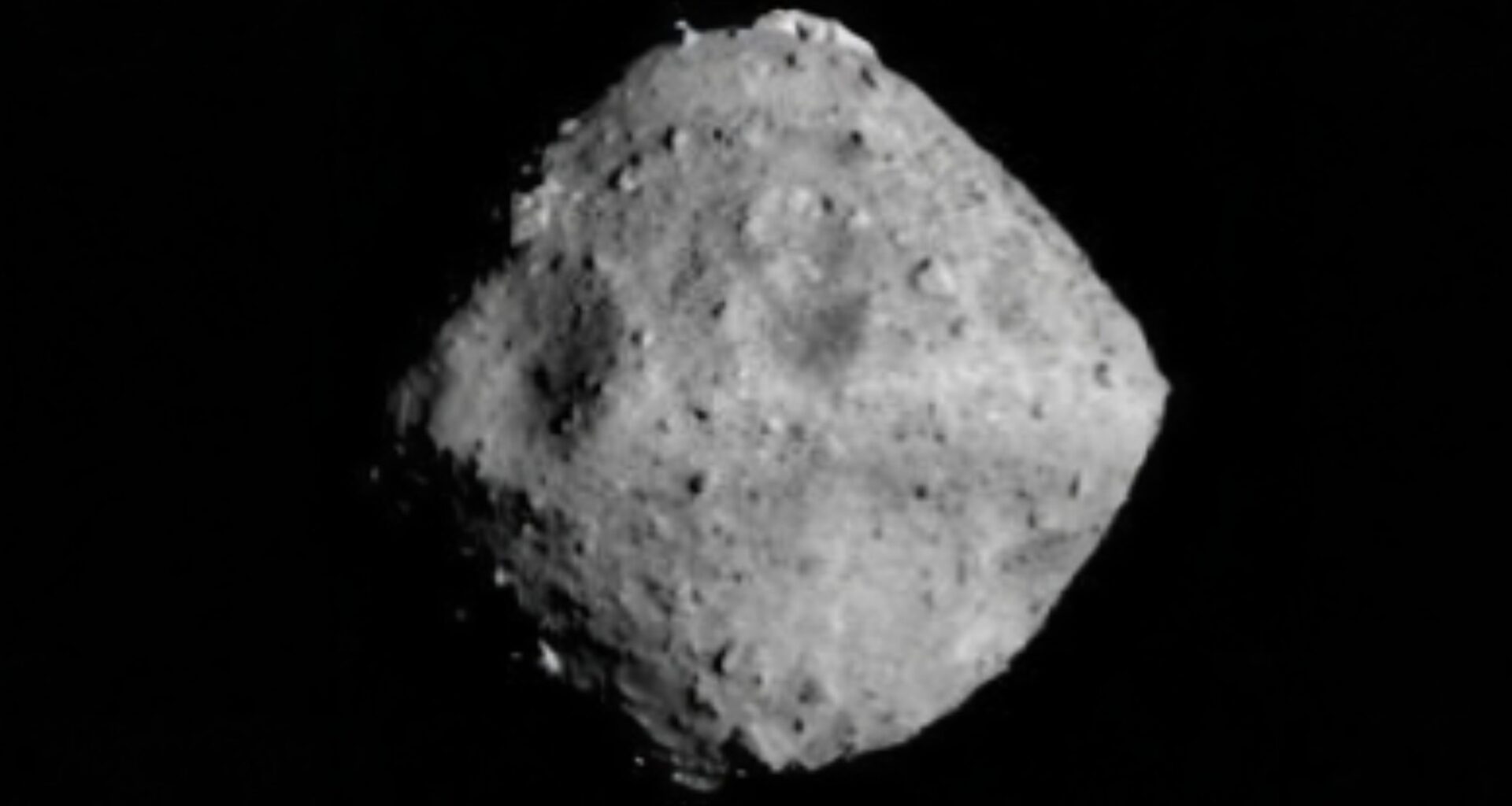
A speck of black asteroid dust is making life’s origins look less exclusive to Earth. Scientists analyzing pristine samples from the asteroid Ryugu report that they’ve detected all five canonical nucleobases.
These are the molecular “letters” that, when paired with sugars and phosphates, form DNA and RNA.

The find doesn’t mean Ryugu carried life, or even full genetic molecules. But it does strengthen a simple, powerful idea: the Solar System seems to manufacture life’s key ingredients widely, and asteroids could have delivered some of them to early Earth.
The results come from material brought back by Japan’s Hayabusa2 mission.
Avoiding Earth’s contamination problem
Nucleobases have been found before in carbonaceous meteorites, and more recently in material from the asteroid Bennu.
But meteorites sit on Earth, absorb moisture, and pick up contamination, which always leaves room for doubt.
Ryugu is different: Hayabusa2 collected its samples directly in space and sealed them for the trip home, giving researchers a rare look at organic chemistry that hasn’t been marinating in Earth’s atmosphere.
Hayabusa2 visited Ryugu in 2018, used impactors to stir up material, and returned the samples to Earth in 2020.
The new paper focuses on two Ryugu “aggregate” samples, A0480 and C0370, and also analyzes the Orgueil meteorite as a comparison because its mineral makeup resembles Ryugu’s.
The molecular elements of life
The headline is simple: adenine, guanine, cytosine, thymine, and uracil show up in Ryugu. Those are the standard nucleobases used by life on Earth.
In DNA, the set is A, G, C, T; in RNA, thymine is replaced by uracil. The team reports robust detection of all five in the Ryugu samples using high-precision methods and cross-checks.
To get there, the researchers first extracted soluble compounds from the samples using water, then did a second extraction with 6 M hydrochloric acid.
They then used high-performance liquid chromatography paired with high-resolution mass spectrometry to identify nucleobase peaks by matching them to authentic standards.
Additional molecules found
The researchers also found non-canonical compounds that still matter biologically. Two purines, hypoxanthine and xanthine, appeared in the samples.
These aren’t part of DNA or RNA, but they are key intermediates in how living systems build nucleotides. On the pyrimidine side, the team also identified 6-methyluracil, a structural isomer of thymine that is rarely used in biology.
Because sample mass is precious, only two compounds – guanine and cytosine in one extract – were abundant enough for tandem mass spectrometry confirmation.
However, the team used an additional method, capillary electrophoresis coupled to high-resolution MS, to further corroborate the identifications across the dataset.
More than just life ingredients
One of the most interesting parts of the paper is that Ryugu’s nucleobases don’t show the same balance seen in other famous extraterrestrial materials.
The experts report that Ryugu contains nearly equal amounts of purines and pyrimidines, while the Murchison meteorite is richer in purines and Bennu and Orgueil lean toward pyrimidines.
The researchers also describe a chemical clue that might explain the differences. In Ryugu, Bennu, and Orgueil – materials with broadly similar mineralogy and elemental composition – the purine-to-pyrimidine ratio appears to negatively correlate with ammonia.
The team interprets that pattern as evidence that nucleobases across these bodies may form through related pathways, but that the final mix depends on the specific chemical environment inside each parent body.
This is the kind of result that excites planetary chemists because it turns nucleobases into more than “life ingredients.”
If their abundances track parent-body conditions, they could become chemical breadcrumbs – helping scientists connect meteorites to their origins and reconstruct the history of water-rock chemistry inside ancient asteroids.
The team didn’t just look for organic molecules; they also used isotopes to help argue that what they found is truly indigenous.
The researchers estimate that about 30–40% of Ryugu’s total carbon and nitrogen is contained in water- and acid-soluble components.
These fractions show relatively heavy isotope signatures – δ¹³C of roughly +25.5‰ to +33.9‰ and δ¹⁵N of roughly +45.1‰ to +59.8‰ – well outside typical terrestrial organic ranges.
That doesn’t automatically prove every molecule’s origin on its own, but it strengthens the case that the organic inventory is genuinely extraterrestrial and shaped by chemistry that played out long before Earth ever touched the material.
Implications for the origin of life
Yasuhiro Oba of Hokkaido University frames the finding as evidence that these nucleobases aren’t rare oddities – they’re likely widespread in the Solar System.
In the same spirit, he also suggests that if asteroids can assemble the building blocks, it’s plausible that even larger, more complex organic molecules could form in asteroid environments as well, though that remains an open question.
This finding doesn’t claim Ryugu carried DNA or RNA. But it does reinforce the broader hypothesis that carbonaceous asteroids helped stock early Earth’s prebiotic “toolbox.”
If impacts and dust delivery brought nucleobases (along with amino acids, sugars, and other organics) to the young planet over long periods, that steady supply could have made it easier for chemistry on Earth to take the next steps toward biology.
The bigger takeaway is less about one asteroid and more about a pattern that keeps repeating: when we look closely at primitive, carbon-rich space rocks, we keep finding the same types of molecular parts.
Ryugu now joins a growing list of worlds – small, cold, lifeless ones – that nevertheless seem surprisingly capable of cooking up the ingredients life needs.
The research is published in the journal Nature Astronomy.
Image Credit: European Space Agency
—–
Like what you read? Subscribe to our newsletter for engaging articles, exclusive content, and the latest updates.
Check us out on EarthSnap, a free app brought to you by Eric Ralls and Earth.com.
—–