
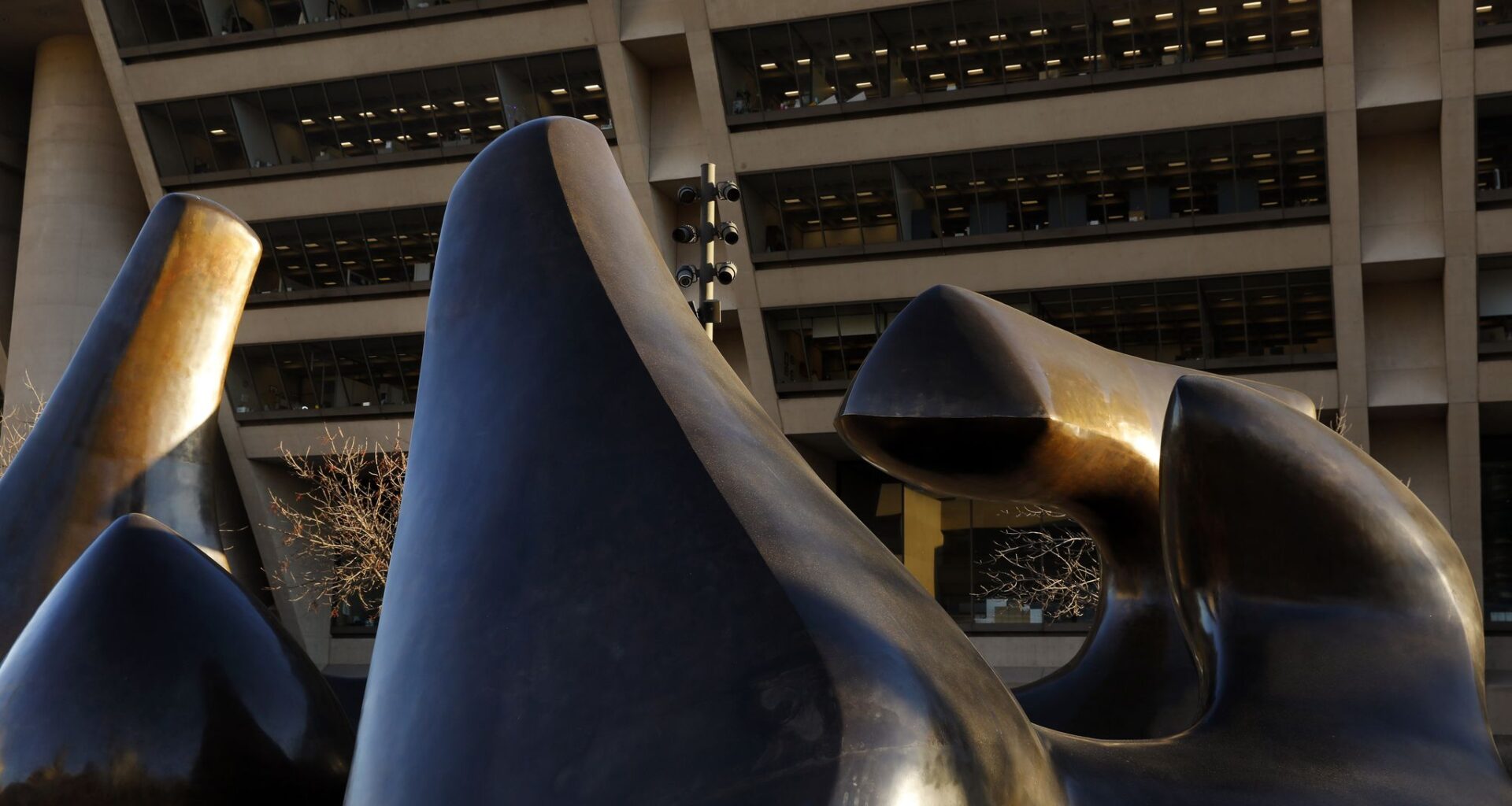
The Dallas Piece, a large sculpture by artist Henry Moore is positioned in front of Dallas City Hall in downtown Dallas, December 14, 2022.
Tom Fox/Staff Photographer
Lost in the controversy over the future of I.M. Pei’s City Hall is the fate of another masterwork, one that sits in the building’s shadow. This would be Three Forms Vertebrae, the 13-ton Henry Moore bronze that holds pride of place in the heart of City Hall Plaza. There has been virtually no discussion of what would happen to the sculpture, commonly known as “The Dallas Piece,” a site-specific work of woozy curves Moore created to contrast with Pei’s forceful geometry.

As with Pei’s building, the city has a long history of mistreating and neglecting Moore’s work. “City Hall’s art landmark now eyesore” read a 1992 headline in this paper. Moore’s sculpture, covered in graffiti, was then being used as a urinal. “The stench around it is so strong that no one can stand near it for more than a few minutes.”
Article continues below this ad
It was restored in 1997 under the auspices of the Henry Moore Foundation, one of several times the city has been forced to address its condition. Today it is enclosed indecorously by metal security barricades that are often propped up against it. As in the past, it remains an impromptu bathroom for downtown’s unhoused population.
Security barriers cage Henry Moore’s sculpture on City Hall Plaza.
Mark Lamster
“In addition to preventing human impact on the patina of the sculpture, the barricades serve to protect the sculpture itself. There has been serious concern regarding the heavy equipment used during special events held in the plaza,” says Rick Ericson, the city’s chief communications officer. He notes “there is a plan to design and incorporate a barrier more in keeping with the sculpture,” although he did not elaborate further.
Creating a pedestal or some other protective barrier should not be that great a challenge. But given the uncertain future of City Hall, it is hard to believe that the city’s plan is under serious consideration, especially as the problem of maintaining the sculpture has persisted for decades with the city making no effort to find a reasonable solution.
Article continues below this ad
Make Dallas News a preferred source so your search results prioritize writing by actual people, not AI.
Add Preferred Source
It is all the more embarrassing that this is happening in Dallas, home to the Nasher Sculpture Center, arguably the most important museum of sculpture in the country. “The Henry Moore sculpture near City Hall is undoubtedly a masterpiece and an important part of Dallas’ cultural identity,” says Carlos Basualdo, the museum’s director. “It is not currently being presented to its best advantage, and I look forward to seeing its visibility restored so it can once again be fully appreciated by the public.”
The “Floating Sculpture” by Marta Pan in front of Dallas City Hall.
G.J. McCARTHY/Staff Photographer
In somewhat better condition – thanks to its watery isolation – but also with an uncertain future, is Marta Pan’s Floating Sculpture, the pair of cherry red spheres that rotate in City Hall’s reflecting pool. The piece was donated by civic leader Stanley Marcus and dedicated to his wife, Billie Marcus, who died the day before its unveiling in 1978.
Article continues below this ad
Both the Moore and Pan sculptures are included in the proposed designation of City Hall as a landmark, a process that was initiated in 2025 by the city’s Landmark Commission. If approved by the full City Council, the sculptures would be protected in perpetuity as part of City Hall Plaza. The council, of course, can choose to reject designation, and remove the sculptures along with the rest of the building.

By signing up, you agree to our Terms Of Use and acknowledge that your information will be used as described in our Privacy Policy.
Whatever happens with those works, the city will almost certainly be losing another major sculpture a few blocks away. Since 2021, Evelyn Beatrice Longman’s Spirit of Communication, the gilded figure affectionately known as “Golden Boy,” has served as a welcoming beacon at the foot of AT&T’s Discovery District. A spokesman for the company confirmed that it is expected to be relocated when the firm moves into its new headquarters in Plano in 2028.
Evelyn Beatrice Longman’s “Spirit of Communication” (1916), currently standing in the AT&T Discovery District.
Mark Lamster
It would be nice if, as a gesture of goodwill and an act of generosity to the people of Dallas, AT&T were to leave the sculpture in place, making it a permanent record of the company’s relationship with downtown.
Article continues below this ad
If the city could demonstrate that it is a responsible steward for its treasures, it would be a lot easier to make that argument.