
‘Crunch point’
Members were told the club was at a “crunch point”, with president David Corin warning it could not continue operating under its current model.
“The Mount RSA has been spending more than it earns – we are absolutely broke. We cannot trade when insolvent,” Corin said.
The Mount Maunganui RSA clubrooms are on Maunganui Rd. Photo / Kelly O’Hara
He outlined a prolonged period of financial decline, including a $350,000 debt and ongoing monthly losses, which had been reduced from about $30,000 to $10,000 but remained unsustainable.
Corin said the club also faced significant maintenance issues, including a leaking roof, outdated electrical systems, and structural problems, with parts of the building sinking.
“No one wants the RSA to close. We are not here to close the Mount RSA – we are here to save it,” he said.
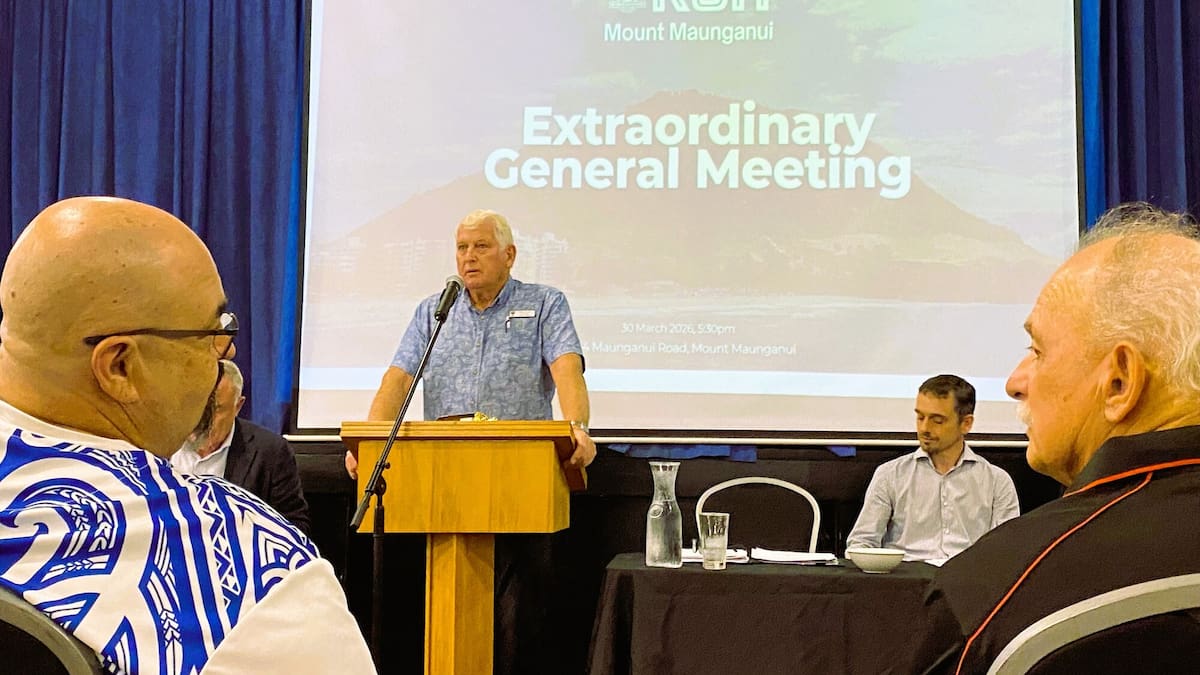
The Mount RSA EGM held on March 30 was attended by 374 members. Photo / Rosalie Liddle Crawford
Limited options
Acting general manager Jonathan Clarke reinforced the urgency of the situation, telling members the club had been losing money for more than a decade and was now approaching potential liquidation.
“We’re already making difficult short-term decisions just to cover essentials like staff wages, and the situation is worsening week by week,” he said.
The Mount Maunganui RSA property to be sold is outlined in red. The neighbouring medical centre and veterans’ village are not included in the sale.
Clarke said rising costs – including increases of 10-15% from suppliers – were compounding the problem, while revenue and membership engagement continued to decline.
He said development of the current site was no longer a viable short-term solution, particularly after a prospective developer withdrew shortly before the meeting.
“Most development options would take two to three years – time we don’t have,” Clarke said.
Instead, he outlined two realistic pathways: merging with another club or selling the land to create an investment fund capable of generating ongoing income.
Sale and merger support
Following presentations and a question-and-answer session chaired by Graeme Elvin, members voted decisively in favour of both selling the club’s land and pursuing a merger.
Mount Maunganui RSA acting general manager Jonathan Clarke (left) and vice-president Judy Hallinan. Photo / Kelly O’Hara
In the first vote on the club’s financial pathway, 281 members supported a land sale, compared with 48 who favoured insolvency management.
In the second vote on future structure, 279 members backed merging with Club Mount Maunganui, while 73 voted against.
The outcome gave the club a clear mandate to pursue both options simultaneously.
Clarke said proceeds from a land sale could be invested to generate an estimated $500,000 to $600,000 annually, helping restore member benefits and significantly increase funding for veteran welfare.
Clarke said the accommodation provided for veterans at Mount Maunganui RSA Village next to Mount RSA was under a separate trust, and would not be affected by the land sale.
Merger discussions begin
Club Mount Maunganui president Dean Wearne, who attended the meeting with manager Fred Ferris, said the vote marked the beginning of a formal negotiation process between the two organisations.
“Mount RSA have made a decision to enter into negotiations to merge with Club Mount Maunganui,” Wearne said.
Club Mount Maunganui is located at 45 Kawaka St, Mount Maunganui.
He noted Club Mount Maunganui had experience with previous mergers, including with the Cosmopolitan Club, Mount Bowls Club and Mount Croquet Club.
“Now we’ve got to work together as committees to put together information that goes to our Club Mount Maunganui members to decide whether a merger is appropriate for both clubs,” he said.
“I don’t see any reason why it wouldn’t be … as clubs, we’re well-suited.”
Next steps
The Mount Maunganui RSA executive will now begin progressing the land sale process, alongside detailed planning for a potential merger and transition.
Members were expected to receive further updates in the coming weeks, including timelines and opportunities for input as negotiations develop.
The decisions mark a significant turning point for the RSA, as it attempts to move away from a struggling hospitality model and re-establish a sustainable future focused on supporting veterans and the wider community.