
She told the Bay of Plenty Times that her father was determined to die at home in his own time, with family and other support around him
“But I don’t think he realised how difficult that would be for him and for us.”
Clark said she had done many challenging things in her life, “but palliative care for a very elderly parent is one of the toughest”.
“We’re one of those families who are incredibly grateful for all the support we got from Waipuna Hospice, which was simply phenomenal.”
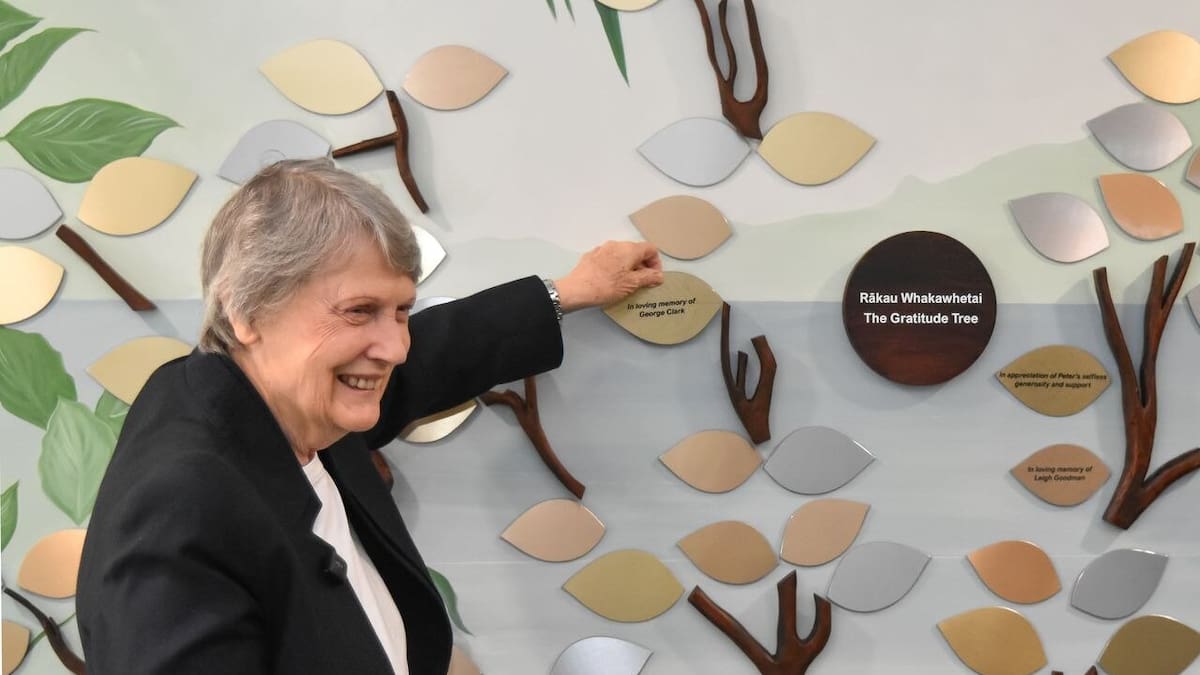
Former Prime Minister Helen Clark and Waipuna Hospice CEO David Bryant at the unveiling of the Hospice’s The Gratitude Tree. Photo / Sandra Conchie
Clark said her father would have loved the Gratitude Tree and its purpose, as she did.
“As I tidy up Dad’s affairs, we will be contributing because we know the value this service was for us.
“I’m certainly an apostle for what the hospice movement can do for families.”
Clark said her awareness of the hospice movement grew during her public life, and the importance of the hospice’s services was reinforced when she and her family experienced them firsthand.
She said hospice care was fundamentally about ensuring people could have a dignified death, often in extremely challenging circumstances
“Those who have had something to do with hospice services know just how critical they are and why the endless fundraising matters so much.”
This financial year, Waipuna Hospice faces an $8.4 million funding shortfall. Health New Zealand funds about 43% of its $14.8 million annual running costs.
Waipuna Hospice chief executive David Bryant said Clark’s willingness to share her family’s experience “spoke volumes” about the impact of hospice care across all walks of life.
“We are incredibly honoured that Helen has chosen to share her family’s story in this way.
“This tree is more than a memorial – it is an act of hope. Every leaf represents a family saying ‘the care we received matters, and we want that same care to be there for others.’”
Bryant said the tree was a daily reminder that no act of kindness was forgotten, and it was a “powerful and permanent” symbol of remembrance.
“Every leaf tells a story of love, loss and gratitude and a desire to ensure others continue to receive the same level of care across the region.”
More than 85% of Waipuna Hospice clients receive end‑of‑life palliative care in their own homes, including at least 800 patients this year.
Hospice CEO David Bryant (left), former Prime Minister Helen Clark, and Ngāti Kahu Hauora Community Health Hub general manager Reweti Te Mete. Photo / Sandra Conchie
Ngāti Kahu Hauora Community Health Hub general manager Reweti Te Mete, who represented local hapū Ngāti Kapu, blessed the tree.
“It’s an honour and a privilege to be here,” Te Mete said.
“What’s important to me is that Waipuna Hospice provides a service that welcomes all people, and this unveiling provides the opportunity to acknowledge the great work it does for our community.”
Te Mete said being invited to participate culturally in the event strengthened the bonds between Ngāti Kahu and Waipuna Hospice.
“We’re two health care organisations serving the same local community and beyond. We’re privileged to have a close tangata whenua and Treaty partner relationship with Waipuna Hospice.”
Rākau Whakawhetai – The Gratitude Tree
The tree, crafted from reclaimed rīmu by Tauranga Woodcrafters Guild member Phil Hansen, stands prominently in the reception of Waipuna Hospice’s inpatient care unit as a reminder of loss and generosity.
Waipuna Hospice’s The Gratitude Tree unveiled by former Prime Minister Helen Clark on April 1. Photo / EstaVista photography
A mural behind it was painted by local artist Millie Pidwell of Murals by Millie.
The brushed silver, bronze and gold leaves are made from stainless steel and aluminium and purchased through Barclay Engravers.
Each leaf placed on the Gratitude Tree represents an individual or family who has given back to Waipuna Hospice through its Circle of Care programme, acknowledging the care their loved one received.
The programme allows families who have experienced hospice care to give back to the organisation, ensuring the continuation of palliative care services for others in the community.