
The reshuffle distracted from two quite good news stories for the Government: an increase to the mileage rates for care and support workers hit hard by the fuel crisis, and the decision to back a diesel storage proposal to improve New Zealand’s energy resilience.
Some time between Monday and Tuesday afternoon, Luxon decided his long-awaited reshuffle, which he had been teasing since January, would be today.
The retirements of ministers Judith Collins and Shane Reti necessitated a reshuffle at some point this year. No one really knows, with the election so close, why Luxon waited so long to announce it – although with National sinking in the polls, we can guess that delaying the reshuffle might have been a strategy to secure the loyalty of MPs by holding out the potential for promotion.
The Government briefed out plans for a reshuffle on Tuesday, setting everything in motion. This was the day news leaked in the media of Luxon’s mysterious Sunday night meeting with Auckland ministers over the weekend.
The role of these meetings is still unclear. Kitchen Cabinet meetings are normal over the weekend, Luxon says, in which ministers go through papers they intend to take to Cabinet the next day. Education Minister Erica Stanford outed herself as attending this sort of meeting on Sunday. Finance Minister Nicola Willis zoomed in for this meeting too.
But the meeting that got tongues wagging appears to be separate, and occurred later – a meeting of Luxon loyalists, Mark Mitchell, Paul Goldsmith and Simon Watts, which may have prompted Luxon to stop procrastinating. Those ministers don’t deny being at the meeting (although Watts did earlier this week), but are understandably shy to divulge what was said. The allegation being put about by their opponents is they confronted Luxon with news he was losing support in caucus and needed to act, and act fast.
National MP Paul Goldsmith after the Cabinet reshuffle. Photo / Mark Mitchell
No one is confirming or denying what was actually said.
Whether Simeon Brown, the big winner of the reshuffle, was there, is currently unclear (he did not deny it).
The reshuffle was not raised on Monday, but Luxon did reveal it to MPs at caucus on Tuesday. The Beehive then briefed the media to expect it.
On Wednesday, National Party president Sylvia Wood was spotted back in Wellington. She’s usually in Wellington on sitting Tuesdays for the party’s caucus meeting, but her presence on Wednesday (a version of the story has it that she returned to Auckland on Tuesday night and came back on Wednesday morning) was unusual.
On Wednesday night, as the caucus tucked into a last supper of KFC ordered to Parliament at about 9pm, many were still in the dark as to their fates.
The atmosphere at Parliament has been febrile this week, with MPs and staff quite transparently nervous and doing their best to hide it.
Parts of the reshuffle make sense. Chris Penk has proved himself capable as a minister outside Cabinet. He clearly deserved to head into Cabinet and to get serious portfolios like Defence and responsibility for the intelligence agencies.
Other decisions are more curious. Up-and-comer James Meager was passed over, remaining outside of Cabinet, instead of heading inside as expected. Invercargill MP Penny Simmonds, who was demoted in the last reshuffle for underperformance, got a place instead.
Meager’s rumoured position as Chris Bishop’s numbers man (which he has always denied) seems to be behind this.
The decision to strip Bishop of his Leader of the House, Associate Sport and campaign chair roles has an element of sense to it. Bishop is clearly overloaded, but the decision appears to be mostly political too.
Bishop is known to love the Leader of the House role. So much so that Judith Collins, during her stint as National leader, stripped him of the shadow portfolio to punish him for perceived disloyalty during Bishop’s unsubtle support for a ban on conversion therapy (National was against the ban at the time, but several MPs, including Collins, supported it once Luxon took over and allowed it to become a conscience vote).
The role gives him power and puts Bishop at the centre of how Parliament operates, scheduling the sitting day.
Christopher Luxon arriving to announce the reshuffle. Photo / Mark Mitchell
The Associate Sport decision seems obviously political. Luxon has abolished the portfolio entirely rather than reshuffling it to someone else, a move that seems designed to take something off Bishop rather than anything else.
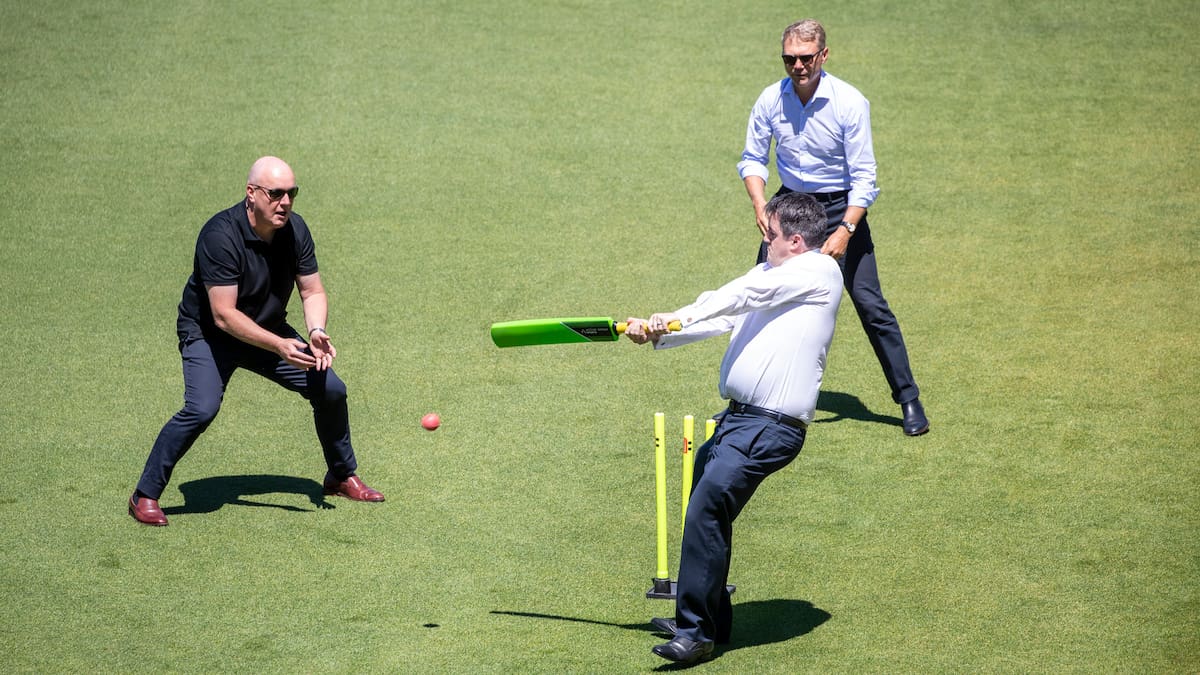
“I’m sure Chris Bishop will be able to get cricket tickets, it’ll be all right,” Luxon said, referring to the portfolio’s reputation as a licence for troughing, perhaps forgetting Bishop’s last cricket trip was to India, where he was tasked with shoring up New Zealand’s reputation in the country as Luxon tries to find support for the free trade agreement.
Stripping the campaign chair role is a far harsher blow, particularly given no one believed that role, which isn’t a ministerial portfolio, was even up for reshuffling.
This too, is an obvious punishment for Bishop and his perceived disloyalty. This was made obvious when Luxon couldn’t really explain why the portfolio had been given to Brown, who was also given the energy portfolio.
Luxon’s reason for relieving Bishop actually stacks up – he is very clearly a busy minister. But the argument fell apart when he was forced to explain why he gave the job to Brown, who is also very busy, and is about to get even busier thanks to being given the Energy portfolio.
“Uh, no, they’re all busy … I get the questions guys, all I’ve done is given Attorney-General to Chris Bishop and I’ve taken away campaign chair and Leader of the House … ” was Luxon’s answer when asked to explain why Brown was so much less busy than Bishop.
In policy terms, it really doesn’t make a lot of sense to add the Energy portfolio, which is currently one of the most important, to the Health portfolio, which is always important, to the campaign chair job in an election year, if what you’re worried about is business.
The decision only makes sense when examined politically. This clearly isn’t a policy reshuffle, but a political one: Luxon rewarded his allies and punished his rivals. It’s also not that harsh to the losers. Bishop is simply too effective to strip from policy-heavy portfolios like Housing and Transport. Punishing him too much would only draw attention to the fact that Luxon’s position is so unstable.
James Meager being sworn in.
Meager’s career may briefly stall, but it won’t stop.
There’s a live debate over whether Brown is right for campaign chair. He’s ruthless, gets under his opponents’ skin, and has a good nose for a story, but he represents an electorate so safe that even during the 2020 wipeout, he held it with a majority of 10,000.
He’s also staunchly social conservative, cutting his political teeth leading pro-life campaigns at Auckland University in the early 2010s. While National does need to win back some socially conservative votes from NZ First, Luxon, who is also socially conservative, and Brown may not have the combined political antennae to win over marginal socially liberal voters who are currently fleeing to Labour.
Luxon will need to ensure he gets good advice to avoid tripping himself up on social issues on the campaign.
There are some other curious calls. Paul Goldsmith getting the Pacific Peoples portfolio highlights the fact that six years after the “National Party so white” controversy, in which Goldsmith, briefly nicknamed “Paora Goldsmith of Ngāti Epsom”, played a starring role, National has still been unable to diversify its caucus.
Luxon was flummoxed when asked to explain that appointment, briefly laughing and saying the portfolio was adjacent to Goldsmith’s culture and heritage portfolio, which it isn’t. The real challenge of the portfolio is fixing issues like persistently high Pacific unemployment, which, at 12.3%, is twice as high as the general rate. Luxon could just as well have taken the portfolio for himself, he’s the only National minister with a Samoan Matai title, after all.
A Taxpayer’s Union Curia poll is likely soon, perhaps as soon as next week. Luxon also has a flurry of pre-Budget polls to worry about. Each of these could be destabilising.
He does have some time on his side. Parliament is about to go into a two-week Easter recess. There’s a certain hopeful symbolism in spending the week celebrating a holiday dedicated to the dead rising once again – well, for 40 days at least.