
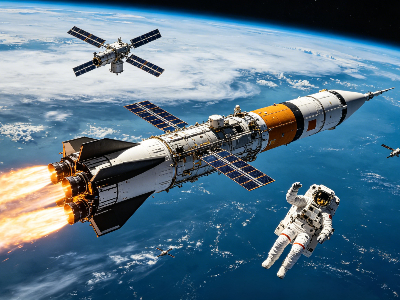
The United States has officially commenced the Artemis 2 manned lunar flyby mission, marking the first such endeavor in half a century. Meanwhile, China’s first satellite manufactured in Xiong’an, named ‘Xiong’an-1,’ has successfully rolled off the production line after overcoming multiple key technological challenges, accelerating the formation of a commercial aerospace industrial chain. Additionally, Amazon plans to acquire Globalstar to challenge SpaceX, while China accelerates its deployment in space computing power and commercial rocketry.
The global aerospace sector has recently seen a flurry of activities, with both China and the United States releasing significant signals almost simultaneously.
According to CCTV News, at dusk on April 1 local time, the new generation lunar rocket ‘Space Launch System’ of the U.S. National Aeronautics and Space Administration was launched from the Kennedy Space Center in Florida, carrying out the ‘Artemis 2’ manned lunar orbit mission. This marks the first time the United States has sent astronauts to the Moon since 1972, signifying a new phase in humanity’s deep space exploration.
 Meanwhile, according to the Science and Technology Daily, China’s first ‘Xiong’an-made’ satellite, ‘Xiong’an-1’, has been completed and is ready for launch, achieving breakthroughs in several key technologies, and accelerating the formation of the commercial aerospace industry chain.
In the commercial satellite internet sector, the competitive landscape is also undergoing changes. According to an article by Wall Street News, the Financial Times of the United Kingdom cited sources familiar with the matter stating that$Amazon (AMZN.US)$is in talks with satellite telecommunications operator$Globalstar (GSAT.US)$regarding an acquisition aimed at challenging SpaceX’s Starlink in the low Earth orbit satellite internet market.
On April 3, the 2026 Space Computing Power Industry Conference will be held in Beijing. In its prospectus, Zhongke Yuhang disclosed the first flight schedule for its various product lines.
United States: Manned Moon Mission After Half a Century
According to CCTV News, at dusk on April 1 local time, the new generation lunar rocket ‘Space Launch System’ of the U.S. National Aeronautics and Space Administration was launched from the Kennedy Space Center in Florida, carrying out the ‘Artemis 2’ manned lunar orbit mission.
This marks the first time since Apollo 17 in 1972 that the United States has sent astronauts to the lunar orbit, a milestone event.
On the commercial aerospace front, Amazon is seeking to accelerate its catch-up with SpaceX through the acquisition of Globalstar.
According to an article on Wall Street News cited by the Financial Times, negotiations have been ongoing for some time, but both parties are still discussing several complex issues. No final agreement has been reached yet, and the negotiations could still change or collapse.
One of the core obstacles to this acquisition is that$Apple (AAPL.US)$Correct.$Globalstar (GSAT.US)$ holds approximately 20% equity, and Globalstar has committed 85% of its network capacity to Apple for iPhone satellite messaging services, adding complexity to the transaction structure.
$Amazon (AMZN.US)$The project to enter the low Earth orbit satellite internet market is named ‘Leo.’ Currently, it has just over 180 satellites in orbit, a stark contrast to Starlink’s more than 10,000 active satellites. In February this year, Amazon CEO Andy Jassy told investors that Leo is one of the ‘incremental opportunities’ the e-commerce giant, valued at $2.2 trillion, intends to pursue.
China: Advancing on Multiple Fronts in Satellites, Computing Power, and Rockets
China’s commercial aerospace sector has recently shown breakthroughs across multiple areas, from satellite manufacturing to space-based computing power, to launch vehicles, with significant progress being reported across the industrial chain.
The first satellite manufactured in Xiong’an, named “Xiong’an-1,” underwent eight months of research, design, production, and testing, and was successfully completed on October 22, 2025. It is now ready for launch. According to the Science and Technology Daily, this satellite achieved breakthroughs in three key technologies:
First, the “Baize” high-performance onboard computer successfully resolved the “computing power bottleneck” issue for satellites; second, the “Chiyu” large-sized flexible solar array effectively addressed the challenge of “energy constraints”; third, the “Jinwu” next-generation Hall-effect electric propulsion system innovatively adopted argon as the propellant for electric propulsion.
“Xiong’an-1” is the first satellite to be fully produced and rolled out in the Xiong’an New Area, marking a substantive step forward for Xiong’an in the field of commercial aerospace manufacturing.
At the industry ecosystem level, the 2026 Space Computing Power Industry Conference will be held at the Tongming Lake Convention Center in Beijing Economic-Technological Development Area (Yizhuang) on April 3. Representatives from leading computing power enterprises, satellite manufacturers, and rocket manufacturers will attend.
The conference will announce the establishment of the industry’s first “Space Computing Power Professional Committee” and launch the “Beijing Space Computing Power Innovation Center.” Additionally, the Development Zone Management Committee will release a list of key common technology challenges in space computing power. The conference features three main topics covering the full ecosystem, including top-level design of space computing power, commercial aerospace, and core components, reflecting China’s strategic integration of computing power and aerospace.
In terms of launch vehicles, Zhongke Yuhang disclosed a detailed timetable for its product launches in its prospectus. For the Lizhi series, the heavy-lift Lizhi-2 rocket is scheduled for its maiden flight in 2028, while the Lizhi-3 is planned for its first launch in 2030. Regarding reusable launch vehicles, the Lihong-2 is expected to make its first flight between late 2026 and the first quarter of 2027, and the Lihong-3 is set for its inaugural flight in 2028.
Editor/Melody