
Australia’s economy could suffer a “sharp recession” and global cost of living could spike to near post Covid highs should the conflict in the Middle East continue.
In a grim warning, Oxford Economics says the global economy could feel the impacts of soaring oil prices and a prolonged downturn should the conflict extend for another two months.
In its base case, Oxford Economicssays the key passageway of the Strait of Hormuz being closed until the end of April before about 50 per cent of ships pass through in May and June.
But under the worst case scenario of a prolonged conflict the price of Brent oil would peak at $US190 ($A276) a barrel by August, driving the world into a global downturn.
Oxford Economics report author Harry McAuley warns that Australia will not be immune to the global downturn.
“In this scenario, the Australian economy would suffer a sharp recession” he said.
“We estimate GDP would contract 0.3 per cent in the June quarter as inflation soars and fall a further 0.8 per cent in the September quarter as fuel rationing begins.”
Should Mr McAuley’s prediction prove correct, it would be the sharpest quarterly fall since the early 1990s, excluding the Covid downturn.
Mr McAuley warns that industries with the highest fuel reliance will be hit hardest by this downturn.
“Transport, manufacturing and mining are particularly vulnerable,” he said.
“Agriculture is similarly exposed and faces medium-term trade-offs between fertilising with more expensive, scarcer resources or lower yields.”
Since the start of the US/Israel conflict with Iran, the price of oil has surged, adding inflationary pressures across the Australian economy.
Prior to the conflict oil prices were about $US56 ($A81) a barrel before leaping to more than $US110 ($A160) barrel in the last month.
For Australians, every $US10 ($A14.46) a barrel the price of oil rises, it adds about 10 cents a litre to what they pay at the fuel pump while also having second-order impacts including rising energy and grocery costs.
The Australian government has announced measures to ease the pain, including removing the fuel excise and foregoing increased GST revenue on fuel transactions.
This will provide another $400m of fuel relief and will be delivered through an additional 10.9 per cent cut to the fuel excise for three months, a further 5.7 cents per litre cut.
Combined with the halving of fuel excise already legislated by the government, the reduction in excise on petrol and diesel is 32 cents per litre.
War gaming a recession
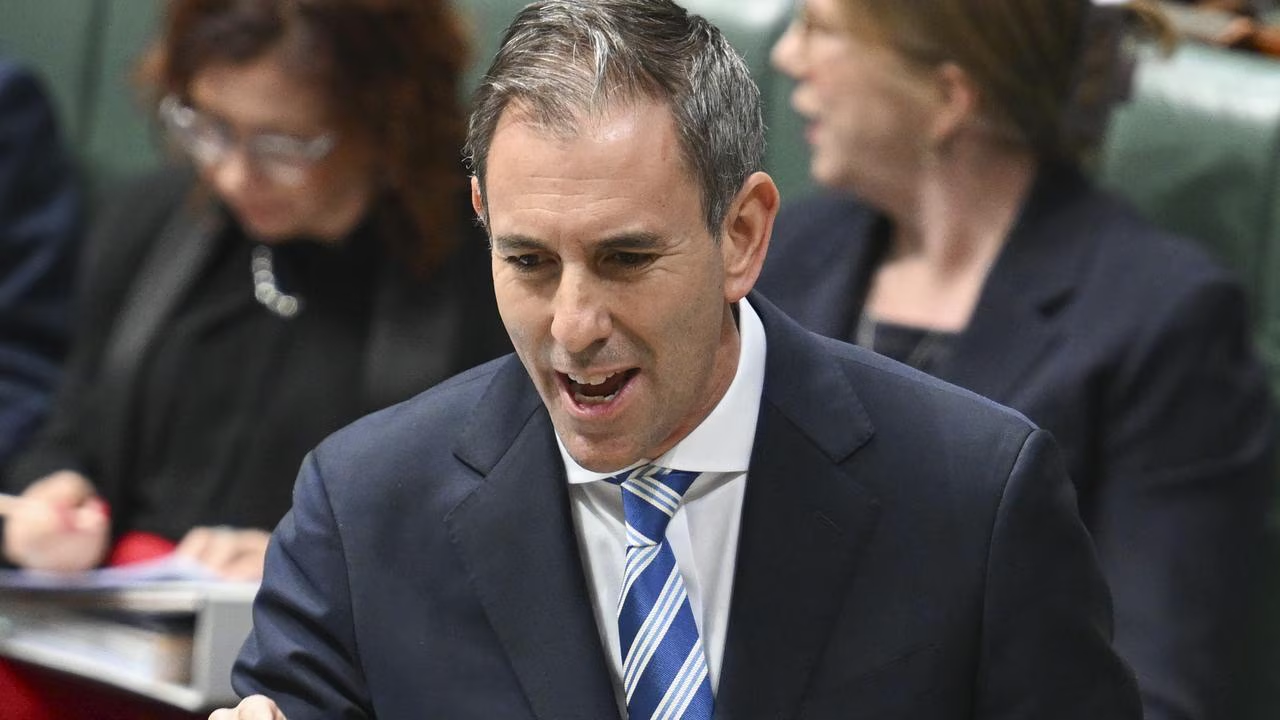
Australian Treasurer Jim Chalmers is aware of the risk, telling the media on Wednesday that his office is war gaming a potential recession plan.
“Obviously, those are the key considerations in that modelling, and the longer the shock drags out, obviously, the harsher the consequences for our economy, whether that’s measured by inflation or by growth or by impacts on the labour market,” Mr Chalmers told reporters.
He said Australia was going “into this quite severe global economic shock from a position of genuine relative economic strength”, pointing to recently released better-than-expected employment numbers.
“So we’ve got strengths as well,” Mr Chalmers said.
But he did note Australians are doing it tougher as a result of the conflict and that would continue for as long as it continued.
“Australians didn’t choose this war,” Mr Chalmers said.
“They’re paying the price for this war at the petrol bowser, and more broadly from an economic point of view, this war can’t end soon enough.
“But the consequences will linger for longer, and that’s why we’re working very closely together to try and shield Australians from the worst the world can throw at us.”
Not there yet
While the worst case-scenario would be a recession and even stagflation – a period of high inflation, slow economic growth, and high unemployment – economists say Australia’s economy isn’t quite there yet.
AMP deputy chief economist Diana Mousina says under the worst-case scenario the price of oil would rise above $US150 ($A217) a barrel and that would cause global pain.
“There will be large cutbacks to spending from consumers and businesses. Global trade will halt and inflation will surge,” she said.
“This would put the central bank in a very difficult position as they will not want to cut interest rates while inflation is high but will want to support the economy.”
Ms Mousina was quick to point out “we have not reached this panic situation yet”.
“Global supply pressures are not yet as bad as they were during Covid when supply was severely constrained and inflation surged,” she said.
HSBC chief economist Paul Bloxham agrees that Australia is unlikely to have a recession but says the combination of rising oil prices and rate hikes will smash consumer spending.
Earlier this week the economist who worked at the RBA for nearly 12 years forecast that about 1.8 percentage points would be knocked off consumer spending as households divert spending towards their mortgages.
“In addition to the mechanical impact on disposable incomes, confidence is also likely to be shaken, which could increase the impact,” he wrote in a note on Monday.
“Early indicators align with this view. Weekly consumer sentiment fell sharply last week, Australia’s PMI declined sharply in March and auction clearance rates declined sharply too.”
But he says Australia will narrowly avoid a technical recession, being two negative quarters of gross domestic product.
“Despite the high uncertainty, we think enough has happened both locally and globally that it is more likely than not that Australia’s GDP will fall in (the June quarter),” he said.
“The longer (the Middle East war) goes on, the more disruptive it will be.”
However, in modelling dubbed the “ugly scenario”, fuel prices reach $US140 a barrel, the RBA hikes rates twice to 4.60 per cent and Australia slides into a recession.
“Clearly, we see tougher times ahead. How tough is uncertain,” Mr Bloxham said.
“However, it is also worth keeping in mind that Australia’s economy has lots of adjustment mechanisms.
“The Australian dollar is a key shock absorber, government debt levels are comparatively low, which should allow some flexibility on fiscal policy, and the RBA has a powerful policy tool it can deploy as needed.”