
New Zealand Rugby (NZR) acknowledged the diagnosis and reiterated its position that the link between repeated head impacts and CTE is not yet definitive.
CTE is a progressive brain disease that can only be diagnosed after death. It damages brain cells and is associated with depression, impulsivity, memory loss, mood changes and, in some cases, dementia and suicide.
Shane Christie playing for the Māori All Blacks at Castle Park in 2012.
In the years leading up to his death, Christie reported worsening symptoms consistent with long-term brain injury, including persistent headaches, fatigue, memory problems, mood changes and periods of confusion.
Christie played as a flanker who captained the Highlanders in Super Rugby and played more than 80 matches for the franchise. He also represented Tasman in provincial rugby and was selected for the Māori All Blacks. His career was cut short in 2018 due to ongoing concussion symptoms.
Christie’s suspected suicide followed the death of his close friend Billy Guyton, whose post-mortem also confirmed CTE.
Guyton, a former Crusaders, Blues and Hurricanes back, died in 2023 aged 33 in what is also a suspected suicide. An inquest has yet to be held into his death and it may yet be merged with Christie’s.
Christie and Guyton both played for Tasman and the Māori All Blacks and were close on and off the playing field.
In the wake of Guyton’s death, Christie became an outspoken advocate for brain injury awareness, linking his symptoms to Guyton’s diagnosis.
In Nelson, where both men lived, Christie set up a shopfront for the Billy Guyton Foundation, creating a visible base for players and families dealing with the effects of concussion while speaking publicly about his own symptoms. He also arranged for his brain to be donated for research, believing it would show he had CTE.
The ruling from the coroner this week lifted a non-publication order prohibiting the CTE diagnosis being made public.
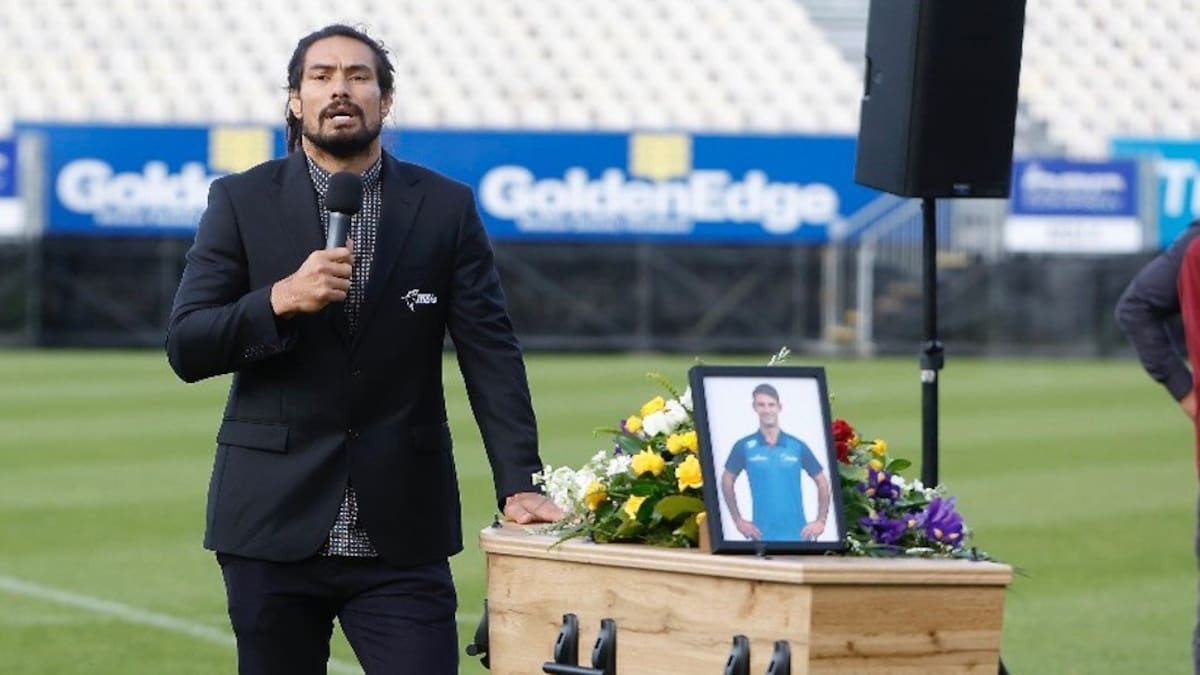
The funeral service for Shane Christie. Photo / RNZ, Samantha Gee
“[Pathologist Dr Clinton] Turner confirms the diagnosis of chronic traumatic encephalopathy [CTE], which he characterises as ‘high stage’,” the coroner said.
However, the coroner stressed the findings were the pathologist’s opinion, and that the cause and manner of Christie’s death have not yet been determined and was his finding to make after considering evidence.
“High stage” CTE refers to advanced disease, with widespread damage to brain tissue and a greater likelihood of significant cognitive and behavioural impairment.
Katrina Kerr, Christie’s sister, said her brother would not have been surprised at the CTE diagnosis.
“I think he would be relieved to know it was that and he wasn’t going crazy. He would have wanted [the diagnosis] made public for awareness.”
She said Christie loved rugby but was campaigning for greater awareness because he wanted it to be safer. “It wasn’t about trying to deflect people from the game.”
Kerr said she wanted to know what processes were in place around players receiving head knocks, how CTE developed and whether players had enough time away from the pitch to recover.
“The duty of care from the rugby playing community is to say this is what can happen to you.”
Shane Christie wearing a T-shirt made to commemorate his friend and former fellow player Billy Guyton.
She said young players might be less concerned about potential future injuries when they’re striving for professional rugby incomes and the elusive All Blacks shirt.
“The dream of playing for the All Blacks seems to be front of their minds but they will have no mind left if they don’t take steps.”
Christie’s lawyer and friend Craig Morice said he believed the former player and CTE advocate would have “absolutely” wanted the CTE diagnosis made public.
“Shane was never about destroying the game of rugby. He just wanted to make it safer.
“He wanted to help those past players who were also wrestling with issues.”
Morice said he had received calls from past players, including All Blacks, in the months since Christie died, who had raised with him concerns about their own emerging behaviours.
He said it could be as simple as turning windscreen wipers on in a car during sunny weather, or forgetting which direction they were walking in. The underlying concern was the degenerative nature of the disease.
“These guys are worrying that things are getting slowly worse for them.”
Morice said it was players like them who had Christie asking: “Are they getting sufficient help and assistance?”
From left, former rugby professional Shane Christie, NZ First MP Andy Foster, CTE victim Billy Guyton’s dad John, Dr Helen Murray from the Auckland brain bank, and former NZSAS soldier Gregg Johnson.
Irene Gotlieb-Old, married to former All Black Geoff Old, had developed a friendship with Christie over shared questions about CTE and support for those whose playing days were over.
She said Christie would have hoped the release of his diagnosis would lead to better medical help and support for others to “overcome the repercussions of a brain disease”.
“In theme of being ‘in service’ to our greater community, Shane paid the ultimate price.”
A statement from NZR interim chief executive Steve Lancaster pointed to an “association” between “repeated head impacts and CTE” but stopped short of saying head knocks caused the disease.
“We share the concerns about the potential long-term effects of repeated head knocks in rugby and support the need for ongoing research into this.
“NZR recognises an association between repeated head impacts and CTE and takes this issue seriously.
“We are working with researchers to strengthen the understanding of CTE, recognising that further research to look at the brains of individuals who have not played contact sports is needed, before a definitive link can be established.”
New Zealand Rugby’s Steve Lancaster. Photo / Photosport
Lancaster said NZ Rugby took a “precautionary approach” to reducing injury risk across the game. That included brain health services for players, education, mouth guards that flashed with impacts and mandatory recovery periods.
“Support for players who do experience post-concussive symptoms, mental health issues, or cognitive difficulties is a priority, regardless of any pathology that may or may not be identified later.”
Lancaster said the opening of community rugby registrations meant “many parents will be giving some thought to their children’s safety”.
He said the community rugby had an emphasis on fun with age-appropriate introduction to contact. He said the risk of concussion was “significantly lower” for those under 12.
World Rugby currently faces ongoing litigation by hundreds of former amateur and professional rugby players alleging they were not adequately protected from repeated concussive and sub-concussive blows. World Rugby has denied liability, arguing the issues were a foreseeable and inherent risk of playing the sport.
The earliest move on CTE in contact sport came from the National Football League in the United States which, in 2016, publicly acknowledged a link between football-related head trauma and CTE. The NFL’s shift in position followed a $1 billion settlement with former players.
It also followed the suicides of a string of former NFL players who were later found to have CTE.
Outside sporting circles, the broad medical view has shifted with the US National Institutes of Health saying repeated head trauma raises the risk of developing CTE. Boston University’s CTE Center states that CTE is caused by repetitive brain trauma, including both concussive and non-concussive hits to the head. The Alzheimer’s Association describes CTE as a progressive and fatal brain disease associated with repeated brain injuries.
David Fisher is based in Northland and has worked as a journalist for more than 30 years, winning multiple journalism awards including being twice named Reporter of the Year and being selected as one of a small number of Wolfson Press Fellows to Wolfson College, Cambridge. He first joined the Herald in 2004.
Sign up to The Daily H, a free newsletter curated by our editors and delivered straight to your inbox every weekday.