
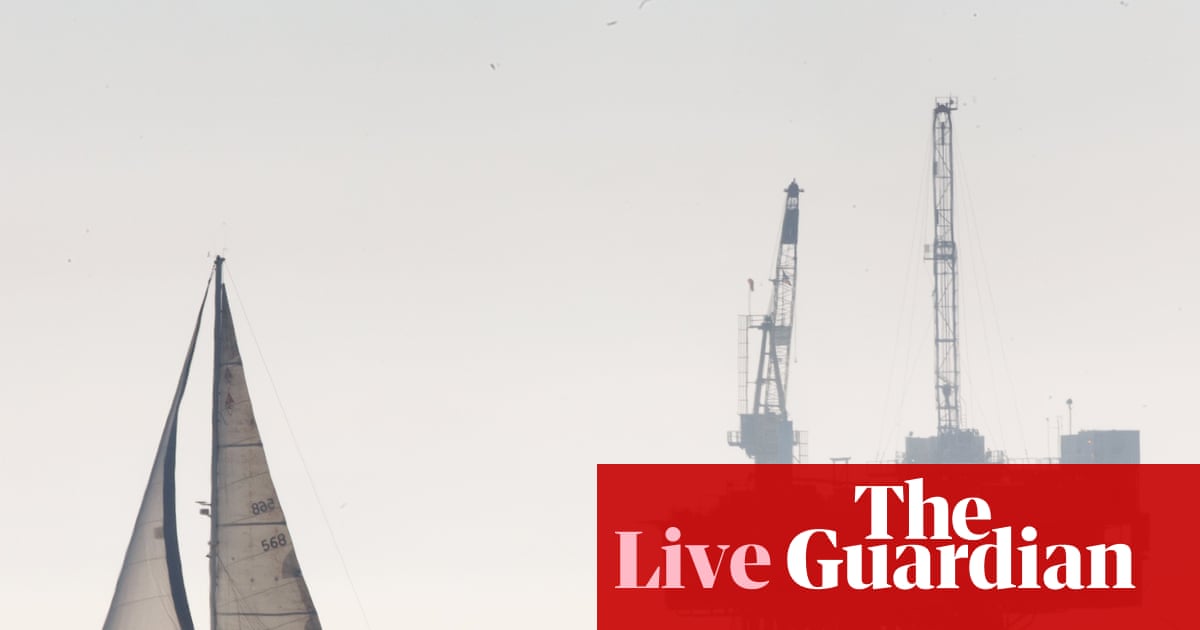
US crude oil hits $110 a barrel
US crude has surged over $110 a barrel today, for the first time in over three weeks.
The price of a barrel of West Texas Intermediate has jumped by 10% today, after US President Donald Trump vowed to hit Iran “extremely hard” for the next few weeks, dashing hopes of de-escalation and an early end to the conflict.
US crude is trading at $111 a barrel, the highest level since 9 March.
This puts a barrel of WTI above the international benchmark, Brent crude, which has jumped more than 8% to $109.32 a barrel.
Although Trump pledged last night to finish the operation in Iran “very fast”, traders seem disappointed by the lack of detail about how the conflict may end.
Daniela Hathorn, senior market analyst at capital.com, says:
double quotation markMarkets are increasingly pushing back against the idea that Trump’s latest address signals de-escalation. In fact, price action suggests the opposite.
Despite attempts to frame the situation as manageable and short-lived, the tone of the speech was more consistent with a war rally, reinforcing the likelihood of further escalation rather than resolution. The renewed threats to strike Iranian energy infrastructure if negotiations fail have shifted the narrative back toward rising geopolitical risk, which is now clearly being reflected in markets.
That helps explain the current configuration: oil higher, equities lower and the dollar stronger.
Updated at 09.50 EDT
Key events
Show key events only
Please turn on JavaScript to use this feature
Closing post
And finally… a roller-coaster day for markets has ended with London’s stock market at a one-month high!
The FTSE 100 share index has closed for the night up 71.5 points, or +0.7%, at 10,436 points, its highest closing point since the first week of March.
Stocks had fallen this morning, after hopes that Donald Trump would outline an end to the Iran war overnight were dashed, with Trump threatening to take Iran back to the ‘stone ages’.
But there’s been a recovery this afternoon, following reports that Iran is drafting a protocol with Oman to oversee traffic in the strait of Hormuz (see here for details).
Oil companies, and ‘defensive stocks’ such as utilities led the risers, as investors looked for safer places for their money.
AJ Bell head of financial analysis Danni Hewson says:
double quotation mark“The prospect of further escalation over the weekend has seen many investors rush to take defensive positions.
“In London, the focus has been on stuff people can’t do without even when their cost of living is under pressure.
European markets closed in the red – Germany’s DAX fell 0.8%, and France’s CAC lost 0.4%.
Stocks are still lower on Wall Street, where the Dow Jones industrial average is currently down 104 points, or 0.23%, at 46,460 points, recovering some of its earlier losses.
Anxiety over the Middle East crisis drove oil up today, with US crude oil surging over $110 a barrel.
Brent crude has dipped back from its highs, but is still up 6% tonight at $107.17 a barrel.
Our Middle East liveblog has all the latest developments:
ShareSputnik: Iran almost finalized draft of new navigation regime in strait of Hormuz
Iranian Deputy Foreign Minister Kazem Gharibabadi has apparently told Sputnik, the Russian government-owned news agency, that Iran has nearly completed its draft protocol, which would establish a new navigation regime in the strait of Hormuz.
Gharibabadi told Sputnik:
double quotation mark“The draft of this protocol is currently in the final stages of preparation. Once we have it ready, we will begin negotiations with Oman so that we can draft a joint protocol.”
Gharibabadi then explained that the protocol would mean that, in peacetime, all vessels that pass through the strait must have all the necessary agreements with the coastal states – Iran and Oman, and obtain the necessary permits and licenses in advance.
Updated at 11.47 EDT
Brent crude is now ‘only’ up 5% today at $106.40 a barrel, following reports that Iran and Oman are working on a protocol to cover travel through the strait of Hormuz.
That’s down from its earlier high of $109.74 a barrel, but still higher than the $99 at which it started the session.
ShareIran ‘drafting protocol with Oman’ to cover strait of Hormuz
Oil is dipping from its earlier highs, and stock markets are recovering losses, following a report that Iran and Oman are working on a ‘protocol’ to cover marine traffic in the strait of Hormuz.
Here’s Reuters’s newsflash:
Some calm is returning to European stock markets.
In London, the FTSE 100 index is now up 87 points or 0.84% at 10,452 points, a four week high!
The losses on other European markets are now less dramatic too – with Germany’s DAX only down 0.8% today.
African economies face the risk of a sharper growth slowdown this year if the war in the Middle East drags on, with prolonged disruption to trade, energy and fertiliser supplies threatening to ripple across the continent, according to a report released today.
The report by two U.N. agencies, the African Union and the African Development Bank said African economies could lose 0.2 percentage points of GDP growth in 2026 if the conflict lasts more than six months (via Reuters).
The jump in oil prices today is hurting US airlines.
United Airlines and American Airlines are both down around 6.1%.
Updated at 10.19 EDT
Paints firm Sherwin-WIlliams (-3.4%) are the top faller on the Dow Jones Industrial average in early trading, reflecting fears of disruption in the oil industry.
They’re followed by DIY firm Home-Depot (-3%), footwear firm Nike (-2.6%), and American Express (-1.8%).
But the surge in the oil price is good news for Chevron’s investors – its stock is up 2.3%.
ShareUS stock market drops at the openThe New York Stock Exchange. Photograph: Spencer Platt/Getty Images
Wall Street has opened with a bump, as traders react to Donald Trump’s address to the nation on the Iran crisis last night.
The Dow Jones industrial average has dropped by 624 points, or 1.3%, at the start of trading as it falls to 45,941 points (further from the 50,000 point mark hit in February)
The broader S&P 500 index has dropped by 1.25% at the start of trading.
The sell-off highlights that investors’ hopes of de-escalation, which build up earlier this week, are wilting.
David Morrison, senior market analyst at financial services provider Trade Nation, says Trump signalled an escalation, not a wind-down, last night:
double quotation markHopes had been raised that Mr Trump would announce an end to hostilities, and this had contributed to gains across risk assets earlier in the day, building on those made on Tuesday. But the President confirmed earlier statements made by him and members of his administration, that military operations would likely continue for another two or three weeks.
He reiterated that US objectives in Iran were almost met but warned that the US would hit Iran “very hard” and would only agree to a ceasefire once the Strait of Hormuz was ‘open, free and clear’.
Updated at 09.44 EDT
IMF: Trump tariffs will reduce US economic activity
The International Monetary Fund is warning the White House that Donald Trump’s trade war will slow the US economy.
In its latest assessment of the US, the Fund says:
double quotation markDirectors expressed concern about the shift in U.S. trade policy, noting that the increase in tariffs and in trade policy uncertainty are expected to reduce U.S. activity and create sizeable negative spillovers on its trading partners.
The Article IV Consultation also points out that “tariffs boosted goods prices”, which wiped out the benefits from falling services inflation.
The IMF also voiced concern about the Iran war, saying:
double quotation markDirectors expressed concerns about the heightened domestic and global uncertainties posed by the significant ongoing policy shifts and the war in the Middle East.
More happily for the White House, the IMF also predicts growth will rise to 2.4% in 2026, up from 2% in 2025.
But…, they are also calling for “determined actions” to address fiscal imbalances.
ShareUK diesel price now up 30% since start of Iran conflict
Back in the UK, drivers will feel the impact of Donald Trump’s attack on Iran when driving during the Easter break.
Motor fuel prices have risen again today, meaning that diesel prices are up 30% since the conflict began.
RAC head of policy Simon Williams has the detais:
double quotation mark“Petrol has now gone up nearly 22p a litre – or 16% – to an average of 154.45p since the start of the conflict in Iran on 28 February. It was last this high at the end of October 2023.
“The diesel story is even more dramatic, having shot up by almost 9p in the last week alone. It’s now risen by 30% since the end of February, with 43p a litre being added, taking it to an average 185.23p – a price last recorded at the end of November 2022.
“Finding the cheapest forecourts by using the fuel finder in the myRAC app has become vital as it can save several pounds at each fill-up. Driving fuel efficiently by keeping steadily within the speed limit in the highest gear possible and avoiding harsh use of the accelerator can also make fuel go further.”