
It seemed a one-sided victory.
On Thursday, Christchurch’s city councillors voted 15-2 (only Andrei Moore and Mark Peters voted against) to spend $7.7 million on new aerators to deal with the stench emanating from the wastewater treatment ponds. Other resolutions, including giving staff the ability to buy more aerators if the ponds underperform, passed 17-0.
But frustration bubbled just below the surface, especially from councillors who felt the council should have gone further. There was also an odd, two-day interplay between Mayor Phil Mauger, who claimed he was being painted as a “bastard”, and his key ally, Waimairi councillor Sam MacDonald, who apologised for having “inadvertently pitted the mayor against the organisation”.
A fire at the wastewater treatment plant in 2021, which destroyed two trickling filters, caused a constant strong stench. Council inaction left many in the community feeling forgotten and abandoned. A damning report confirmed the council’s response was inadequate, and successive mayors have apologised.
The smell subsided somewhat but came back, with a vengeance, over summer, thanks to an oxygen-depleting build-up of sludge. The pong permeated across the city, sparking thousands of complaints – and another apology from Mauger at a tense public meeting.
On February 27, ECan, the environmental regulator, issued the council with an abatement notice for “failing to provide an adequate action plan”.
A temporary solution to the stench needed to be found, ahead of a $140m new activated sludge reactor becoming operational in 2028.
The following week, on March 2, Mauger announced staff were investigating whether partially treated wastewater could be diverted from the ponds and straight out to sea, through the existing ocean outfall pipe. The plan, designed to reduce the pong, “surprised and concerned” ECan.
It was only this week that the effect of the mayor’s ocean outfall diversion became clear.
A full diversion through the ocean outfall was effectively ruled out by council staff, who said it was too expensive, too risky, and wasn’t supported by mana whenua. Even a partial diversion was pooh-poohed, with staff favouring the most cost-effective option of adding 16 aerators to the existing 11.
(Aerators pump air into wastewater to promote the growth of microbes, which feed on organic matter.)
This was called the 95 percent option, which, modelling said, would cope with loads of biological oxygen demand 95 percent of the time, with only three estimated days of “offensive and objectionable odour”.
The more costly option, “99 percent”, involving 21 extra aerators, would make a stench unlikely on “any days”.
‘I just generally wandered around, talked to enough people until someone listened to me.’
Phil Mauger, Christchurch mayor, on asking council staff to explore an idea to divert partially treated wastewater out to sea
At Wednesday’s workshop, it was revealed council staff had engaged consultants to consider the stench issue in January, and had enough budget to buy more aerators without troubling councillors for a decision.
Gavin Hutchison, the council’s head of three waters, said: “We would have liked to go out and purchase the aerators a month ago.”
MacDonald, the Waimairi councillor, demanded to know why that didn’t happen. He appeared to have forgotten about the mayor’s intervention.
(On March 3, The Press newspaper’s front page story was headlined: ‘Concern over plan to pump wastewater into ocean’. The online version was recast to: ‘ECan ‘surprised and concerned’ about mayor’s plan to pump partially treated wastewater into the sea’)
Diplomatically, chief executive Mary Richardson said the council team had been working on a solution but were then asked to explore other options.
MacDonald continued to ask why the decision wasn’t made, and wondered what he was missing.
A councillor was seen to mouth the words “For f**k’s sake”.
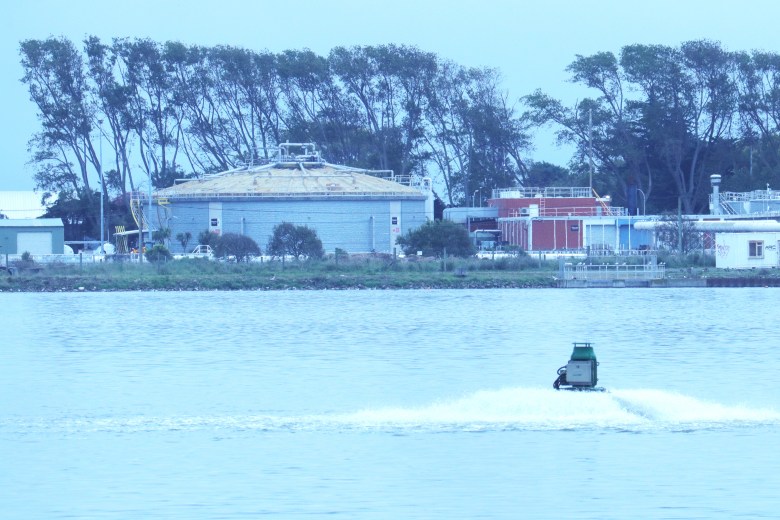 The Christchurch treatment plant processes wastewater from Christchurch and over the hill in Whakaraupō/Lyttelton Harbour. Photo: David Williams
Coastal councillor Celeste Donovan pointedly asked if the reason staff were bringing a paper to councillors was because of the suggestion of an ocean outfall pipe.
When Hutchison repeated that staff could have decided more aerators under existing budgets, as an operational decision, it was too much for Mauger.
“I can see what you are doing,” he told Donovan, adding “I can see people painting a wee picture of ‘Phil’s a bastard’ here.”
Somehow, the mayor was the victim. He said he’d been in the gun, getting pressure “from every direction”. When he discussed the ocean outfall idea with staff no one said the aerators were “on their way”.
Cue another Press headline. This one, on Thursday: ‘Mayor says people are painting him as a ‘bastard’ after his wastewater plan delayed work to fix stench’.
During Thursday’s debate, MacDonald apologised to Mauger. “I inadvertently pitted the mayor against the organisation. I think that was poor form on my part. I didn’t do it intentionally, and I felt terrible about it last night.”
Jumped the fence, did his homework
After the meeting ended, Newsroom asked Mauger about the genesis of the ocean outfall idea.
He recalled emerging from February’s public meeting in Bromley – “and you could smell it”. He was adamant the council had to do something to relieve the suffering of local people.
A few days later he drove to the ponds, “just me, jumped over the fence”, and did “my homework”.
(Later, Mauger said he’d worked at the treatment plant for three months about 45 years ago, while working for the family business, Maugers Contracting. He stepped aside from leading the company when he campaigned to become mayor.)
His thought was: If less organic material went into the ponds it would give them a rest. Later, he bounced ideas off his contractor mates – “If we put a pump here, and we do this, and instantly my mind’s going berzerk.” He also discussed it with ECan chair Deon Swiggs.
So the diversion to the ocean outfall was his idea? “It was mainly me.”
“I said to [council] staff, look, I will wear this, right? I’m not going to throw them under the bus. I said, ‘Come on guys’ – you know how enthusiastic I get.”
Who did he talk to within council? Was the conversation had in the council building?
“Oh, I just generally wandered around, talked to enough people until someone listened to me. I said, ‘I’ve got an idea let’s look at it’, and they said, ‘oh yeah, we could look at that’.”
The big issue, he said, was treating the wastewater with chlorine. “I still stand by the point that we weren’t putting anything out to sea that was over our consent.”
But the perception of using chlorine, or the bugs that died because of the chlorine, that’s what “lit it up”. The plan was criticised by Fisheries Minister Shane Jones – “and the last thing you do is cross swords with him”, Mauger said, so he backed away from it.
Was it appropriate for the mayor to approach staff directly, and ask an idea to be explored, without a mandate from councillors?
“I just wanted to throw the idea out there and see what fell out of it, more or less.”
Did his defensive reaction on Wednesday, saying he was being painted as a bastard, signify his plan had backfired because it delayed ordering the aerators, and that’s what councillors decided should be done anyway?
“No, no, no,” Mauger said, reiterating he was never told he was “holding things up”. It was only a month’s delay, the mayor said, “and it hasn’t smelt for a month”.
In hindsight, was his intervention a mistake? “No.”
95 percent versus 99 percent
At Thursday’s meeting, councillors voted for the “95 percent” option, to add 16 new aerators to the ponds, leading to three estimated days a year of “offensive and objectionable odour”.
During the debate, several councillors bemoaned the fact they weren’t allowed to vote on the “99 percent” option because it was blocked, on a technicality, by Mauger, and the seconder of his motion, Central councillor Jake McLellan.
Linwood councillor Yani Johanson asked to amend their motion.
“The problem is,” McLellan said, “whether it’s an amendment or not because the amendment is identical to another option in the report. It’s clearly a foreshadowed motion.”
Mauger said: “If Jake and I had agreed to it, it could be alright, but we didn’t.”
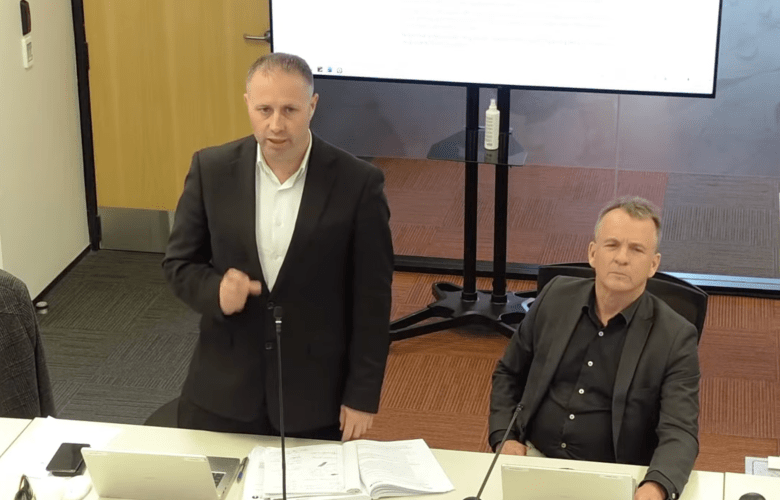 Linwood councillor Yani Johanson, standing, speaks during Thursday’s debate. Screenshot: Christchurch City Council livestream
Before voting in favour of the 95 percent motion, Johanson said, constructively: “Today is about recognising that we’re doing something constructive and positive to address an ongoing issue that has happened in our community, particularly in the east of the city, that has had an adverse and significantly negative impact.”
On his preference for the 99 percent option, he said: “I think we owe it to this community to minimise and mitigate the risk as much as we can, rather than leave any risk that they will go through the hell that they’ve been through in the past in the future.”
Hornby councillor Mark Peters said Thursday’s decision “couldn’t have come soon enough”. “I believe we don’t have any social licence out there in Bromley any longer.”
Tyla Harrison-Hunt, of Riccarton, said the east deserved nothing less after decades of awful odour issues.
Councillors gave staff approval to buy further aerators if the ponds under-performed under the 95 percent option.
Harrison-Hunt said action must be taken as soon as a trigger point is reached. “Even three days is not good enough for the community.”