
“We are getting just a beautiful view of the dark side of the Earth right now, lit by the moon,” said Hansen. “Phenomenal.”
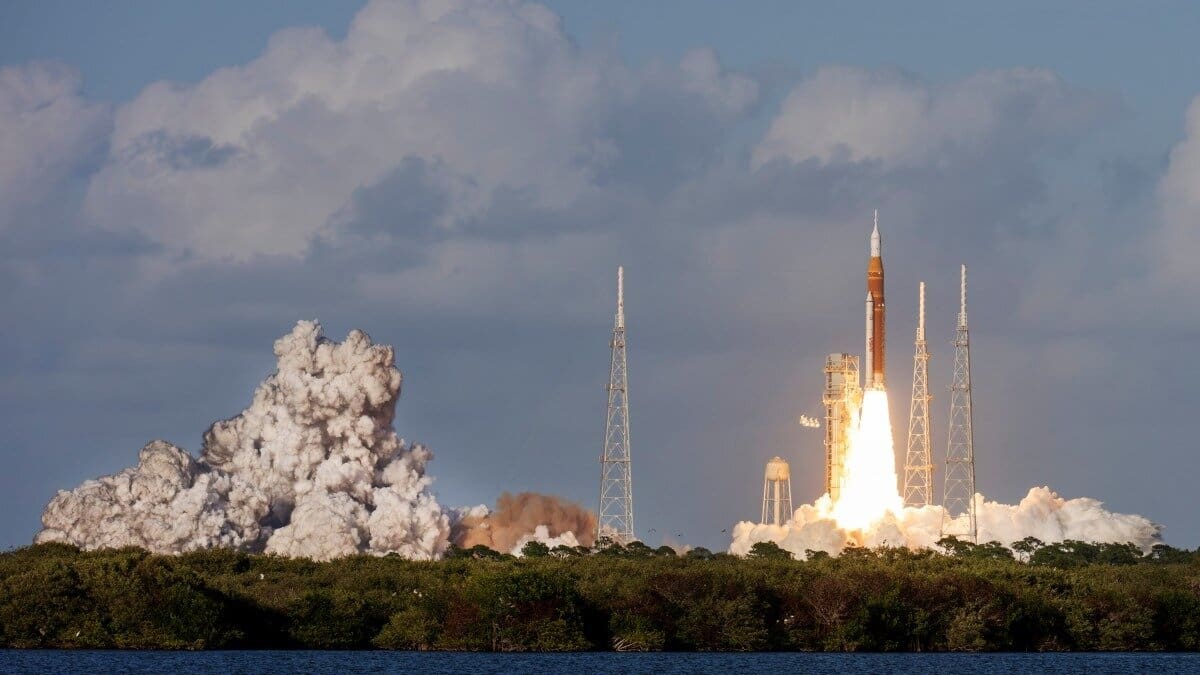
Today’s burn, the last major ignition of the mission, came one day after the enormous orange-and-white Space Launch System (SLS) rocket carrying the Orion capsule launched from Kennedy Space Centre in Florida for the long-anticipated journey around the moon.
Now that they’re moonbound, there’s no turning back: the astronauts are on a “free-return” trajectory, which uses the moon’s gravity to slingshot around it before heading back towards Earth without propulsion.
“From this point forward, the laws of orbital mechanics are going to carry our crew to the moon, around the far side and back to Earth,” said Glaze.
The astronauts are wearing suits that also serve as “survival systems” – in the unlikely case of a cabin depressurisation or leak, they’ll maintain oxygen, temperature controls and the correct pressure for up to six days.
The astronauts – Americans Reid Wiseman, Victor Glover and Christina Koch, along with Canadian Hansen – spent their first hours in space performing checks and troubleshooting minor problems on the spacecraft – which has never carried humans before – including a communications issue and a malfunctioning toilet.
Howard Hu, who oversees the Orion spacecraft, said during the briefing that the team had accomplished the objectives of tests designed to demonstrate the capsule’s ability to dock with a future lunar lander.
The crew did “a terrific job”, Hu said.
“I’m just really happy that we’re headed to the moon,” he added.
Artemis 2 aims to pave the way for a moon landing planned for 2028. Photo / Miguel J Rodriguez Carrillo, AFP
Historic journey
The astronauts began the second day of their mission by playing Green Light by John Legend and André 3000, Nasa said – a reference to the go signal they would soon get to fire up the engine and get moving towards the moon.
They also had their first workouts of the mission on the spacecraft’s “flywheel exercise device” – each astronaut will carve out 30 minutes a day for fitness, a bid to minimise the muscle and bone loss that happens without gravity.
The 10-day Artemis 2 mission is aimed at paving the way for a moon landing in 2028.
The mission marks a series of historic accomplishments: sending the first person of colour, the first woman and the first non-American on a lunar mission.
If all proceeds smoothly, the astronauts will set a record by venturing further from Earth than any human before – more than 402,336km.
It is also the inaugural crewed flight of SLS, Nasa’s new lunar rocket.
SLS is designed to allow the United States to repeatedly return to the moon, with the goal of establishing a permanent base that will offer a platform for further exploration.
It was meant to take off as early as February after years of delays and massive cost overruns.
But repeated setbacks stalled it and even necessitated rolling the rocket back to its hangar for repairs.
The current era of American lunar investment has frequently been portrayed as an effort to compete with China, which aims to land humans on the moon by 2030.
During a post-launch briefing, Isaacman said competition was “a great way to mobilise the resources of a nation”.
“Competition can be a good thing,” he said. “And we certainly have competition now.”
The Artemis programme has come under pressure from Trump, who has pushed its pace with the hope that boots will hit the lunar surface before his second term ends in early 2029.
But the projected date of 2028 for a landing has raised eyebrows among some experts, in part because Washington is relying heavily on the private sector’s technological headway.
– Agence France-Presse