
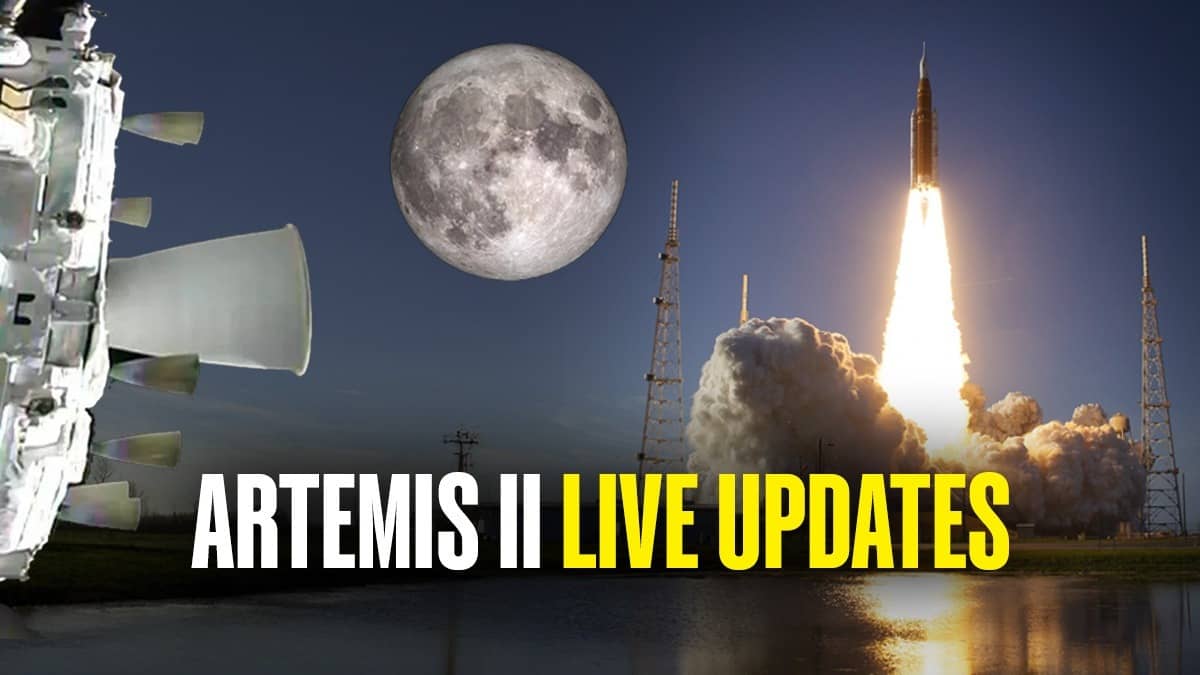
Artemis II LIVE: Milestone Achieved; Translunar Injection Burn Complete! NASA Crew Finally Heads For The Moon | Image: Republic/NASA
NASA’s Artemis II mission, which launched on Wednesday, is humanity’s first lunar voyage in more than half a century and the thrilling leadoff in NASA’s push toward a landing in two years. The mission is expected to last about 10 days, sending four astronauts on a high-speed journey around the moon and back in the first crewed lunar mission since the Apollo era.
Artemis II is designed to pave the way for future missions aimed at returning astronauts to the lunar surface later this decade. Carrying three Americans and one Canadian, the 32-story rocket rose from NASA’s Kennedy Space Center where tens of thousands gathered to witness the dawn of this new era. It is NASA’s biggest step yet toward establishing a permanent lunar presence.
Five minutes into the flight, Commander Reid Wiseman saw the team’s target: “We have a beautiful moonrise, we’re headed right at it,” he said from the capsule. On board with him are pilot Victor Glover, Christina Koch and Canada’s Jeremy Hansen. It was the most diverse lunar crew ever with the first woman, person of color and non-U. S. citizen riding in NASA’s new Orion capsule.
The astronauts will stick close to home for the first 25 hours of their 10-day test flight, checking out the capsule in orbit around Earth before firing the main engine that will propel them to the moon.
3 April 2026 at 12:57 IST
Artemis II LIVE: NASA has invited the public to track the Artemis II mission in real time using the Artemis Real-time Orbit Website (AROW). As four astronauts venture around the Moon inside the Orion spacecraft, AROW allows users to visualize data collected by Orion’s sensors and sent to the Mission Control Center at NASA’s Johnson Space Center in Houston.
 Online, users can follow AROW to see where Orion and the Artemis II crew are in relation to the Earth and the Moon and follow Orion’s path during the mission.(Image Source: NASA)
The real-time data will be available starting about one minute after liftoff until Orion’s atmospheric reentry to Earth at the end of the mission.
Online, users can see where Orion and the crew are in relation to Earth and the Moon, follow Orion’s path, and view key mission milestones, including information about Apollo program landing sites.
3 April 2026 at 09:34 IST
Artemis II LIVE: NASA’s Artemis II astronauts fired their engines and blazed toward the moon Thursday night, breaking free of the chains that have trapped humanity in shallow laps around Earth in the decades since Apollo.
The so-called translunar ignition came 25 hours after liftoff, putting the three Americans and a Canadian on course for a lunar fly-around early next week. Their Orion capsule bolted out of orbit around Earth right on cue and chased after the moon to nearly 250,000 miles (400,000 kilometers) away.
“Ladies and gentlemen, I am so, so excited to be able to tell you that for the first time since 1972 during Apollo 17, human beings have left Earth orbit,” NASA’s Lori Glaze announced at a news conference.
The engine firing was flawless, she noted.
Canadian astronaut Jeremy Hansen said he and his crewmates were glued to the capsule’s windows as they left Earth in the rearview mirror, taking in the “phenomenal” views. Their faces were pressed so tightly against the windows that they had to wipe them clean.
3 April 2026 at 08:10 IST
Artemis II LIVE: Lori Glaze, Deputy Associate Administrator of NASA said – “So ladies and gentlemen, I am so, so excited to be able to tell you that for the first time since 1972, during Apollo 17, human beings have left Earth orbit. With Artemis II’s successful 5 minute and 52 second translunar injection burn this evening, our four crew members, NASA astronauts Reid Wiseman, Victor Glover, Christina Koch and Canadian astronaut Jeremy Hansen are now on their trajectory toward the moon.”
“The burn was executed by our flight operations team here in Houston and it was flawless. The burn was the last major firing of this mission. From this point forward, the laws of orbital mechanics are going to carry our crew to the moon, around the far side and back to earth. Our crew is healthy and our spacecraft is performing really well. After we’ve had a series of checkouts since launch and again, everything really performing pretty well, and we are on the path that we designed for this mission. But just a reminder again, you hear us keep saying it over and over again, this is still a test flight. We are going – we are getting and we’re going to continue to get lots of new data every day, important information as we continue learning how we’re going to operate this Orion Spacecraft in the actual space environment. And I’ll tell you, we’re already learning a lot as we go. We’ve encountered several things along the way. We’re not really tracking anything right now that’s of concern, but anything that we’ve encountered since we’ve – since we’ve launched, was brought to our mission management team today and discussed. And the satisfactory path forward on every case and a unanimous decision to proceed forward with the go for the translunar injection burn,” Glaze said.
3 April 2026 at 08:05 IST
Artemis II LIVE: NASA’s Artemis II astronauts fired their engines and blazed toward the moon Thursday night, breaking free of the chains that have trapped humanity in shallow laps around Earth in the decades since Apollo.
The so-called translunar ignition came 25 hours after liftoff, putting the three Americans and a Canadian on course for a lunar fly-around early next week. Their Orion capsule bolted out of orbit around Earth right on cue and chased after the moon to nearly 250,000 miles (400,000 kilometers) away.
“Ladies and gentlemen, I am so, so excited to be able to tell you that for the first time since 1972 during Apollo 17, human beings have left Earth orbit,” NASA’s Lori Glaze announced at a news conference.
To set the mood for the day’s main event, Mission Control woke up the crew with John Legend’s “Green Light” featuring Andre 3000 and a medley of NASA teams cheering them. “We are ready to go,” Glover said.
2 April 2026 at 16:39 IST
The four astronauts on Artemis II are:
The mission commander, Reid Wiseman, is a former test pilot and pilot in the United States Navy. In 2009, he joined NASA as an astronaut, and in 2014, he spent 165 days aboard the International Space Station (ISS).Victor Glover is the spacecraft’s pilot. He piloted SpaceX Crew-1 and spent November 2020–May 2021 on the International Space Station. He holds three master’s degrees and will be the first Black astronaut to travel to the moon.Christina Koch, a mission specialist, became an astronaut in 2013. With a duration of 328 days, she holds the record for the longest female spaceflight. In addition, she will be the first female lunar traveler.The other mission specialist is Jeremy Hansen. He’ll be the first Canadian to travel to the moon. As part of his NASA aquanaut training, he has also lived underwater for seven days. 2 April 2026 at 12:43 IST
Artemis II LIVE: NASA’s Artemis II crew has completed a critical proximity operations demonstration, marking an early milestone in the mission, according to a NASA blog update.
The test involved manually flying the Orion spacecraft near its upper stage to evaluate handling and navigation in close-range conditions.
With the manoeuvre complete, the mission is now preparing for the next major step, which is a perigee raise burn that will adjust Orion’s orbit and set it on course for its journey toward the Moon. The milestone is part of a series of system checks designed to validate spacecraft performance during the 10-day lunar flyby.