
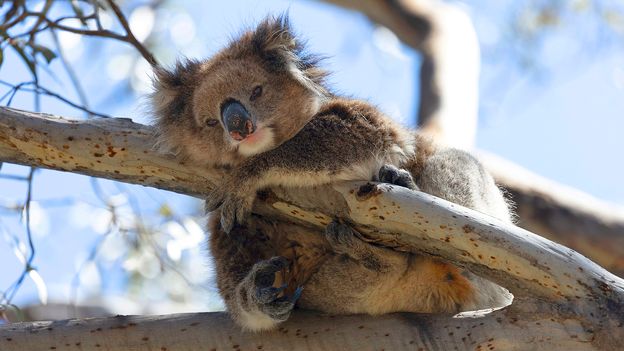
A disease-free island enclave could hold the key to koalas’ survival – but it is also a genetic bottleneck. Can scientists stop their decline, before it’s too late?
Brandishing long plastic poles, a small team of researchers are trying to coax a female koala down from the gum tree she’s comfortably perched on.
At first, she seems unfazed. Then everything happens quickly. She clambers down the trunk, leaps onto the grass, and lets out a deep growl before rolling onto her back, claws raised in defence. In a series of well-practiced steps, the experts carefully lift her into a crate. Once sedated, she is laid on a towel for a routine health check.
“I think she has chlamydia,” says Karen Burke Da Silva, a conservation biologist at Flinders University in South Australia. Chlamydia has become a major epidemic among koalas, affecting up to 88% of individuals in some mainland populations. Caused by the bacterium Chlamydia pecorum, it can lead to blindness, infertility, pneumonia and – unlike chlamydia in humans, which is rarely fatal – often death.
Chlamydia has swept through the mainland, and this captured koala is one of about 40 inside South Australia’s Belair National Park, near Adelaide, collared by scientists studying their health and genetics.