
Mars has long been seen as one of humanity’s best hopes for colonization, but its harsh environment, freezing temperatures, thin atmosphere, and lack of liquid water, has made it an impossible destination for human life. However, a new study suggests that we may be closer to turning this barren world into a place where humans could one day thrive. In a bold new approach, scientists propose using engineered aerosols to warm the Martian surface, potentially making it habitable in just 15 years. This innovative idea could be the key to transforming Mars into a more welcoming home for future explorers.
The Terraforming Debate: What’s at Stake?
For decades, scientists have pondered how to make Mars more habitable for humans. The primary challenge is the planet’s extremely cold climate, averaging -55°C, with temperatures plummeting to -125°C during dust storms. Combine that with a thin, carbon-dioxide-heavy atmosphere and a lack of liquid water on the surface, and the task becomes even more daunting.
While many have considered raising Mars’ temperatures by melting its frozen carbon dioxide caps or using nuclear explosions to mimic artificial suns, these ideas have faced strong skepticism. Even Elon Musk’s proposal for nuclear explosions was criticized, as models suggested it would raise the planet’s greenhouse effect only slightly, insufficiently warming the surface to the necessary degree for liquid water to exist.
However, the latest research shifts focus to engineered aerosols. By releasing particles into the Martian atmosphere that interact with infrared radiation, the new study proposes a more effective, sustainable method of raising the planet’s surface temperature. This concept, which utilizes the naturally occurring dust and the aerosols’ ability to trap heat, could mark a turning point in the search for a Mars that humans could one day inhabit.
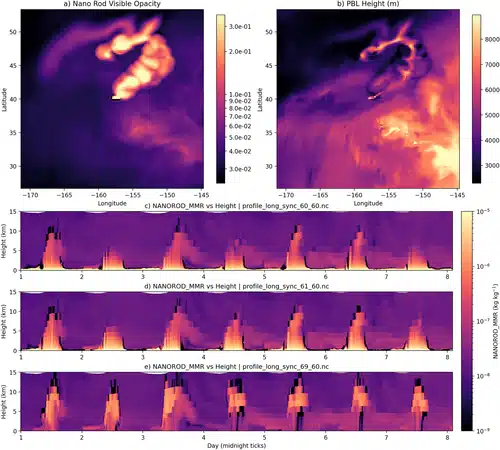 Local plume dynamics during initial deployment of 60 nm diameter Al rods at 60 L/s. Results are captured ∼6 sols from the time the plume is initiated. (a) Column-integrated opacity of particle plume at wavelength = 0.67 μm (τvis, unitless). (b) Planetary boundary layer (PBL) height (m). Both panels are for the same timestep, with a true local solar time of 11 a.m. at the source site. A mix of shadowing of the ground by plume particles and radiative heating of plume particles leads to a mixture of PBL suppression and augmentation in different locations. (c–e) Time-height cross-sections of plume mass mixing ratio in the lowest 10 km. Panel (c) is centered over the plume release site, (d) is one grid point (∼10 km) to the east, and (e) is ∼100 km further east. Nighttime accumulation in the stable surface layer is evident as a lighter color/yellow band; daytime convection ventilates the accumulated particles deep into the atmosphere, which can then advect downwind in the free atmosphere. Results are for release at Arcadia Planitia (202°E 40°N). MarsWRF has been set up to nest from 2° × 2° GCM domain, with two levels of nesting. The nested domain shown has 120 × 120 grid points and a grid spacing of 0.222°, corresponding to less than 13 km. Credit:
The Breakthrough: Engineered Aerosols for Warming Mars
In the study led by Mark I. Richardson of Aeolis Research, and in the journal Geophysical Research Letters, aerosols were modeled for the first time not as static particles but as dynamic entities moving through the Martian atmosphere. The team used a sophisticated 3D model to simulate the effect of two types of engineered aerosols, graphene disks and aluminum rods, on the planet’s temperature. These particles, measuring just a few nanometers in size, absorb and scatter thermal infrared radiation emitted by the Martian surface, gradually warming the atmosphere.
The researchers found that a continuous, steady release of these aerosols into Mars’ atmosphere could drastically increase the surface temperature. In fact, within 8 Martian years, the temperature could rise by as much as 25°C. Over 15 years, the temperature could stabilize at 35°C, a significant enough increase to allow the possibility of liquid water on the surface. This discovery provides hope for those dreaming of a more hospitable Mars in the distant future.
How the Model Works: A Deep Dive Into the Data
Richardson and his colleagues created a global, 3-dimensional model to track the behavior of aerosols over time. The study focused on the effects of releasing aerosols at a rate of 3 liters per second for the first five years, followed by a 20-fold increase to 60 liters per second. Their model accounted for the influence of natural dust, which is also a significant factor in the Martian climate, and simulated a storm-free period in the atmosphere.
The results were striking: after 8 Mars years, the surface temperature jumped drastically from 3°C to about 25°C above the unperturbed temperature of Mars. After 15 years, the temperature stabilized at around 35°C. This temperature shift would be enough to potentially allow liquid water to exist, a crucial factor for future human habitation.
Despite these promising results, the study also acknowledged that this model is still in its early stages. As the authors point out,
“This study addresses only some aspects of the question of how IR‐active particle release might modify Mars’ climate: atmospheric processes are inherently complex, and many open questions remain.”
These include unknowns related to the water cycle feedbacks, as well as how aerosol particles might agglomerate or clump together, which could alter their effectiveness in warming the atmosphere.
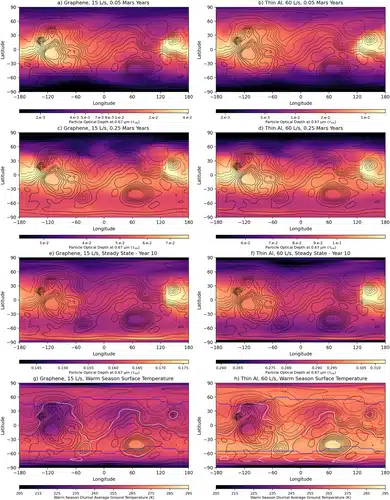 Dynamics of particle spread and steady-state global warming. Left: 15 L/s carbon (graphene) disks (run Cc41). Right: 60 L/s metal rods (run Cc16). Both assuming 0°N 135°E release. (a–f) Particle optical depth at 0.67 μm (τvis). (g, h) Filled color: warm season temperatures (K). Black topographic contours correspond to elevations of −5 and −2 km (dashed), and 0, +2, and +5 km (solid). White contour: 610 Pa (∼6 mbar) mean pressure level. Blue contour: Approximate equatorward extent of H2O ice at <1 m depth based on GRS data (Feldman et al., 2004). Red contour: Highlights warm-season average surface temperatures above 273 K.
The Future of Terraforming Mars: Unanswered Questions and Challenges
While the findings are encouraging, scientists remain cautious. The behavior of aerosols in Mars’ atmosphere is not fully understood, and there are many variables that could influence the outcome of this approach. One of the key challenges is how the Martian water cycle would respond to the increased temperatures. As the temperature rises, more water vapor could be introduced into the atmosphere, which in turn could contribute to further warming. However, the aerosols themselves might also act as ice nuclei or cloud condensation nuclei, possibly causing some particles to fall out of the atmosphere and reducing their long-term effectiveness.
Another consideration is the role of dust storms. Mars is known for its massive dust storms that can last for months and completely engulf the planet. These storms could either exacerbate or mitigate the effects of engineered aerosols, and their impact needs to be thoroughly studied in future models. Stronger winds might lift more dust into the atmosphere, creating a positive feedback loop that could amplify the warming effect.
In short, while this new research presents a promising avenue for warming Mars, many aspects of the process remain uncertain. As the study’s authors note, “many open questions remain,” and further research is necessary to fully understand the complexities of atmospheric aerosols and their role in terraforming the Red Planet.