
She developed several gardens in the region and wrote the famous book My New Zealand Garden, by A Suffolk Lady, published in 1902.
White planted many trees, particularly red-flowering gums and pōhutukawa, which are still a feature in the suburb.
She planted around the mid-1880s on the land here, as well as gums at Victoria Park, Ben’s Place, and corymbia ficifolia along Springvale Park.
Wyatt-Trillo’s willows, elms, puriri, a redwood and some black willows are descendants of White’s plantings.
Wyatt-Trillo is a visionary gardener, committed to the principles of syntropic agroforestry.
Sign at the entrance to the garden. Photo / Phil Thomsen
In the nearly frost-free environment on St Johns Hill, Whanganui, he grows and experiments with 47 banana varieties, pawpaws, and a wide range of other subtropical fruits, focusing on sustainable, high-density food production.
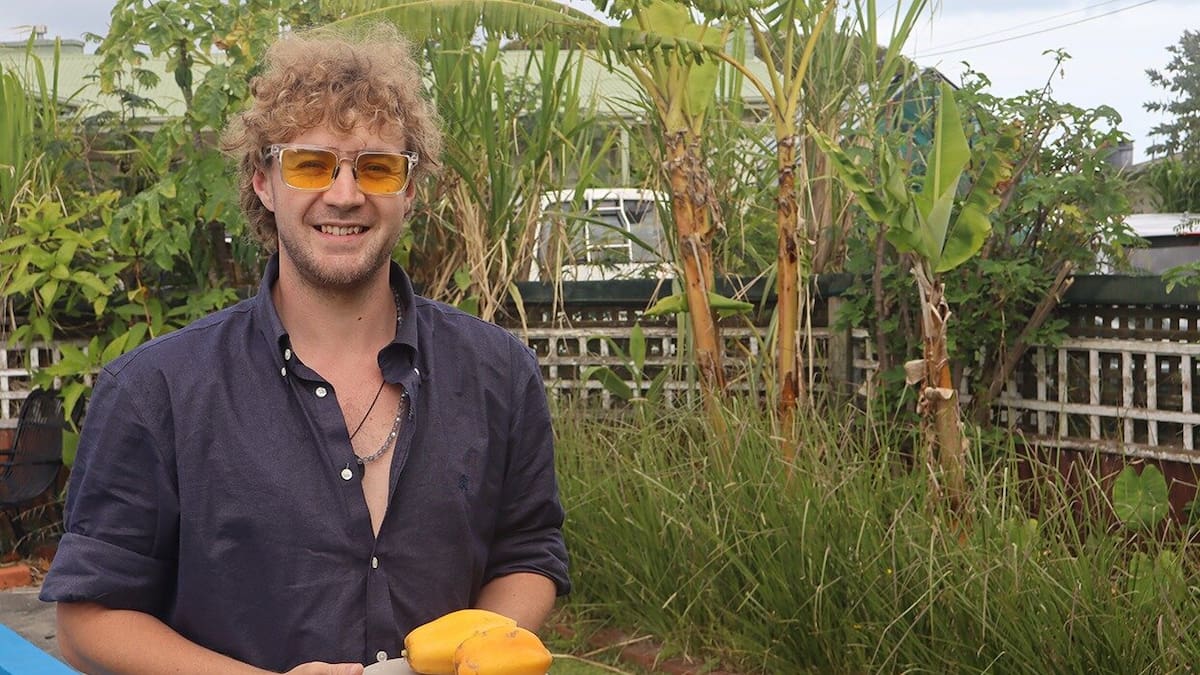
His garden is dripping with bananas and pawpaws, creating a feeling of being in the tropics, not in a suburban section in the middle of Whanganui.
He works with various growers of sub-topicals around the country to determine the best plants for fruit production in home gardens and with local garden centres regarding distribution to the public.
He works hard to improve the soil, using the chop-and-drop approach, as well as using arborists’ chips and grass clippings from contractors.
Jake is enthusiastic about the merits of the Mexican sunflower. Photo / Phil Thomsen
He is a fan of Mexican sunflower (Tithonia species), which is grown from cuttings, because the seed in New Zealand plants is sterile.
Wyatt-Trillo feels it is a good protection for the soil and is an effective windbreak, contributing a lot of organic matter to the soil.
Jake’s garden is dripping with bananas and papayas. Photo / Phil Thomsen
His understanding and observation are that it will also suppress convolvulus and kikuyu by inhibiting chemicals secreted from the roots.
For a protective canopy, Wyatt-Trillo planted Eucalyptus nitens, followed by brush wattle.
Shining gum (Eucalyptus nitens) and brush wattle form a protective canopy. Photo / Phil Thomsen
He pollards these diligently to prevent them getting out of hand, but is gradually replacing them with the smaller-growing tree lucerne, which is a favourite with native birds such as kererū.
“Hopefully, we can inspire each other to grow healthy living foods, to educate our next generations and to bring about the positive change needed in the world, while looking after our planet,” he said.