
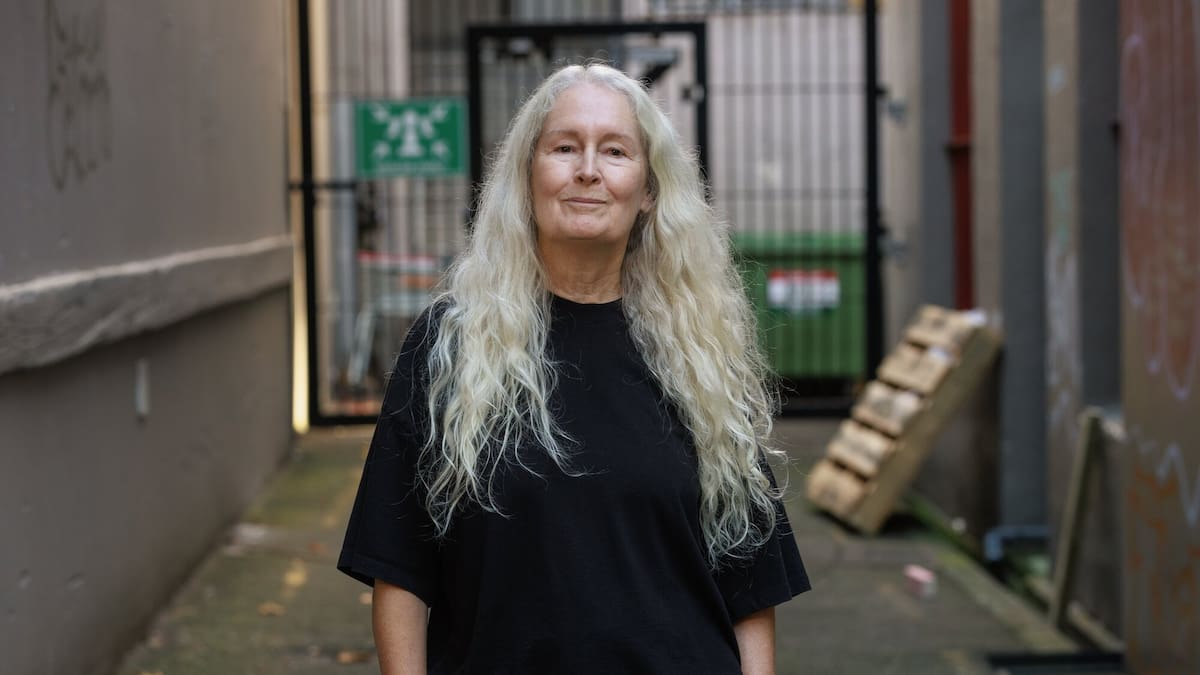
But for her, the book is about achieving specific goals and reaching out to others. “I set out to write about what it’s like to have a family member be a victim of violence, and what it’s like to have a family member who has motor neurone disease, because I think they’re both quite lonely experiences.”
In 2009, three calamities struck Knox. The middle child of three, Knox had to get her older sister, Jo, sectioned and hospitalised after she had a psychotic episode. Knox’s brother-in-law, Duncan, died in Rarotonga, deliberately struck by a vehicle driven by a man who had argued with Duncan’s friends. And Knox’s mother, Heather, was diagnosed with motor neurone disease (MND), a degenerative neurological condition.
The calamities kept coming. A friend died. The film adaptation of her breakthrough novel, The Vintner’s Luck, was panned. Knox suffered a gastric bleed, her life saved by a blood transfusion.
The couple’s sewerage system collapsed, costing $30,000. Their cat broke his leg in three places and was then rejected and attacked by his brother and sister. It almost felt like a film montage, she says.
So in 2015, with a writer’s grant, she sat down to write a memoir about this three-and-a-half-year period of calamities. Little did she know it would take her 11 years on and off to complete, between her novel writing.
As a memoirist, she had to write about herself, not just around herself. However, she isn’t the self-disclosing sort. “I had a bit of a breakdown about the same time I started trying to write the memoir, not coincidentally,” she says.
Knox started by writing about her mother when she became ill. Not yet diagnosed, she began crying intermittently, something she never used to do.
“It turned out to be part genuine distress, and also a symptom of MND,” says Knox. “She’d say, ‘I’m not really that upset’, although she had good reason to be upset.
“I couldn’t write about the degree of my mother’s worrying unless I wrote about what Mum was worried about. That meant I couldn’t leave out my older sister’s story.
“To write about Mum, I had to write Jo.”
Writer Elizabeth Knox’s published work includes novels for adults and teenagers, autobiographical novellas, and a collection of essays. Photo / Mark Mitchell
There was a certain topic Knox had been circling in the memoir until she couldn’t put it off any longer. “I thought, ‘Elizabeth, you’re going to have to seize this thistle’.”
Between the ages of 8 and 11, Knox was sexually abused by Jo, who is three years older. Few details are disclosed in her account, which reads almost as if it happened to someone else.
“The book changes point-of-view to the third person in this part, so I could just get it written,” she says. “Also, I don’t want to upset the reader too much, so I minimise some things.”
As an adult, Jo experienced mental-health problems that included, during her psychotic crisis, delusions, paranoia and erratic behaviour. It was after things deteriorated badly that Knox had Jo sectioned for her own safety.
Knox spoke to the crisis team, filled out the forms, and she and Fergus accompanied the crisis team to Jo’s house. Jo was admitted to hospital. Knox would rather leave details of that day to her account in the memoir.
Her sister is still alive, but Knox doesn’t want to say anything more about that, either. “But the book took so long partly because I kept waiting for Jo’s situation to change. Also, it was very difficult to get it right. It was the first time that I’d really tried to make sense of my older sister.”
Despite all that has happened, Knox has never not loved Jo. “I don’t understand how people end up not loving someone they did love, particularly from childhood,” she says.
“Jo isn’t a person you can blame for anything. Her brain architecture was just different. The things that form you can be good and bad, and as a presence in my life, Jo was both.
“She was kind of magical. She was fearless. She had this incredible imagination and that was a big part of my becoming a novelist.”
Knox always wanted to write. In 1983, she started an English Literature degree at Victoria University, then did Bill Manhire’s Original Composition course. She met Barrowman when he was involved in publishing her first book, After Z-Hour, in 1987.
Her fourth novel, The Vintner’s Luck, about the emotional and physical relationship between a winemaker and an angel, won the Deutz Medal for Fiction at the 1999 Montana New Zealand Book Awards and was longlisted for the UK’s prestigious Orange Prize.
Fast forward 24 years, and The Absolute Book was listed as one of the best science-fiction and fantasy books of 2021 by the New York Times.
Knox, fourth from left, in Paris in 2007 for the Les Belles Etrangeres festival with a group of New Zealand writers, including Vincent O’Sullivan, Fia Siegel, Fiona Kidman, Dylan Horrocks, Alan Duff and Albert Wendt. Photo / Edouard Caupeil
Far more comfortable with fiction, Knox considered abandoning her memoir many times, often feeling unable to work out how to talk adequately about certain things.
“But my writers’ group were instrumental in me finishing it, and in me believing that it could, and possibly should, be out in the world,” she says. “They were not just encouraging, but kind of evangelistically encouraging.”
Knox had hinted at abuse before. In 1998, she published the novella Tawa, a fictionalised account of the abuse her youngest sister Sara experienced (by someone outside the family).
Nine years before that, Knox had published her thinly veiled autobiographical novella Paremata. “The abuse is very mildly represented there.”
Yes, Jo read Paremata. “She said, ‘That never happened’ and ‘If you say you were upset, you’re lying’. She flashed from denial right to minimising. I thought, ‘I’ll leave it there’.”
Paremata would have been the first time their parents heard about the abuse. Knox says she’d rather leave what she has to say about that to her memoir.
In Night, Ma, she writes that she doesn’t know if the book is an apology, an excuse or tale-telling. An excuse for what?
“Being sorry I wasn’t able to do more for my older sister with her troubles,” she says. “I wasn’t strong enough to do more, which is the excuse.
“But tale-telling, and how someone gets treated when they tell on someone, is in there. I’m tale-telling in a way because the families of people with mental illness deserve to be able to tell their stories. Their stories are legitimate.
“I also have a really strong conviction that things in the book should be talked about. I want people whose loved ones have died by violence, the families of sufferers of motor neurone disease, and victims of familial sexual abuse, to feel less lonely.”
A “literary gentleman” who congratulated Knox on Paremata told her he’d found the abuse “strangely titillating” to read. “That comment threw me and reinforced the idea that this isn’t something I can talk about or be listened to,” says Knox.
“But if people feel able to tell someone about abuse, then it’s less likely to happen. Because parents might know what to look out for, and survivors might seek help earlier. Or to just understand, as [multiple rape survivor] Gisele Pelicot says, the shame has to change sides.”
Does she feel shame? “Of course. You feel like an idiot because you think you’ll be able in time to walk away from the trouble, then you realise the trouble is part of you – and you think, ‘Why didn’t I protect myself?’
“It’s a strong sense of having let yourself down. And people can say, ‘You shouldn’t feel that, you’re not right to feel that.’ But hearing that feels like just another thing you’re getting wrong.”
In her memoir, Knox also writes about the death of her brother-in-law, Duncan. It was important for Fergus, his father, stepmother and sister to go to the trial in Rarotonga, and Knox wanted to be there, too.
The accused was found guilty of manslaughter. For Knox, it wasn’t as much about a conviction as it was about him taking accountability. That didn’t happen. “It would have been better for everyone, including him, if he’d pleaded guilty.”
Fergus Barrowman has been a publisher at Te Herenga Waka University Press since 1985 and co-founded the long-running literary magazine Sport with Elizabeth Knox, Damien Wilkins and Nigel Cox. He and Knox married in 1989. Photo / Victoria Birkinshaw
At the trial, Knox recorded the testimony and transcribed the sound files afterwards, folding this in to write an account of the night Duncan was killed. “I felt I needed to remember clearly what to write about what happened, for when Duncan’s four kids are old enough to read about it.
“With Mum and Jo, I was closer to the situation. With this part of the book, I created a certain distance in the narrative voice, as I was the auntie and sister-in-law, not the uncle and brother.”
She says writing about Duncan was the hardest thing to get right in the book. “But once I figured out how to do it, it wasn’t something that remained difficult to write about, whereas the other stuff remained difficult.”
The aftermath still affects her today. “Fergus and I witnessed a crime of violence about three weeks ago, which we gave statements about. And we both immediately thought of Duncan. It’s just really deep inside you.
“I think I’m more upset now than I was when it happened. Because we’ve spent so much time with his kids and, because I love them, I feel their loss more. It’s, like, why? Just the carelessness of it [the crime].”
Duncan’s daughter recently messaged Knox about the book with a love heart. “Fergus was really pleased that I wrote about Duncan, and pleased I wrote about things from my childhood that have had a huge impact on me.”
Jack, their only child, 33, also gave her his blessing. A love of writing runs in the family; he works in Wellington at Unity Books.
Something Knox nearly didn’t write about was Niki Caro’s adaptation of The Vintner’s Luck, but this, too, is part of her story. In the film, the sexual love story between a man and an angel had been reduced to a friendship.
“What I tried to do in that chapter was get across how incredibly puzzled and shocked I was,” she says. After a private screening, she went home and ripped down the poster on her wall.
Gaspard Ulliel as the angel Xas in the 2009 film adaptation of The Vintner’s Luck.
A journalist kept phoning Knox for comment and eventually she spoke to him off the record. “In the end, exasperated no doubt, he said to me that I should scratch his back because ‘one day you’ll have another book you’ll want to publicise’.” She regrets letting him quote her as a result. “If someone threatens something I love to do, particularly with my imaginative life, I cave in.”
Not long afterwards, Knox became very unwell (unrelated, she says, to stress around the film). After experiencing a gastric bleed, she needed a transfusion. Two litres of blood dripped into her veins over several hours.
It was such a strange experience that she didn’t even feel scared initially. Because she’d lost so much blood, she wasn’t thinking clearly. “Otherwise, I think I would have worked out what was happening.”
Knox does want to talk about her mother. As an adult, she fell in love with her. “Night, Ma” was their nightly sign-off.
“Once I left home, I was the daughter she talked to most, I think. I’m temperamentally a lot like my mother. Once she stopped being extremely exasperated by this somewhat fiery middle daughter, she kind of decided she liked me.
“I really wanted to honour Ma [in the book], because she had such valour. She was an incredibly sensible, useful human being. Practical, strong, stoic, lovely, tricky, very exacting, very interested in people.”
Her mother showed extreme fortitude when dealing with MND. Knox doesn’t spare readers the details.
“People who have family members with MND are witnessing and dealing with these same things, and feeling they can’t really talk about it in case they upset the people around them. So in this book, I’m speaking to them, and to ‘future thems’, because it’s a very specific experience.
“Mum remained interested in life, completely herself, completely true to who she’d always been. She did have moments of extraordinary frustration.”
Respecting her mother’s independence and decision-making was hard to balance with the urge to take care of her. Her younger sister, Sara, lives in Australia, but made trips to Wellington to help their mother during her illness.
Knox writes about care as “the greatest cause in the world” and says her mother’s caregivers did amazing, underpaid work.
“The world seems made up of people who tear things apart and people who put things back together again, who keep things going. In families, care generally falls to people who are on hand and most capable.
“Care is a lot of cognitive work too, particularly with MND. When Mum was diagnosed, researchers were still discovering more things about it. I was always thinking, ‘What more can I know or do?’
“Then, when Mum could no longer talk or write, but had all her mental faculties, it was ‘What is she trying to say?’”
Shortly before she died, Heather asked to talk to Jo, but couldn’t, because Jo had been hospitalised with a twisted bowel. “And we couldn’t make sense of what Mum was writing on her message pad, because her hands were so weak and shaky.”
Knox says there is a lot in Night, Ma about communication problems and issues with trust.
“In my own experience, because of that childhood betrayal of trust, I have had difficulty trusting people. That disrupts your relationships. The people you’re very close to come to understand it, but others can feel themselves being not quite trusted, and that’s unpleasant for them.
“So I’m constantly trying to think, ‘How do I project my belief in this person?’ Because it’s a conscious effort. It’s not natural. And the thing is, I actually like and believe in people.”
Maybe, now, people will understand her more? “Yes. I want to be understood.”
Night, Ma (Te Herenga Waka University Press, RRP $40) is out on April 9. Knox will be at the Auckland Writers Festival, May 12-17, writersfestival.co.nz