
Unlock the Editor’s Digest for free
Roula Khalaf, Editor of the FT, selects her favourite stories in this weekly newsletter.
Stephen King’s 800-page epic The Stand was published in 1978 and again in 1990, this time in an unexpurgated edition roughly 50 per cent longer, with text that was trimmed from the original edition restored. Its tale of civilisation all but wiped out by a lethal strain of influenza went on to carry more resonance in the years of the Covid pandemic, helped by TV adaptations.
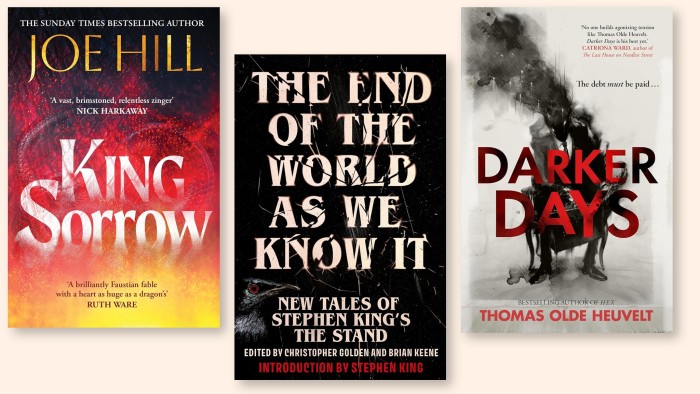
The End of the World As We Know It (Hodder & Stoughton £25) is an anthology of 34 short stories set during and after the events of the novel, and clocks in at a similarly sizeable 779 pages. Conceived and compiled by Christopher Golden and Brian Keene, its roster of authors includes both familiar and lesser-known names from the world of horror fiction, as well as a handful from outside the genre.
Each contributor weaves a narrative through the interstices of the source material, principally fashioning their vignettes out of whole cloth but sometimes exploring existing characters, as in “Abigail’s Gethsemane” by Wayne Brady and Maurice Broaddus, and sometimes expanding on glancing references, as in Nat Cassidy’s “The Unfortunate Convalescence of the SuperLawyer”.

Notable inclusions are “Grace” by Tim Lebbon, set aboard a space shuttle orbiting the stricken planet; “The African Painted Dog” by Catriona Ward, showing how zoo creatures might cope after their keepers are gone; and “Wrong Fucking Place, Wrong Fucking Time” by C Robert Cargill, in which three amiable survivors in Texas try to ride out the apocalypse as best they can.
All told, there isn’t a bad entry in the book, and even if the collection as a whole doesn’t add much to the original, doesn’t feel essential, there is still pleasure to be had in re-immersing oneself in King’s disease-ravaged world, where the struggle between good and evil is sharply delineated and the doom feels all too real.
Of King’s three children, two are authors themselves. His older son, who writes under the name Joe Hill, is probably better known than younger brother Owen King, with a backlist encompassing such notable works as Horns, NOS4R2 and the graphic novel series Locke & Key. Like his father, Hill has a tendency to pen whopping great doorstops, and at nigh on 900 pages his latest offering, King Sorrow (Headline £22), continues the trend.
It’s about a group of friends, headed up by bookish English lit student Arthur Oakes, who summon a deadly dragon, the King Sorrow of the title, to get Arthur and his mother out from under the malign influence of a gang of drug dealers. The problem is that they have inadvertently entered into a Faustian pact with the beast and must thereafter keep selecting people for him to kill annually, or pay with their own deaths.
Starting in the late 1980s, the story charts the effect this grievous mis-step has on their lives and relationships over the ensuing decades, and Hill displays admirable skill in following a set of characters from youth through to adulthood, much as his father did in It (1986). The dragon himself is portrayed marvellously, a charmingly sinister presence throughout. Hill’s previous book, 2016’s The Fireman, was not without its longueurs, and a bit of bloat blights this one too, but it’s a commanding, captivating read nonetheless.

As if that weren’t enough Stephen-King-related matter for one column, there’s this: a picture-book version of Hansel and Gretel (Hodder Children’s £20), for which King has written the text and which utilises, for its illustrations, set and costume designs by the late Maurice Sendak. These were created for a production of Engelbert Humperdinck’s opera version of the Grimm brothers’ fable, put on by the Houston Grand Opera in 1997.
King’s 2022 novel Fairy Tale delivered a Trumpian parable incorporating a range of tropes from the genre, and here, with his trademark blend of the folksy and the fear-inducing, he brings added depth and nuance to the material, subtly updating it in places. And of course, nothing drawn by Sendak is going to be anything other than a creepy delight. The sequence of images showing the witch’s house morphing from candy cottage to a hideous face is sure to raise a shudder.
In all, it’s a fascinating curio for the horror fan with young children who won’t suffer from bedtime-reading nightmares.
Just enough room remains to squeeze in a mention of a very King-esque novel, Darker Days by Thomas Olde Heuvelt (Harper $32). In Lock Haven, a small town in Washington State, the residents of one street seem happier, healthier and more prosperous than most. This charmed life comes at a cost, however, in the form of an annual human sacrifice presided over by a dapper, devilish entity known as the Accountant.
The Netherlands-born author digs deep into the conflicts and consequences arising from such a premise, his tale neatly and slyly probing the rotten roots of privilege, all the way to a gut-punching final twist.
James Lovegrove’s latest book, his 70th, is ‘Fantastic Four: The Coming of Galactus’
Join our online book group on Facebook at FT Books Café and follow FT Weekend on Instagram, Bluesky and X