
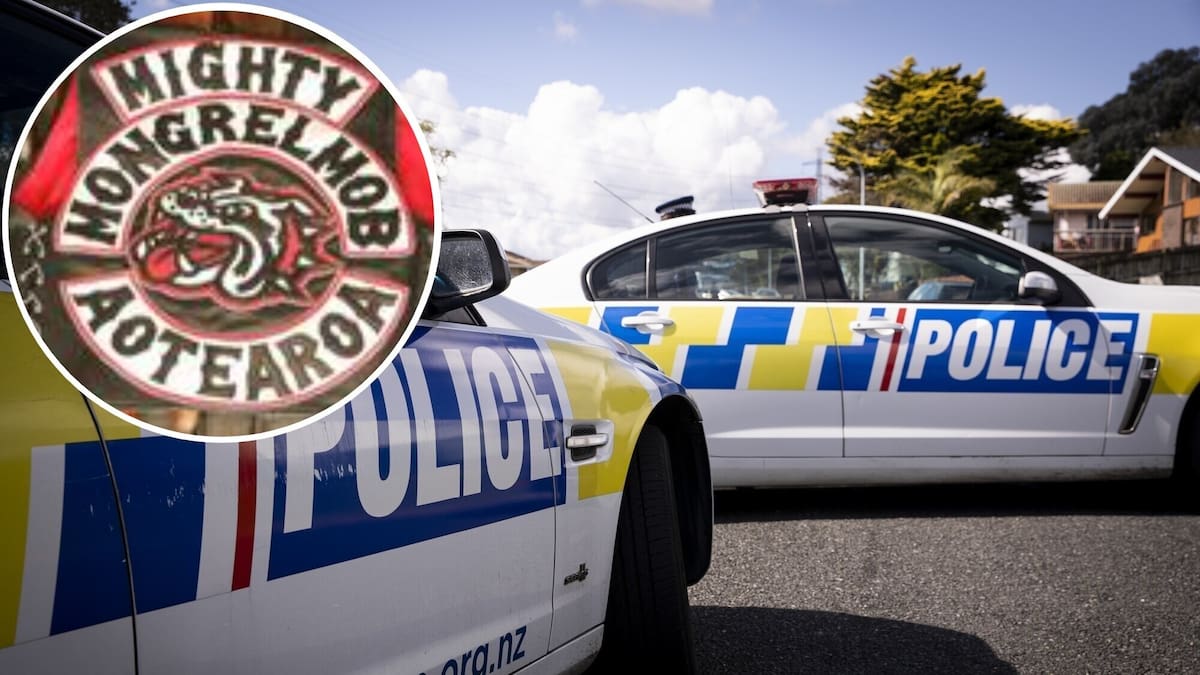
The new Gangs Act law makes it an offence for any person to knowingly, and without reasonable excuse, display gang insignia at any time in a public place and, in this context, the vehicle was a public place.
Te Whata defended the charge at a judge-alone trial in the Tauranga District Court, but was convicted by Judge Paul Geoghegan.
He then appealed to the High Court, with his lawyers, Michael Douglas and Tim Conder, disputing whether the prosecution had proved beyond a reasonable doubt that Te Whata was knowingly displaying Mongrel Mob gang insignia at the time he was stopped and, if so, whether he was doing so without reasonable excuse.
Te Whata’s evidence at trial was that he is a patched member of the Tauranga Mongrel Mob.
On December 27, 2024, he spent two days at Waharoa, attending the unveiling of his deceased brother-in-law’s headstone, as part of tangihanga ceremonies.
His brother-in-law had also been a patched member, and once he arrived at the venue, as a mark of respect to the deceased, he changed into a red T-shirt that had Mongrel Mob insignia on the sleeve. He also wore a leather vest with his Mongrel Mob patch on the back.
James Te Whata was spotted wearing his gang insignia while driving late at night. Photo / NZME
He said he knew he was not permitted to wear clothing with gang insignia on it in public, and therefore wore other clothing when travelling with his family to the unveiling.
Late in the evening on December 29, he decided to drive his family, including his wife and their two grandchildren, home to Tauranga.
He was still wearing the T-shirt and leather vest at this time.
It was just after midnight when a police officer spotted him.
Te Whata said in his evidence during the trial that he did not turn his mind to the fact that he was still wearing the clothing that bore the gang insignia before he began his journey home.
A ‘chance encounter’
During the hearing in the High Court at Tauranga last month, Conder initially argued that the relevant section of the Gangs Act should be construed narrowly to protect Te Whata’s Bill of Rights Act rights.
He initially submitted that the courts should interpret the term “display” as applying only to situations where a person displays gang insignia with the intent to intimidate or create fear.
However, Justice Graham Lang said the argument overlooked the fact that the mere display of gang insignia may create intimidation and fear for members of the public, even where that is not the intended effect.
In a recently released judgment following that hearing, Justice Lang said he considered that “Parliament intended the prohibition to prevent this from occurring even where the display is not intended to create intimidation and fear”.
However, Conder then argued that a person will only “display” gang insignia in circumstances where it is likely to be seen by members of the public, or where the defendant knows or is reckless as to whether that may happen.
During the hearing, Conder said Te Whata didn’t expect to stop or be seen, as he was focused on getting the young children home.
“He’s driving home at night. He’s not on a motorcycle. He’s inside an enclosed vehicle,” Conder said.
“It seems to be something of a chance encounter that a headlight managed to illuminate him enough that his identity, not necessarily even of the patch, but as a gang member, because of his facial tattoos, could be identified.”
He said it was not the kind of display where a person would be reasonably expected to encounter others or for others to see or be affected by the insignia.
However, Justice Lang disagreed.
He agreed with another decision, of Justice Gregory Blanchard, that it was sufficient if it was able “to be seen by any persons who may be in the vicinity of the defendant at any time whilst the defendant is in a public place”.
“The police officer who saw Mr Te Whata driving his vehicle through the intersection immediately observed the gang insignia on the sleeve of his T-shirt,” Justice Lang said.
“He said the area around Mr Te Whata’s vehicle was well lit, and he did not need the assistance of his own vehicle’s headlights to see that Mr Te Whata was wearing insignia associated with the Mongrel Mob.”
As to the question of whether Te Whata had “knowingly” displayed gang insignia, Justice Lang considered Te Whata’s behaviour on the trip to Waharoa.
“As Judge Geoghegan noted, Mr Te Whata knew he was not permitted to wear clothing bearing gang insignia whilst in a public place.
“He had complied with this restriction when travelling to the unveiling in his vehicle two days earlier,“ Justice Lang said.
“The fact that he failed to turn his mind to that issue because he was anxious to get his family home cannot, in my view, constitute a reasonable excuse.”
He said the relevant section, dealing with a reasonable excuse, anticipated a situation where no reasonable person in the defendant’s position would consider it likely that the insignia would be seen by members of the public.
“However, Mr Te Whata could not avail himself of this argument. There were any number of ways in which members of the public could have seen the gang insignia he was wearing as he drove between Waharoa and Tauranga.”
There was also discussion about the Bill of Rights Act, but Justice Lang noted that Parliament had enacted the Gangs Act knowing that it would conflict with the Bill of Rights, following advice from the Attorney-General, and the courts had to give effect to Parliament’s intention.
The High Court appeal was dismissed, but Te Whata’s lawyers have indicated they now plan to take the matter to the Court of Appeal.
Hannah Bartlett is a Tauranga-based Open Justice reporter at NZME. She previously covered court and local government for the Nelson Mail, and before that was a radio reporter at Newstalk ZB.