

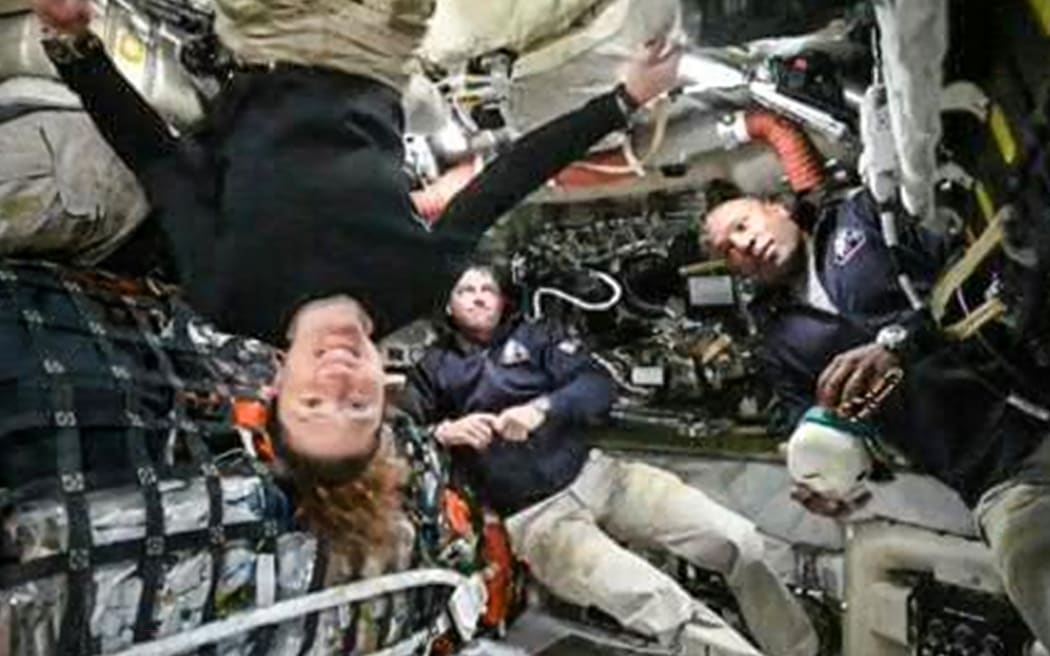
This screen grab from NASA's feed released on April 3, 2026, shows the four Artemis II crew members (L-R) Canadian Space Agency (CSA) astronaut Jeremy Hansen, Artemis II mission specialist (hidden), NASA astronauts Reid Wiseman, Artemis II commander, Christina Koch, Artemis II mission specialist and Victor Glover, Artemis II pilot as they head to orbit the Moon for the first time in more than half a century. The spacecraft lifted off from Kennedy Space Center in Florida at 18:35 EDT the previous day. (Photo by Handout / NASA TV / AFP) / RESTRICTED TO EDITORIAL USE - MANDATORY CREDIT "AFP PHOTO / NASA" - HANDOUT - NO MARKETING NO ADVERTISING CAMPAIGNS - DISTRIBUTED AS A SERVICE TO CLIENTS

Four Artemis II crew members (L-R) Canadian Space Agency (CSA) astronaut Jeremy Hansen, Artemis II mission specialist (hidden), NASA astronauts Reid Wiseman, Artemis II commander, Christina Koch, Artemis II mission specialist and Victor Glover, Artemis II pilot as they head to orbit the Moon for the first time in more than half a century.
Photo: AFP/SUPPLIED

The four Artemis astronauts have passed the halfway point between Earth and the Moon on the way to their planned lunar flyby, NASA says.

“You are now closer to the moon than you are to us on Earth,” mission control told the astronauts, according to the space agency’s official live broadcast.

“We all kind of had a collective, I guess, expression of joy at that… we can see the Moon out of the docking hatch right now, it is a beautiful sight,” said astronaut Christina Koch replied.
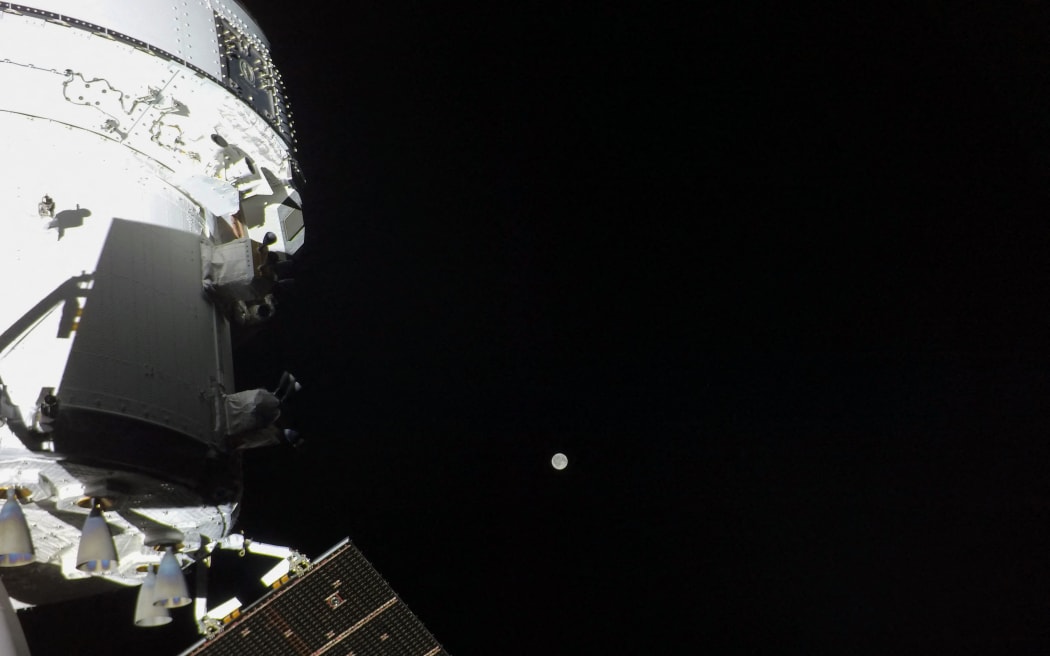
This handout picture provided by NASA shows the Orion spacecraft with the Moon in the distance, as captured by a camera on the tip of one of its solar array wings, on April 3, 2026. As Artemis II astronauts forged ahead on their lunar mission, NASA released initial images taken from the Orion spacecraft, including a full portrait of Earth featuring its deep blue oceans and billowing clouds. After a flurry of high-stakes activity including a dramatic blast-off and an engine firing that catapulted them on their historic trajectory to circle the Moon, the four astronauts aboard were able to catch their breath, even as they continued to perform a variety of equipment checks and tests. (Photo by NASA / AFP) / RESTRICTED TO EDITORIAL USE - MANDATORY CREDIT

The Orion spacecraft with the Moon in the distance, as captured by a camera on the tip of one of its solar array wings, on April 3, 2026.
Photo: NASA handout/AFP

The milestone was hit about two days, five hours and 24 minutes after liftoff, according to the NASA official broadcast.

The US space agency’s online dashboard showed that the Orion spacecraft carrying the astronauts is now more than 219,000km from Earth.

“We’re halfway there,” NASA posted on social media.

The spacecraft’s next milestone will be entering the lunar sphere of influence, scheduled to take place on day five of the flight, according to NASA.
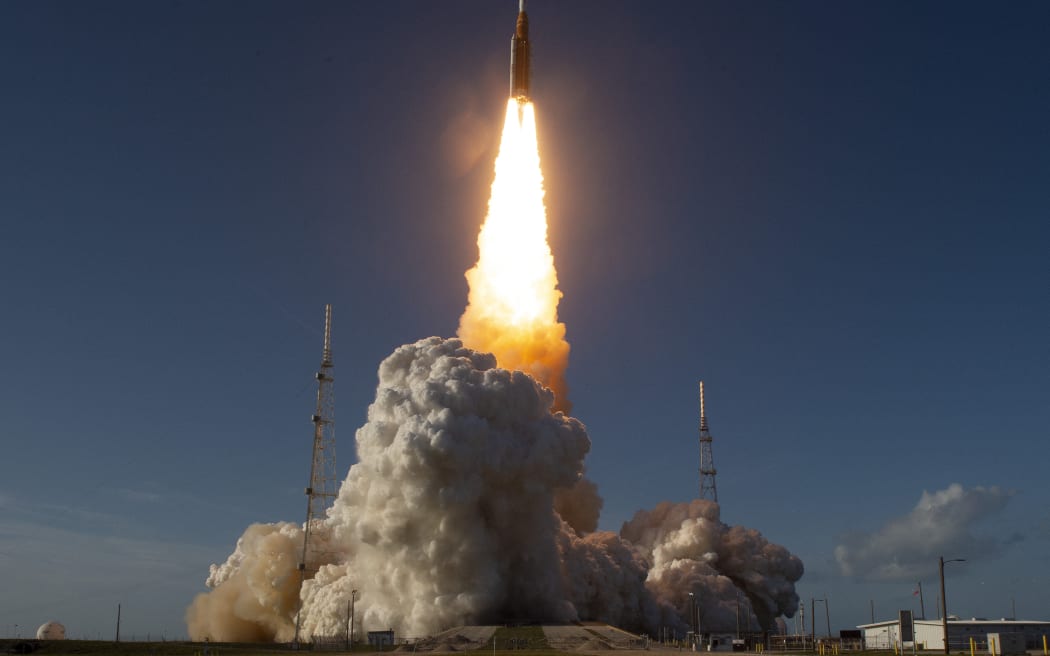
The Artemis II crewed lunar mission lifts off from Pad 39B at Kennedy Space Center in Cape Canaveral, Florida, on April 1, 2026. Four astronauts blasted off aboard a massive NASA rocket April 1 on a long-anticipated journey around the Moon, the first crewed lunar flyby in more than 50 years. With an intense roar that reverberated far beyond the launchpad, the enormous orange-and-white rocket carried three Americans and one Canadian away from Florida's Kennedy Space Center at approximately 6:35 pm local time, according to an AFP journalist onsite. "We're going to the Moon!" yelled a spectator. (Photo by Jim WATSON / AFP)

The Orion spacecraft carrying the four astronauts is now more than 219,000km from Earth.
Photo: JIM WATSON / AFP

The astronauts – Americans Koch, Victor Glover and Reid Wiseman, and Canadian Jeremy Hansen – are now on a “free-return” trajectory, which uses the Moon’s gravity to slingshot around it, before heading back towards Earth without propulsion.

– AFP