
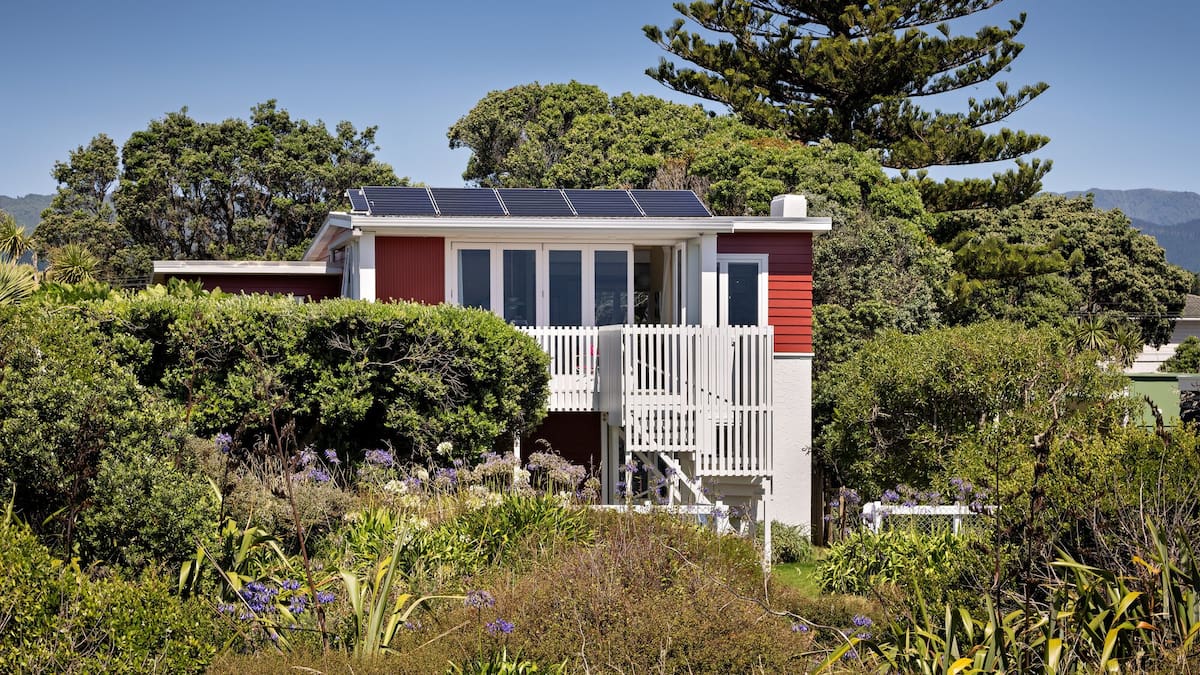
But does that still hold true in today’s world?
“Absolutely,” says Tim Dorrington of Dorrington Atcheson Architects (DAA).
“In a way, a bach is really just a tent you don’t take down. That’s one of the enduring lessons of the bach. You don’t need excess to create comfort, pleasure and connection.
“Often the smartest move is restraint. The bach was the bare minimum, which meant less to do and less to maintain. It’s about making a modest space work really well.”
Tim Dorrington: “In a way, a bach is really just a tent you don’t take down”.
It’s this stripped back simplicity that underpins its attraction. A bach is as small as can be, low to no maintenance – it’s where you go to relax.
“You compromise and make do when you’re at the bach,” says Dorrington, a spokesperson for Te Kāhui Whaihanga NZ Institute of Architects.
“A lot of its charm comes from simple materials, practical spaces, no unnecessary fuss. Design doesn’t have to mean expensive or overdone. Quite often it means being clearer about what matters and stripping away what doesn’t.”
Bach furniture also had a ‘less is more’ approach, one that was more about sentimentality than Scandinavian chic.
Sinking into a bach sofa is like putting on an old and familiar pair of slippers that are past their prime, worn and faded but comfortable.
“Sometimes that comfort comes from familiarity rather than luxury,” says Dorrington.
“Gran’s old dining table, a slightly faded couch, a daybed in the sun that’s perfect for reading. It may not be polished but it feels right.
“That’s often what good design comes down to as well, not making something flashier, but making it feel useful, enduring and right for the way people actually live,” he continues.
“A quirky, colourful little building with personality is a place you go to get away from it all, to gather with friends and family. The classic Kiwi bach is where jandals rule and community is key, where doing a jigsaw and building a fire become the main event.”
There are things you can get away with at the bach that you can’t get away with at home, he adds: “The mindset is different. What might feel like a chore at home becomes part of the ritual at the bach, even something like washing the dishes.
“You wear togs all day long, you read a book without feeling guilty, and meals become the way you mark time.”
Second-hand pieces, often from relatives, furnish many baches. Photo / Cave Studio
Bach culture is a uniquely Kiwi response to New Zealand’s warm summer climate, a tiny house movement that evolved many years before that phrase was even thought of.
“The economy of space is a big part of the appeal,” says Dorrington.
“A smaller footprint, when it’s well thought through, can be both more affordable and more enjoyable to use. A lot of bach life happens outdoors. You don’t want too much space, because then there’s more to clean, more to maintain, and more to worry about.”
There’s a common belief that the classic Kiwi bach will always be linked to a time when life wasn’t as challenging and complicated as it is today.
“In some ways that’s true,” says Dorrington.
“Life was probably more structured, building was less regulated, and self-builds were more achievable. Land was also much cheaper, relative to income than it is now, even coastal land.
“So it does seem to reflect a different era. But I think the long-term appeal is more than nostalgia. It’s the idea that what’s important to living well is a good connection with the outdoors, things like natural light and flexible shared spaces, and having a solid, low-maintenance structure that can adapt as your needs change,” he continues.
The classic Kiwi bach doesn’t need a large footprint because most activities take place outside. Photo / Cave Studio
It was back when middle New Zealand could afford to own a simple holiday home.
“I’m no expert on the historical economics of it, but they were often tied to a particular activity or way of spending time; fishing, white baiting, hiking, and they were quite often self-built as a family or community effort,” says Dorrington.
“The bach was once a more modest and accessible idea than the holiday home can be today. That’s one reason this conversation still matters.
“The principles behind the bach; flexibility, simplicity and making space work harder, are just as relevant when we talk about affordable housing now.”
Flexible spaces were fundamental to the bach lifestyle.
Decks extended the bach living space and reinforced its connection with nature. Sometimes they had provision for shade from the sun and protection from the rain.
“That’s a good example of smart design adding value without necessarily adding much cost, having flexible spaces where you can put up temporary shelter if you need to, and take it down when the weather allows,” says Dorrington.
DIY design reigned supreme in bach construction, reflecting a time when there was less red tape associated with building.
Most were basic, often resembling a child’s drawing of a house, but some were influenced by one of the most important design movements in recent times, mid-century modernism.
With an aesthetic that championed logic and simplicity, its style appealed to some bach owners.
“A lot of baches were built in an era when there was a recognition that you didn’t need masses of space to create a functional, liveable and enjoyable home,” says Dorrington.
Little and charming, a bach is all about simple materials, practical spaces, and no unnecessary fuss. Photo / Paul McCredie
Over time, and it’s difficult to pinpoint exactly when this began, the holiday home started to move away from the cute baches of yesteryear.
“I think it happened almost by accident,” says Dorrington.
“We seem to have drifted into more of a beach house culture, maybe because of what got built next door, or because of resale thinking, or just what people saw in magazines and online.
“And yet people are still drawn to the classic Kiwi bach for a reason. I think that says something important. Bigger and more expensive isn’t automatically better. A lot of people still respond to the modesty and clarity of a traditional bach.”
With coastal land prices soaring in recent decades, is the humble Kiwi bach in danger of disappearing?
“It is, although I’d like to think it can make a bit of a resurgence,” says Dorrington.
“There’s always going to be a place for beach houses, and they’re not in competition with baches. They’re just answering a different brief.”
Beach houses took a couple of new directions – there’s a hybrid that’s still small and deeply pragmatic.
Often architect-designed, its roots are firmly in the classic Kiwi bach vernacular. Commonly an unadorned plywood box, with a floor-plan dictated by the size of a sheet of ply, the structure is simple, and the emphasis remains on outdoor activities.
“It’s often small, durable, low-maintenance and easy to lock up and leave. In fact, our office is in the process of coming up with a basic bach design that tries to respond to exactly that,” says Dorrington.
“As architects, we’re trained to solve quite complex problems of brief, budget and context, and turn them into a specific response for a specific site.
“When that thinking is applied to a bach, you can still end up with something very simple, very emotive and very cost-effective. That’s where good design really adds value, not by making something more elaborate, but by making it work harder.”
Mid-century modernism had an influence on bach design, such as this lakeside holiday home in Taupo. Photo / David Straight
The other style of bach in this new design-driven beach house world is not really a bach at all – more of a large beach house with all the mod cons of home.
A home away from home, clustered in popular coastal bolt holes like Omaha, Pauanui and Waiheke Island.
“I think beach houses and baches are really just two different types of building solving two different problems,” says Dorrington.
“They can happily co-exist. The architect’s role is to help clients get the best outcome for their brief, budget and site, whatever scale the project is.”
For some, owning an impressive holiday home is important.
“Everyone’s different,” he continues.
“For some people, that probably is the goal, and for others it’s not. The architect’s job isn’t to impose one answer, but to solve the brief clearly and efficiently.”
If bach ownership is slipping out of the grasp of middle New Zealand, are there ways we can reverse this?
“I’m no economist, but I do think it would be great if a low-cost, simple bach could become more common again,” says Dorrington.
Achieving the Kiwi dream of owning a bach will invariably involve finding cheaper land in more out-of-the-way places, as well as making the most of smaller sections and smaller footprints.
“Lower costs should open it up to more people. Shared ownership or family ownership may be part of that.
Baches are often handed down for generations.
Architects can help families think ahead and design baches that will still work for the next generation, and which can easily adapt as lifestyles and tastes change.”
Has New Zealand developed into a country of two halves, where mansions are right next door to old-style baches?
“Yes, and I don’t think there needs to be any judgement in that,” says Dorrington.
“Baches and beach houses can comfortably co-exist. It really comes down to what you want from a holiday place. Somewhere you live half the year probably requires more home comforts in comparison to somewhere you go for shorter breaks.
“But I do think there’s still a strong public appetite for the simpler bach idea, because it speaks to practicality, memory and value. That’s probably why the idea continues to resonate so strongly with New Zealanders.”