
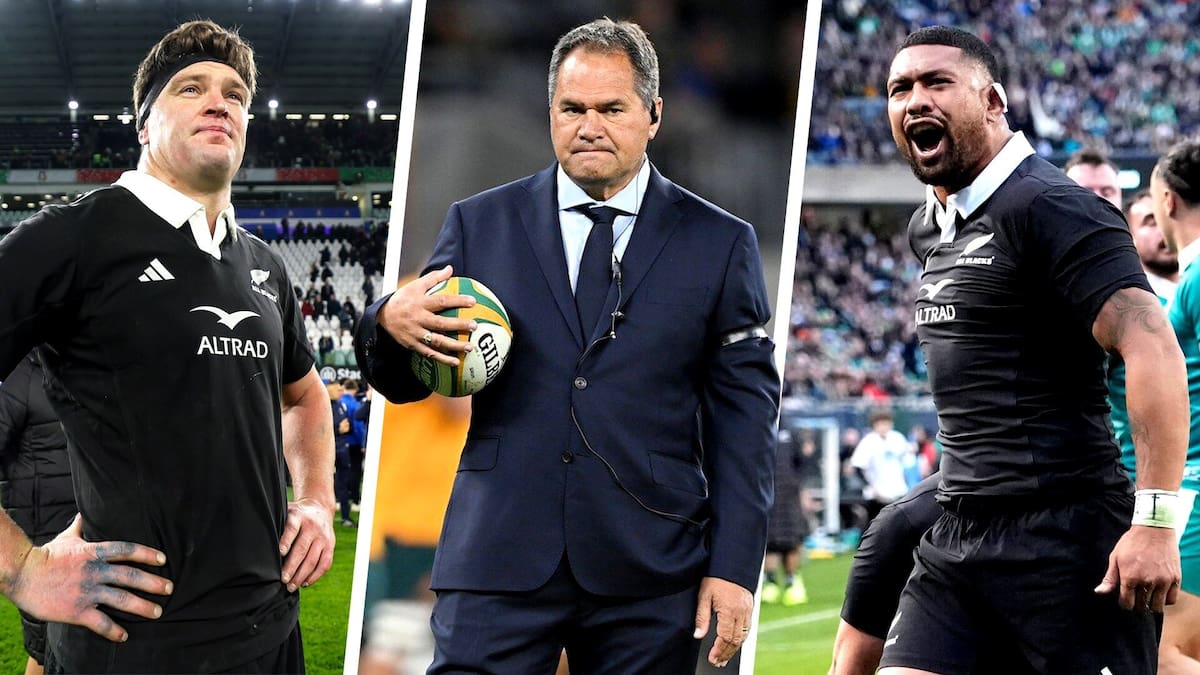
Gregor Paul analyses the All Blacks’ captaincy options.
The unfinished project
Why Rennie doesn’t need to finish Razor’s Barrett project
It’s a bit like the story of industrialisation, where cities grew not just because of urban pull, but also because of rural push, in that there are strong reasons for Rennie to not persevere with Barrett – and equally compelling factors to switch to Savea.
Regime change doesn’t always have to be absolute and ruthless, but it does have to be effective, and if Rennie is indeed driven by the one simple aim of making a decision that is right for the team, it will be hard to justify retaining Barrett as captain.
Barrett, in his two years in the role, never once looked comfortable and there is more poignancy tied into his initial hesitation to take the job than is perhaps realised.
When Barrett was first asked about doing the job in early 2024, he took a few weeks to say yes. It was assumed that the prolonged consideration was a sign of respect for the magnitude of the job.
All Blacks captain Scott Barrett has a word with the side. Photo / SmartFrame
Two years on and it feels more like Barrett genuinely didn’t know how he felt and was riddled with self-doubt, both about his desire and his ability to do it.
It reached the point last year where it felt like the nation needed to stage an intervention to take the captaincy off Barrett and let the poor man be free of a responsibility that looked as comfortable on him as lycra on middle-aged male cyclists.
This once-colossus of a player seemed to shrink. The athleticism that defined Barrett’s game deserted him, as if the whole business of being the team’s figurehead was a literal weight he was lugging around the field.
Midway through the season, the form of fellow locks Tupou Vaa’i and Fabian Holland was such that Barrett’s selection was marginal, and the captaincy was reverse-engineered as the reason he was being picked.
Maybe a different coach would have made a tougher call – taken the captaincy off Barrett or dropped him to the bench – but Scott Robertson seemed stuck on the idea that time would shape his captain into being the iconic leader the All Blacks needed.
Some of Barrett’s difficulties in the role were because he had been plagued by injury. He rarely had a consistent run of games and he was forever trying to play his way back into form after an injury break.
Robertson’s plan to rejuvenate his captain was for Barrett to skip most of this year’s Super Rugby Pacific campaign, fix his various injuries and return to the All Blacks in July physically rebuilt, mentally refreshed and with a few games for the Crusaders under his belt.
A reconditioned Barrett would likely have the confidence to play better and lead through his improved performances.
But Robertson was trying to make someone who never really gave the impression they wanted the job fall in love with it.
Scott Robertson (left) and Scott Barrett face the public after the All Blacks’ record defeat to South Africa last year. Photo / Photosport
Barrett’s heart has never appeared to be in the job, and it feels as if he only said yes because it would have been disrespectful – certainly impolite – to have said no, and there was no evidence that he was discernibly better at or more comfortable in the role by late 2025 than he was in mid-2024.
Rennie is not compelled to persevere with Barrett as captain for the plan to be considered a success, as there’s value in having a super-charged Barrett return to the international fold in prime condition.
The question for Rennie will be, why twist when he will have banked plenty if he sticks? If he gets Barrett back to his 2023 form, why potentially jeopardise that by giving him the captaincy?
That feels like a high-risk option with no evidence to suggest it would be anything other than low reward.
Two other things need to come into consideration, the first of which is that brand is all-important in the commercial and digital age and the All Blacks captain has to give off James Bond vibes, with a quintessential Kiwi flavour.
Barrett has never looked at ease in the media glare, and Rennie will be smart enough to understand that the commercial side of the business will be easier for him to manage if there is a sense of alignment and buy-in from the All Blacks head coach.
But the most significant reason Barrett’s not the right choice for Rennie is that he’s possibly going to be assigned an amended role where he operates as chief agitator around the breakdown, in much the same way Brodie Retallick did when the Chiefs were in their pomp.
Rennie likes his tight five to combine ruthless technical precision with a take-no-prisoners attitude and lingering around the tackled-ball area to impose himself on the opposition would be right on-brand for Barrett.
Speaking with the media two weeks ago, Barrett said Rennie has already addressed the players and laid out the big picture of what he wants his All Blacks to be.
Scott Barrett leads his side off the field after defeating Wales on the 2025 end-of-year tour. Photo / Photosport
“He just introduced himself and had a conversation on what he’s going to bring to the team and some of the expectations around the type of athlete that he’s looking for and the game that we want to play,” Barrett said.
“That was the first introduction that he had with the group and myself – so, yeah, it’s a bit of a transition period, but I think he’ll hit the ground running.
“You can sort of see the way [Rennie’s] previous teams have played. The Chiefs team, the style and the DNA that they want to bring out in their game, that’s sort of unique to his style of coaching and obviously being influenced by [Sir] Wayne Smith. He’s a sharp coach and I think he’ll have a positive influence on the group as well.”
It’s going to be hard for Barrett to build rapport and respect with referees if he’s forever looking like a crime scene, splattered in opposition DNA.
And rapport and respect are often-underappreciated but vital commodities for international captains to have, and they are certainly qualities that Savea has built.
The case for Savea
Savea ticks every box an All Blacks captain should
Savea seems to live that same charmed existence that former All Blacks captain Richie McCaw did, where he can emerge from the bottom of every ruck with referees presuming his innocence.
It’s an important quality to have, as reputation can be hugely influential in the biggest games.
McCaw secured the All Blacks a World Cup in 2011 when he won favourable decisions in the final on the strength of his reputation, while Siya Kolisi seemed to avoid a red card in the 2023 final purely because he was Siya Kolisi.
Savea sits among this exalted company, referees naturally warm to him and let him engage – and the respect officials hold for him filters through to the way they perceive the All Blacks.
On more tangible issues, Savea has shown over the past decade that his standards don’t slip, making it almost certain that he’ll merit a starting place between now and the World Cup.
He’s also, since he was first asked to do it in 2021, been entirely comfortable with every aspect of the All Blacks captaincy.
The role has not overwhelmed nor diminished him and he brings the charisma that the sponsors who write the biggest cheques need to see, while he’s the player most regularly chased by young fans hunting selfies when the All Blacks are in foreign cities.
Ardie Savea (left) and his club coach in Japan, Dave Rennie, face the media at the Kobelco Kobe Steelers. Photo / Photosport
Savea has already spent the past four months working with Rennie (and attack coach Mike Blair) at the Kobelco Kobe Steelers, he has a strong relationship with incoming defence coach Tana Umaga and an equally good connection with scrum and maul coach Jason Ryan.
Savea ticks about every box and above all else, he simply feels like the right choice to captain the All Blacks through to the World Cup.
But there are specific issues that weigh against Savea being captain – starting with his possible unavailability for the July tests.
The case against Savea
How could he lead the side if he’s not here?
As the Herald has revealed, Savea told New Zealand Rugby (NZR) in November last year that he wanted out of the last two years of his contract because he was missing being away from his family and he was physically and mentally tired.
That he felt the way he did was understandable, but he was also the architect of his own predicament as he had negotiated two playing sabbaticals in 2024 and 2026.
Not everyone will be sympathetic to his plight, but it wasn’t contradictory for Savea to opt for two sabbatical seasons in Japan (where he likely banked around $4 million) where he would be living without his wife and children and then tell NZR late last year that he was missing his family too much to carry on.
The argument that a family man wouldn’t choose to live away from his family arguably isn’t looking at Savea’s career choices with a broad enough lens.
There is a short earning window for professional athletes and $4m is the sort of money that can make a difference for generations – and surely, providing is the ultimate act of a family man?
What Savea is guilty of is a miscalculation. He thought he could bank the cash and keep playing around the clock but clearly underestimated the physical impact of rolling one season into the next. Two years out from a World Cup, his 32-year-old body has signalled its need for some kind of break if he’s to make it to Australia next year.
But so too does NZR need to take an element of accountability, as it signed off on its star asset playing in Japan twice in three years.
Employer and employee are jointly culpable for not making a good plan to manage Savea through this World Cup cycle and work is now being done to remedy that and build a schedule that enables him to take some kind of extended break and spend more time at his Wellington family home.
The 2026 season is split into three blocs: the July tests, the Greatest Rivalry Tour and Bledisloe Cup, and the November tests.
Quinn Tupaea, Ardie Savea and Fabian Holland in action against the Springboks. Photo / Photosport
The highest-value bloc is the middle one and while not going to the UK in November would give Savea the longest break and most time at home, discussions are believed to be focusing on him missing the July series.
He’ll be home from Japan in early June – eight weeks before the All Blacks head to South Africa – a gap which he could use to rest before finding some club or provincial fixtures in late July.
The goal of taking a break in July is to enable Savea to be refreshed for the seven-week tour of South Africa, but if he does sit out those tests, can he still be captain?
Can the Rennie era begin with Savea as the nominated captain but not actually playing?
It wouldn’t be ideal, but the answer would be yes. Barrett could potentially skipper the team, or it could be a chance for someone else – perhaps Jordie Barrett, Tupou Vaa’i or Codie Taylor – to lead the All Blacks.
The situation could be sold as an opportunity to grow the leadership pool – much as it was back in 2013 when Kieran Read captained the All Blacks in June while McCaw was on sabbatical.
NZR will also be conscious that there is a lingering narrative that Savea somehow orchestrated the demise of Robertson – a story that has enraged some fans – but the Herald has proven that was not the case.
Ardie Savea struck rich form when he joined Moana Pasifika last year. Photo / Photosport
Still, the reputational damage has been done, and there is a pocket of rugby followers who, judging by social media comments, see Savea as a divisive figure.
That’s maybe a cross he has to bear for doing things differently and a PR job for NZR to clean up, but it doesn’t strike as a strong enough reason to prevent Savea being the captain.
Savea has the respect of his peers, he’s an inspirational force on the field and he’s said – and proven with his form at Moana – that he’s at his best when he feels a depth of connection with the team he’s playing for.
On the strength of the Herald’s exposé this week, Savea has felt marginalised within the All Blacks. Making him captain is a way to reconnect and empower him.
The new coaching group has 18 months to rebuild the All Blacks in time for the World Cup and it would be hard to justify making anyone other than Savea captain.
The other contenders
Codie Taylor
Taylor is being touted as a candidate on the strength of his longevity and seniority. But he has limited captaincy experience, has been prone in recent times to needless acts of ill-discipline and as a hooker, he is unlikely to ever play a full 80 minutes.
He’s a valuable member of the leadership group, but has a relatively unconvincing claim to be captain.
Codie Taylor leads the All Blacks haka against France last year. Photo / Photosport
Jordie Barrett
Barrett is a certain starter and someone who leads through the range of his skillset and influence on the game.
He’s been All Blacks vice-captain for two seasons and has built experience playing in Ireland. But like Taylor, he hasn’t built a portfolio of experience to suggest he’s ready or equipped to lead the All Blacks.
He does, however, seem calm, composed and level-headed on the field.
Jordie Barrett in training with the All Blacks at North Harbour Stadium. Photo / Photosport
Tupou Vaa’i
He’s a strong candidate to take the role permanently after the 2027 World Cup, but it would be a risk to promote him now, as he’s only just establishing himself as a heavyweight All Black.
Vaa’i is a thinker and he’s articulate; he has a presence about him on the field and the respect of his peers. He needs to stand up in South Africa to really prove he’s ready to be the All Blacks captain.
Tupou Vaa’i on the charge for the All Blacks. Photo / Photosport
Gregor Paul is one of New Zealand’s most respected rugby writers and columnists. He has won multiple awards for journalism and written several books about sport.