
New emerging diseases and other threats, including climate change, are upending muskox recovery in parts of the Canadian Arctic Archipelago.An emerging pathogen, dubbed Erysipelothrix rhusiopathiae Arctic clone, was linked to widespread muskox mortalities on Victoria and Banks islands from 2009-14. Another outbreak was identified on Ellesmere Island in 2021.Brucellosis, a zoonotic disease, is now appearing in muskoxen on Victoria Island and parts of the mainland, with rates increasing since 2015.These emerging diseases were identified, researched and tracked via an innovative community-based wildlife health surveillance program that teams up Inuit hunters and trappers, scientists and government agencies. Muskoxen are a key food source for many Inuit communities and play a vital role in Arctic ecology. Their loss could put food security and Indigenous culture at risk.
See All Key Ideas
As winter comes to the Canadian Arctic, muskoxen (Ovibos moschatus) abandon the valleys and head to higher ground, where winds sweep away the snow. That’s where we go to find them, Allen Niptanatiak, chairman of the Kugluktuk Hunters and Trappers Organization, tells Mongabay in a video call.
The Inuit harvesters focus on culling the younger cows and bulls, leaving the breeding animals alone. It takes a couple hours to skin, butcher and load up the sleds, the older and younger generations working together in -30° Celsius to -35°C (-22° Fahrenheit to -35°F), weather that is “just perfect,” says Niptanatiak, an Inuk hunter and trapper from Nunavut, who is also a retired conservation officer. “Then we eat and have a big meal and just enjoy it and talk and say, ‘Oh, this is a blessing,’” he says.
Muskoxen are an integral part of Arctic ecology and, with their thick shaggy coats, are synonymous with the Far North. Nearly driven to extinction by commercial hunting in the early 1900s, surviving in just a few pockets in Canada, they began to recover following a 1917 hunting ban. By the 1990s, the Canadian population was estimated at 108,600. About 70% of the Canadian population was on Victoria and Banks islands, in Canada’s Arctic Archipelago — large islands with a combined area of nearly 290,000 square kilometers (12,000 square miles), about the size of Italy.
Niptanatiak lives in Kugluktuk, a small hamlet on the mainland, just across from Victoria Island. Diets vary there, but for many of its Indigenous and traditional people, harvesting wild game is central to culture and food security. “Our elders always said, ‘Look after your food basket.’ (You know, they said it in our language.) ‘Look after it well, keep it well.’ And that always stayed with me,” Niptanatiak says.
With steep caribou declines in the region since the late 1990s, the recovery of muskoxen populations has been a “blessing,” he adds. Mother Nature “accommodated us so perfectly, or else we’d be starving.”
But over the past couple of decades, muskox recovery has been threatened by new emerging diseases and escalating climate change impacts, worrying biologists and communities.
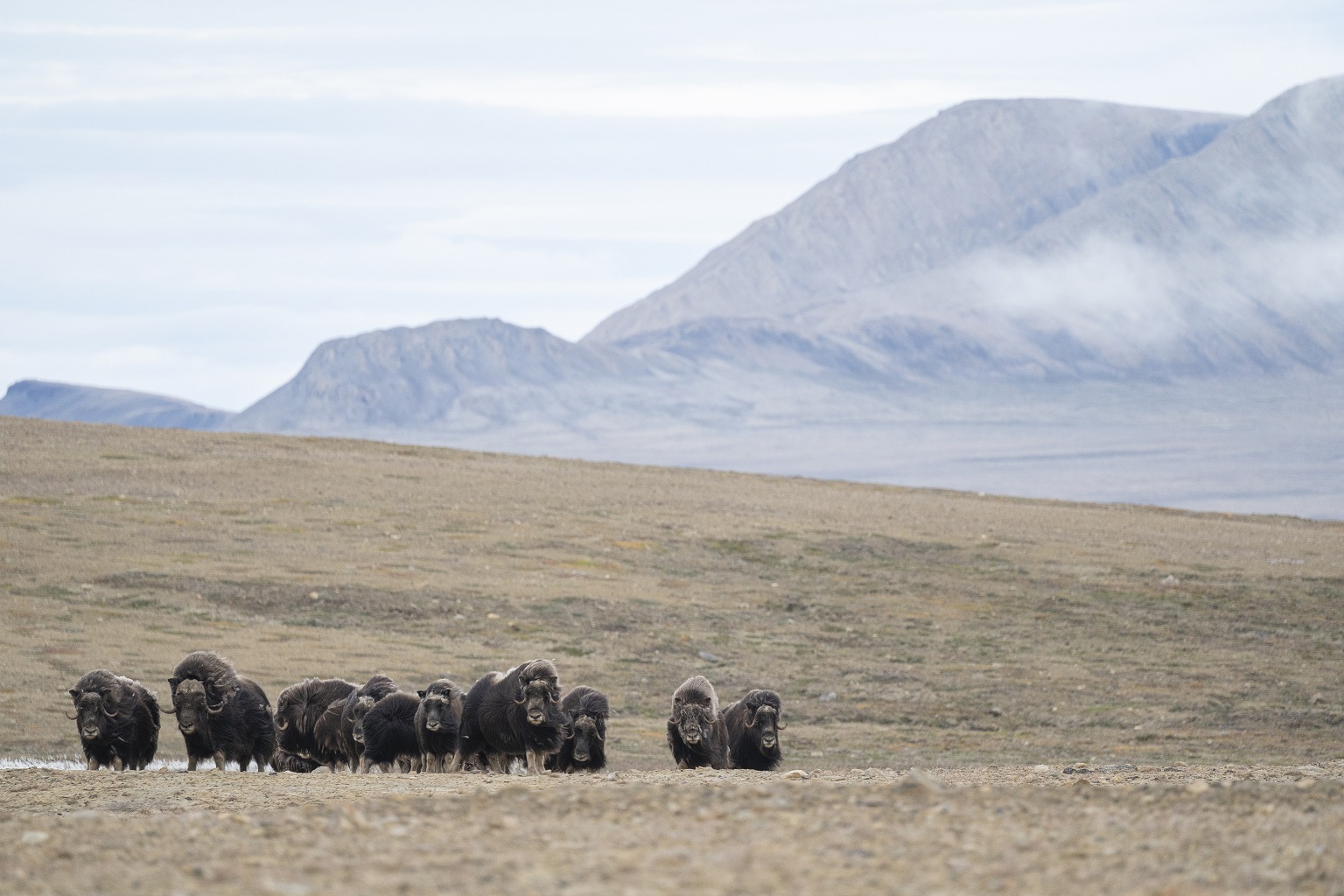 Muskoxen have survived harsh Arctic conditions in the Canadian Archipelago for untold centuries. But now, emerging diseases and climate change are posing serious threats to the species. Image courtesy of McCaide Wooten.
Outbreak on Victoria and Banks islands
Starting in around 2009 and continuing through 2014, hunters on Victoria Island began finding muskox carcasses strewn across the tundra — half a dozen or so animals within a relatively small area, with no signs of predation or other obvious cause of death. It was frightening, says Niptanatiak, who was then a conservation officer with the government of Nunavut in Canada. In 2012, a total of about 150 carcasses were found on nearby Banks Island, prompting more thorough investigation.
The cause, researchers determined, was a bacteria called Erysipelothrix rhusiopathiae (Er). Common in pigs and poultry, and known to be present in marine ecosystems, the bacteria had not previously been found in muskoxen. Subsequent phylogenetic analysis revealed this to be a unique strain of Er dubbed the “Arctic clone.” The lack of genetic diversity within the strain indicated that it was very new and moving quickly.
“We’ve never really seen anything like this before,” as compared to other strains of Er, Taya Forde, a senior lecturer at the University of Glasgow and first author of a 2016 Frontiers in Microbiology study on the pathogen, tells Mongabay by video call.
The impact on muskoxen was devastating: On Banks Island, the population fell from 37,000 in 2010, to fewer than 14,000 in 2014, post-outbreak.
“Erysipelothrix, the mortality rates and the impact, they are alarming,” Susan Kutz, a professor at the University of Calgary, who heads a research program on emerging diseases in muskoxen and caribou, tells Mongabay in a video call. “You try to be balanced on this, but it’s alarming.”
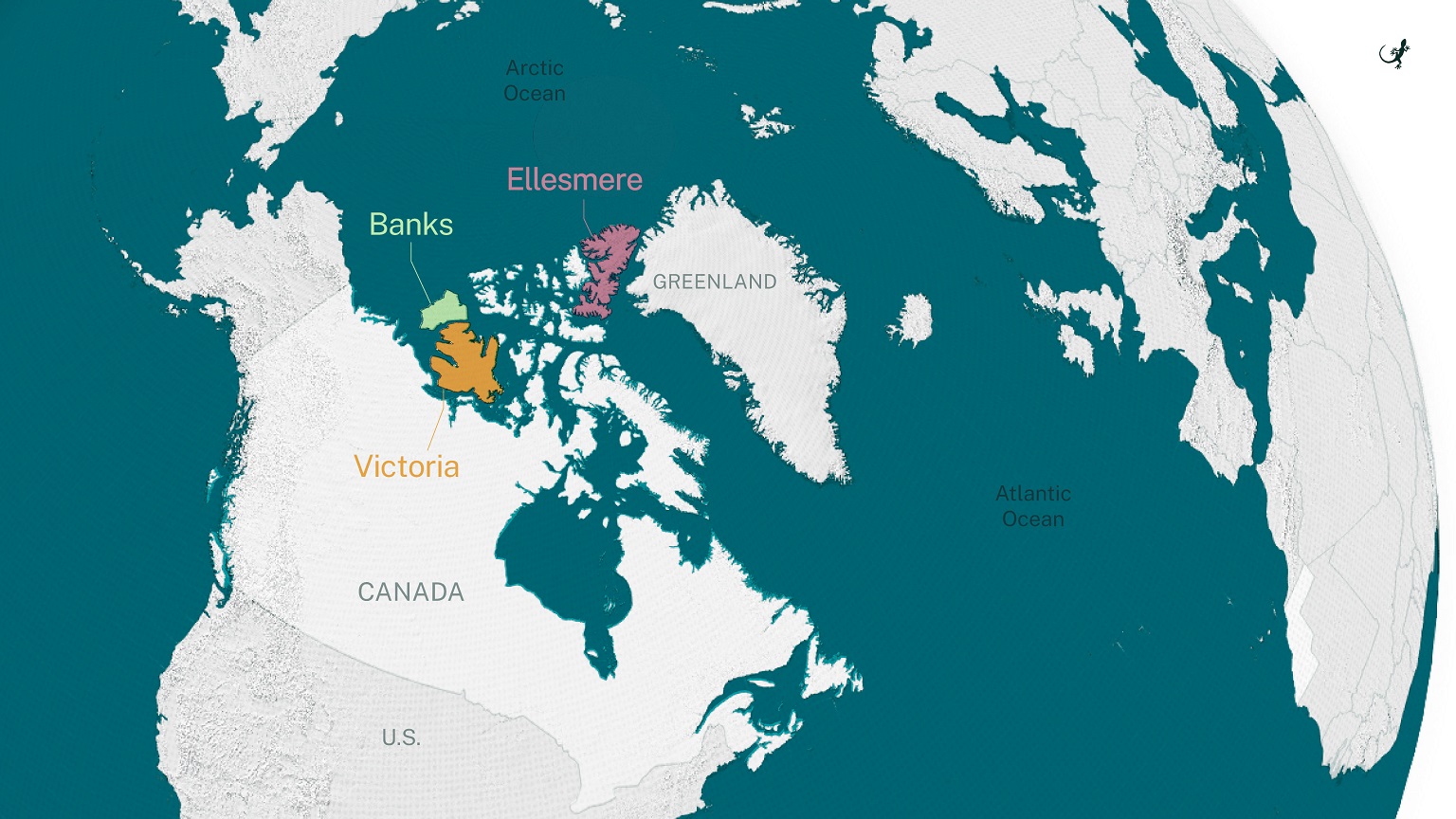
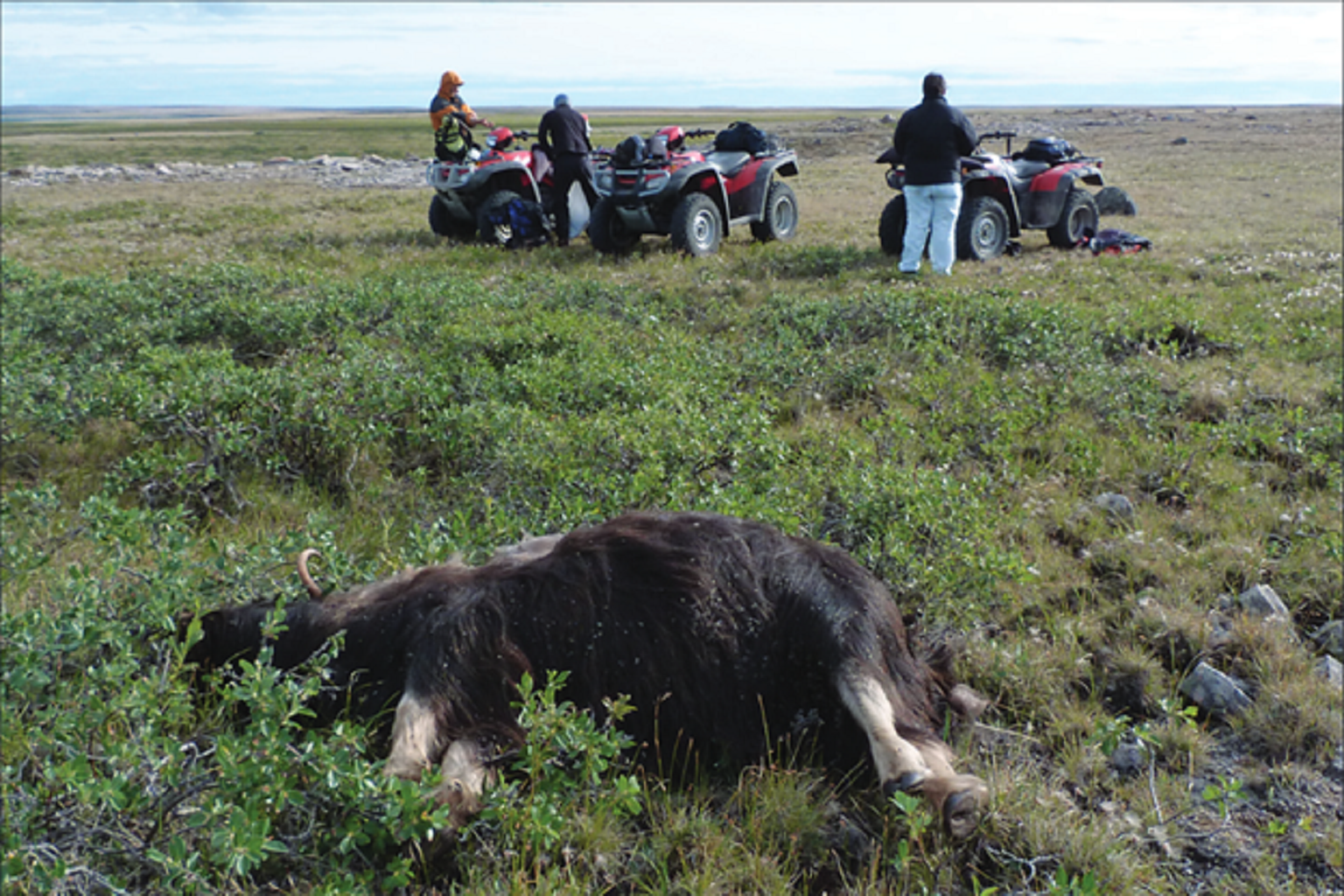 A dead muskoxen on Victoria Island in 2011 (see locator map below). Starting in about 2009 and continuing through to 2014, hunters and trappers began noticing mysterious numbers of dead muskoxen on Victoria and Banks islands. Image courtesy of McCaide Wooten, from Kutz et al. (2015).
‘Two-eyed seeing’: An Arctic early warning system
As bad as those declines have been, they don’t tell the whole story: On the positive side, an innovative collaborative effort was quickly able to fill in disease data gaps in a remote Arctic region where tracking wildlife health is extremely challenging.
Kutz’s scientific research group partners with traditional hunter and trapper associations, government agencies and other groups in a community-based wildlife health surveillance program focused on muskoxen and caribou. Under the program, hunters collect blood, tissue and other samples from harvested muskoxen and caribou, noting anything they find concerning, and send the samples out for analysis.
In addition, the research team collects traditional knowledge through interviews. Originally working with just three communities — Kugluktuk, Ekaluktutiak (Cambridge Bay) and Ulukhaktok — the program has now expanded to seven communities. Over time, its “two-eyed seeing” approach has helped detect several wildlife disease outbreaks.
When Matilde Tomaselli, a former Ph.D. student in Kutz’s research group, sat down with hunters and trappers in Ekaluktutiak (Cambridge Bay) on Victoria Island in 2014, they described in detail how the epidemic had unfolded over a six-year period, tracing precisely where and when each animal had died over a large area.
“If we had not done those interviews, there’d be this massive population decline, and people would say ‘what happened?’ … Biologists would have eventually done a survey and gone, ‘yeah, you’re right. There’s no muskoxen around, where’d they go?’” Kutz says.
 In 2021, a wildlife film crew on Ellesmere Island noticed dozens of muskox carcasses within just a few weeks. A four-year study showed that the mortalities were linked to Erysipelothrix rhusiopathiae Arctic clone, an emerging pathogen in muskoxen. Image courtesy of McCaide Wooten.
Er appears on Ellesmere Island
Then, in August 2021, on Ellesmere Island, a remote and largely uninhabited island about 1,000 km (620 mi) east of Victoria Island and near Greenland, a wildlife film crew spotted dozens of dead muskoxen over just a couple weeks.
When the scene was later described to Kutz, it was hauntingly familiar. “Summer mortalities, muskoxen of all age classes that otherwise look healthy, dropping dead. So quite dramatic, really, and depressing,” she says.
Over the next four summers, Kutz and her team, in partnership with the Nunavut government, sampled carcasses on Ellesmere and neighboring Axel Heiberg islands; cutting up livers, kidneys and other organs, cracking open bones and collecting soil near the carcass sites. They also sampled carcasses of other species and collected scat to try to determine the bacteria’s source and how it was transmitted.
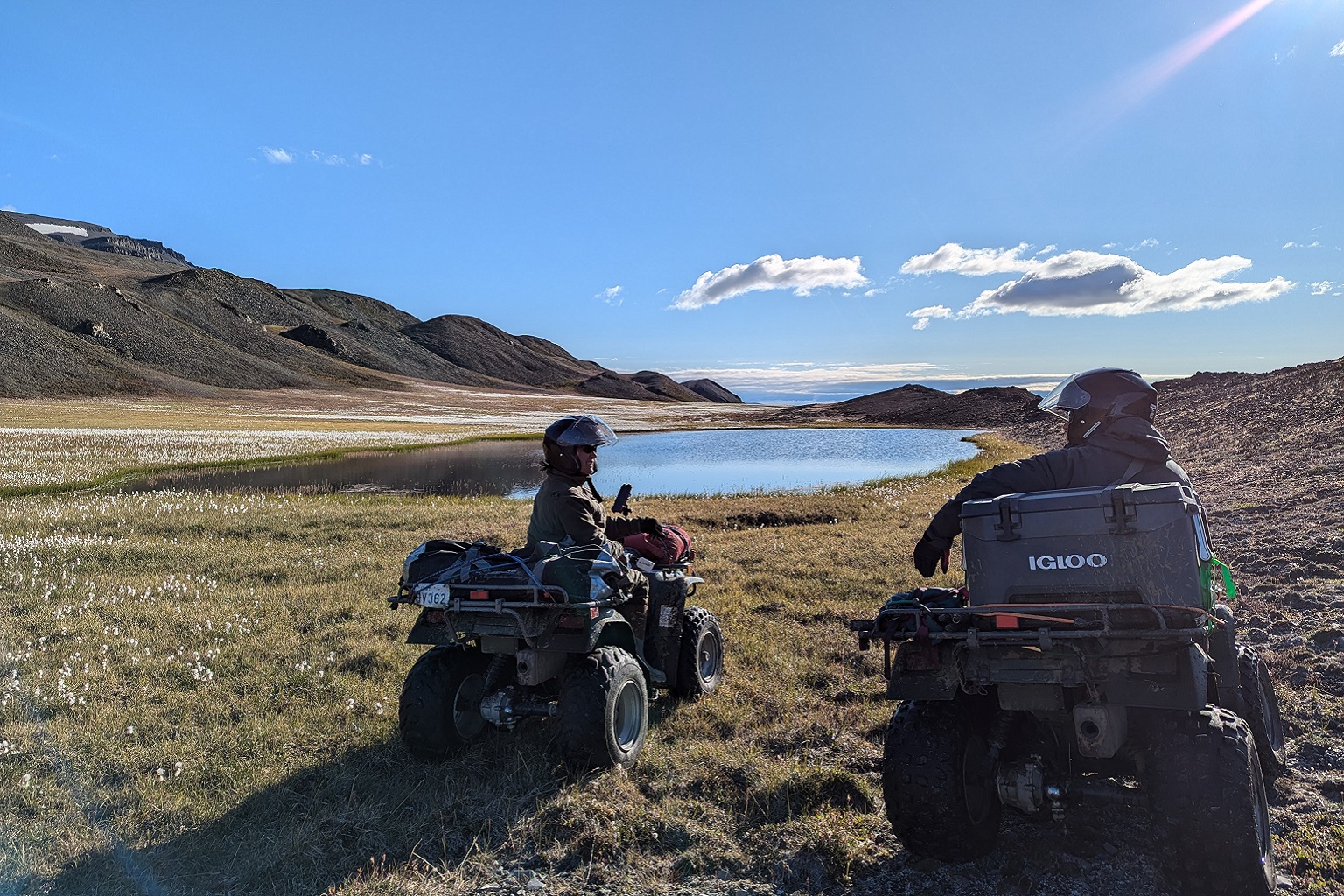 Research team using ATVs to get around Ellesmere Island. Large parts of the Canadian Arctic are uninhabited, and wildlife disease outbreaks can go unnoticed. Conducting field research in places like Ellesmere is logistically challenging and expensive. Image courtesy of McCaide Wooten.
The pathogen, it turns out, is “pretty hardy” and can last for up to five years in soil, McCaide Wooten, a Ph.D. student in Kutz’s lab, and first author on a 2025 Scientific Reports study on the Ellesmere Island outbreak, tells Mongabay by video call. The researchers also found the pathogen in carcasses of a few other species, but it wasn’t possible to tell if Er was the cause of death or how widespread mortality might be. There are a lot of sparsely inhabited areas in the Arctic, and smaller carcasses disappear quickly, making it hard to track the path of a deadly malady.
“It’s concerning, given its apparent pathogenicity in muskoxen, that [Er Arctic clone] could be causing pretty significant disease in other species, like caribou, or other species of high importance to people living in the North,” Wooten says.
Researchers still don’t know where the bacteria originated or how it traveled from one region to another. It’s possible the Er Arctic clone could have jumped from the marine to the terrestrial environment, been released from thawing permafrost or just be a random mutation that has proven extremely virulent for muskoxen, Wooten says.
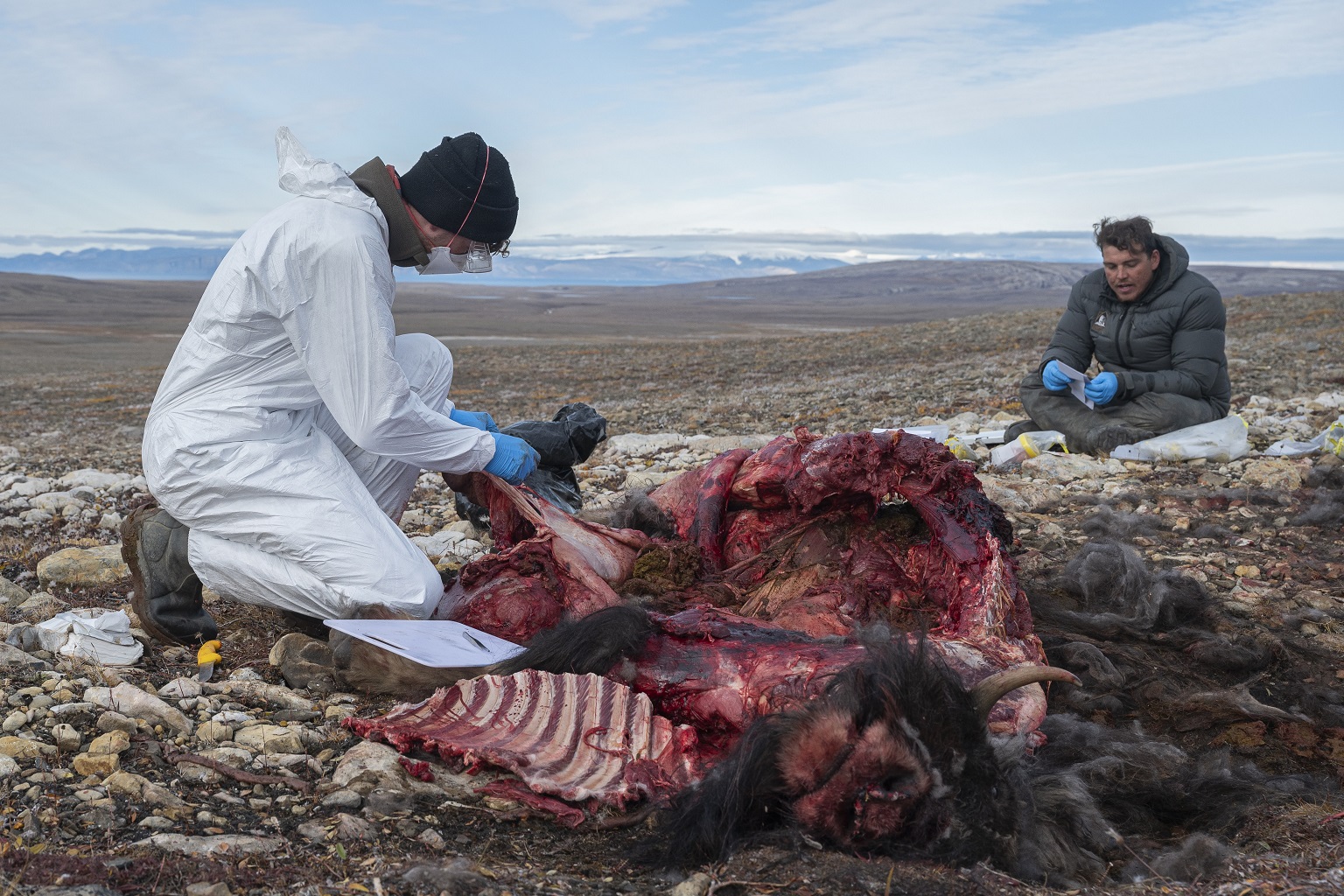 Ph.D. candidate McCaide Wooten sampling a muskox carcass on Ellesmere Island with Grise Fiord Conservation Officer Olaf Christensen. This muskox cow was killed by wolves, but samples were collected to check the health status of the animal and to detect pathogens. Image courtesy of McCaide Wooten.
Continuing declines are a worry for Inuit communities
On their last visits to Ellesmere and Axel Heiberg islands, researchers found fewer fresh carcasses, and in 2025, they were relieved to see calves and yearlings in muskox herds.
But on Banks and Victoria islands, muskoxen are still declining. A 2020 survey estimated about 11,000 muskoxen on Banks Island; that’s about a quarter of the pre-Er population and a fraction of the nearly 70,000 estimate from 2000. Losses were likely similar on Victoria Island, Kutz says.
The continuing decline may be due to multiple factors, Kutz adds. Working with the community-based wildlife health surveillance program, researchers have discovered that brucellosis, a zoonotic disease already found in caribou in the area, is also now emerging in muskoxen. Since 2015, the number of muskoxen on Victoria Island and parts of the mainland that are seropositive for brucellosis has shot up.
In wildlife, brucellosis causes lameness and abortions. People can also contract brucellosis from handling or eating infected animal parts. The disease causes fever and, if untreated, reproductive issues, so harvesters must exercise caution when handling infected animals.
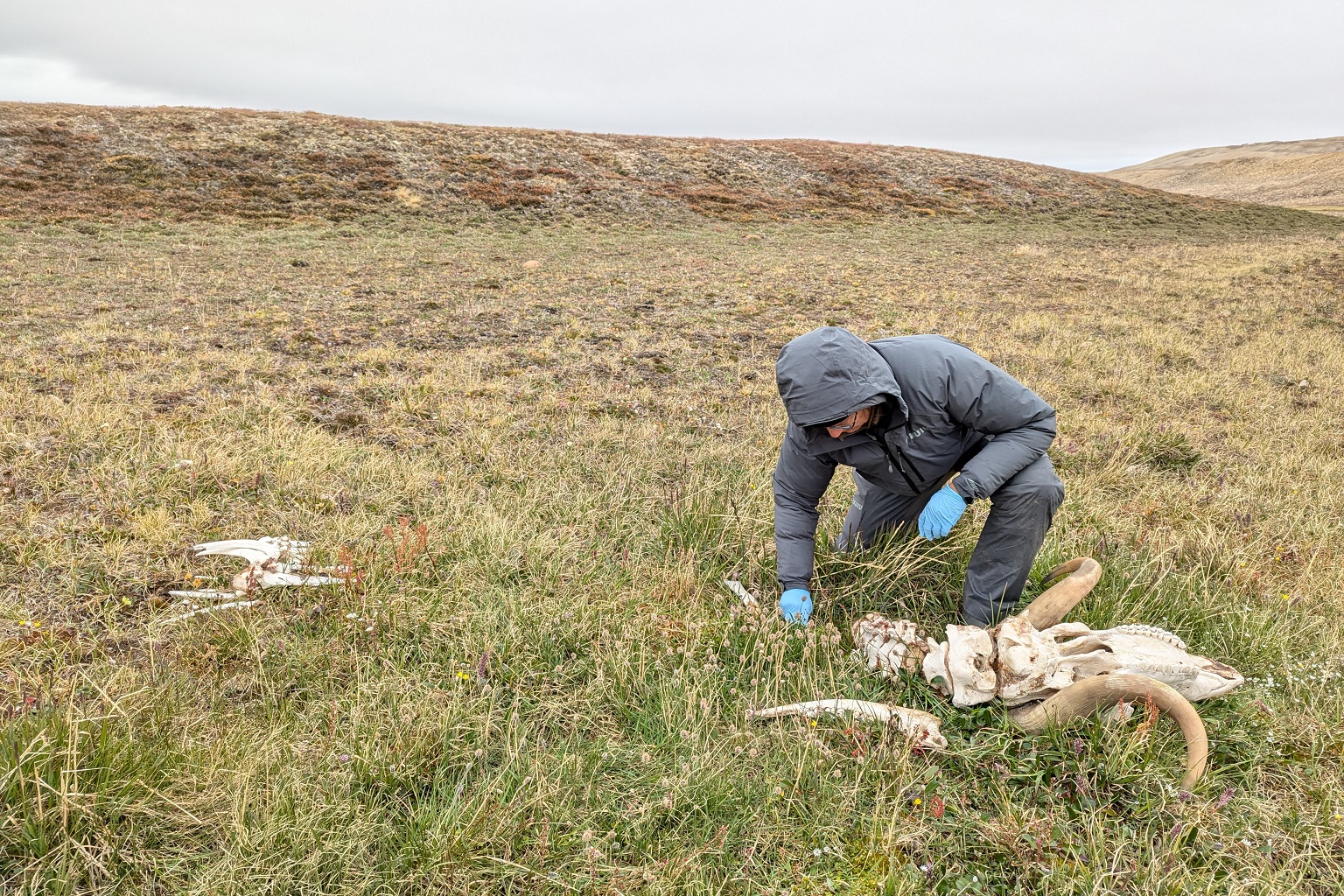 Susan Kutz, professor at the University of Calgary, examining a muskox skeleton on Ellesmere Island. This strain of Er can persist in the soil for up to five years. Image courtesy of McCaide Wooten.
In muskoxen, the signs of brucellosis infection in the animal are slightly different than in caribou. That makes it especially important to get the word out to harvesters, Forde says, so they can take precautions and collect samples to check if animals are infected.
For now, the Canadian mainland muskoxen populations near Kugluktuk are healthy, Niptanatiak says. This year there was plenty of fat on the meat, something he hasn’t seen in a long time. Members of the Kugluktuk Hunters and Trappers Organization used to also hunt muskoxen on Victoria Island but haven’t for years, as they allow populations to recover.
For some communities, especially those on Banks and Victoria islands, the steep muskoxen declines mean hunters have to travel farther to harvest food for their families, Niptanatiak says. Cambridge Bay used to have a commercial muskox meat processing plant, but with the muskox population crashing, it shut down. Harvesting wildlife is a central part of Inuit culture and food security.
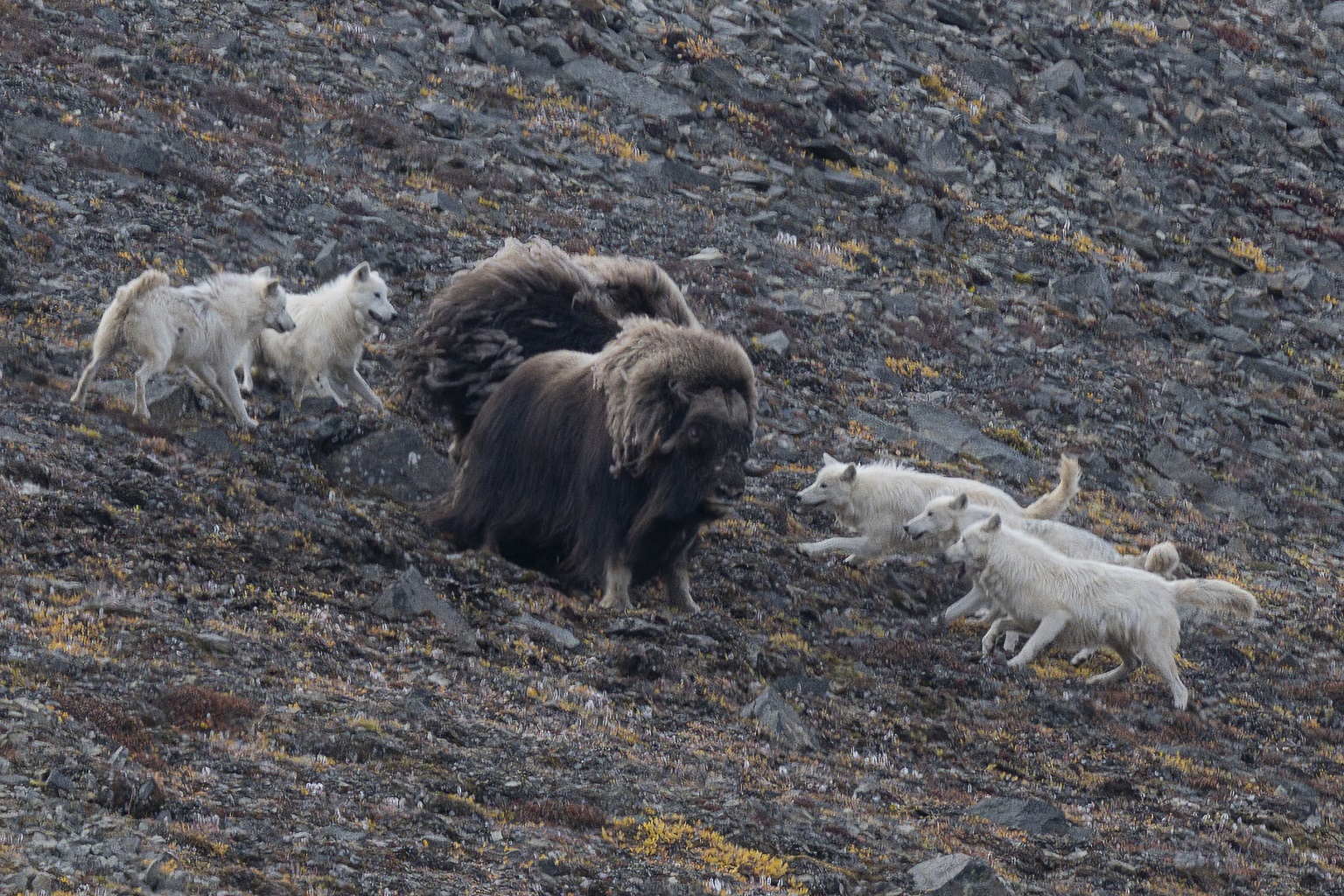 A bull muskoxen defending a cow and her calf from wolves. The wolves eventually killed both the cow and calf. “Watching the hunting and killing of the muskoxen was not easy, but being able to see this activity at the end of that day under gorgeous light was incredibly special and really put the ‘circle of life’ in perspective,” Ph.D. candidate McCaide Wooten writes in an email to Mongabay. Image courtesy of McCaide Wooten.
Hotter summers, melting permafrost and ‘rain-on-snow’
Muskoxen are not only plagued by emerging diseases; they’re also impacted by an Arctic that is warming nearly four times as fast as the global average.
One look at a muskox, with its dark, shaggy coat and plush qiviut underfur, is all you need to know about a beast perfectly adapted to extreme cold. That’s backed up by work on fossilized bones, Anne Gunn, a former wildlife biologist with the Northwest Territories government and a muskox expert, tells Mongabay by video call. During past glacial periods, muskoxen thrived; when the climate warmed, muskoxen suffered.
Today’s hotter, drier summers are physiologically stressful for muskoxen, with scant surface water and disappearing permafrost making it harder for the animals to cool down. This could explain a seemingly paradoxical impact of climate change, with muskox numbers crashing on Arctic islands but expanding their range south on the mainland to the treeline, where they may find more shade, Gunn says.
Climate change poses a second problem: A warmer Arctic increasingly sees ice storms, also known as rain-on-snow events. These occurrences make it hard for muskox and other animals to break though the icy crust that forms atop snow to find food, Gunn says, which can lead to large die-offs or affect survival. On Banks Island, large numbers of muskox carcasses were found following rain-on-snow, freezing rain and deep snow events in the winters of 1993-94 and 2003-04.
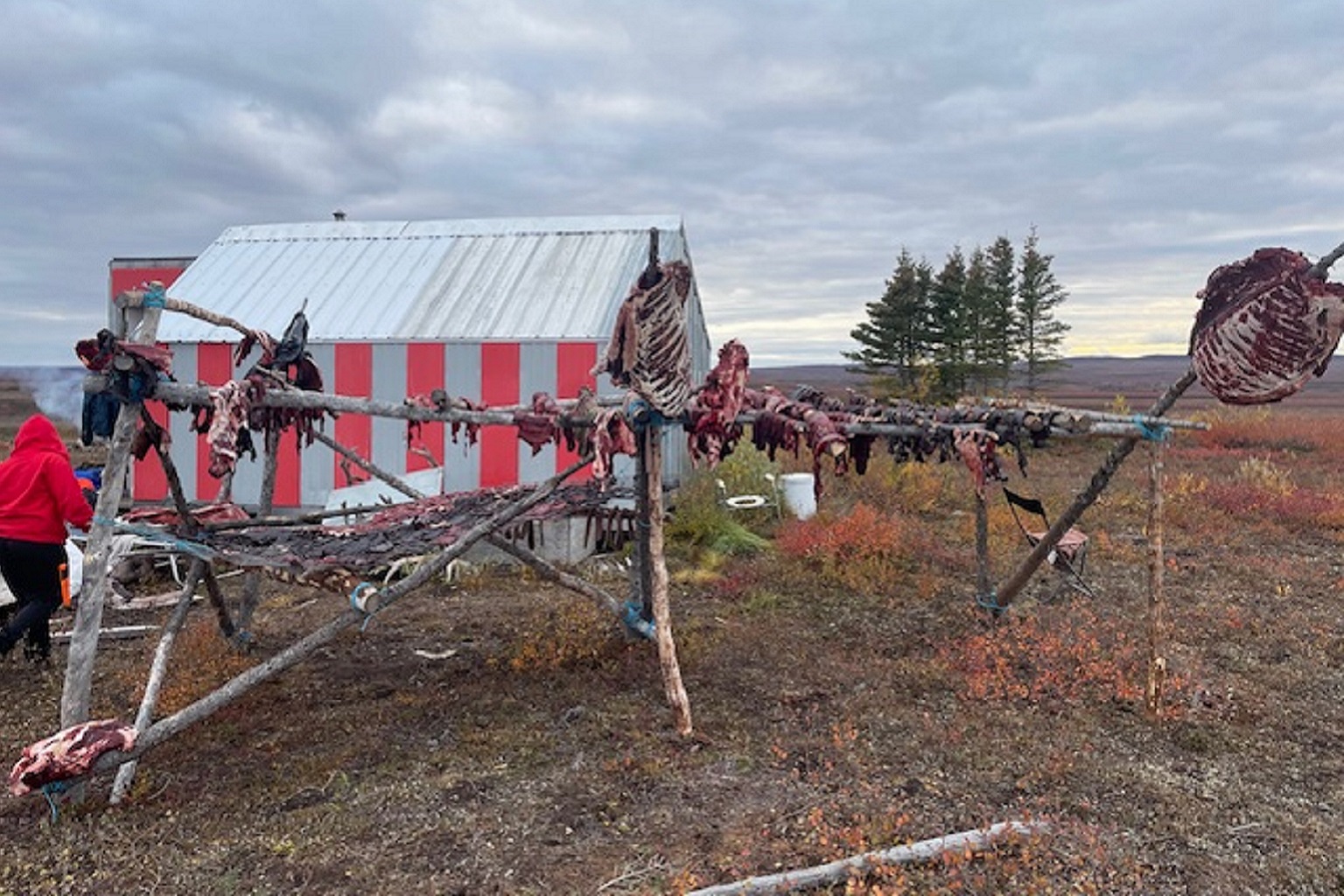 Drying muskox meat. A community-based wildlife health surveillance program, a collaboration between hunter and trapper associations, University of Calgary researchers and other agencies, is helping to answer many questions about wildlife health and emerging diseases. Image courtesy of Allen Niptanatiak.
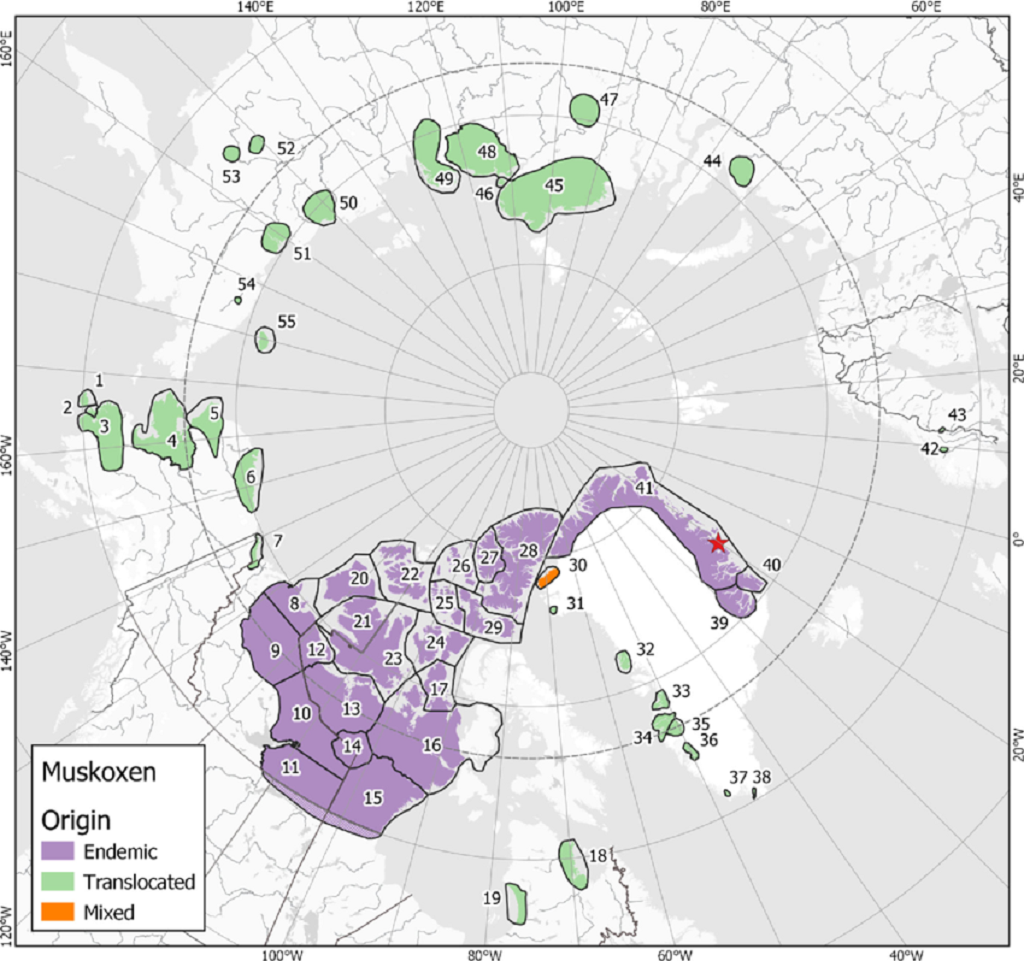 Current global muskox distribution, showing endemic, mixed (translocation to an area with endemic muskoxen) and translocated (introduced and/or reintroduced) populations. Note the boundaries of populations are approximate. The muskox is often called an “ice-age survivor” and has been around for about a million years, with its range shrinking and contracting over time. Image courtesy of Cuyler et al. (2020).
Climate change has indirect impacts as well. Kutz’s team has found that muskoxen on Victoria Island, and in some other areas, are now low in critical trace minerals like selenium, needed for growth, reproduction and immunity. Usually, muskoxen get these trace minerals from salt licks or their food. But thawing permafrost, changing plant diversity or even changes in flowering times could be altering mineral content in soils or uptake by plants.
Then there are the parasites. Muskox lungworms are parasitic worms that form cysts on infected animals’ lungs. They were first detected in muskoxen in the 1980s. Lungworms can only survive in certain temperature conditions due to their life cycle, and that kept numbers down and prevented spread. But over the past few decades, researchers have found that lungworms are showing up farther north, with muskoxen also carrying a heavier parasite load, according to a 2020 study on which Kutz was a co-author. In heavily infested muskoxen, lungworm cysts can take up half of an animal’s lung space, she says.
It’s likely all these stressors are acting together, to varying degrees, contributing to the dramatic muskox declines seen on Banks and Victoria islands, Gunn notes.
“I think there’s uncertainty about the role of epidemics and parasites to [fully] explain the rate of decline that was observed. … It’s going to probably turn out to be a complex of factors that started to operate together and … add to each other’s impacts,” she notes.
Today the global muskox population sits at about 141,000, with about 81,000 in Canada, Gunn says.
Muskoxen are survivors, she concludes. They have been around for a million years, lived through glacial periods, and in modern times, rebounded from near-extinction to occupy a wide range of geographies. But we shouldn’t be “complacent.”
The problem, Gunn says, is that the past is no longer a reliable guide to the future.
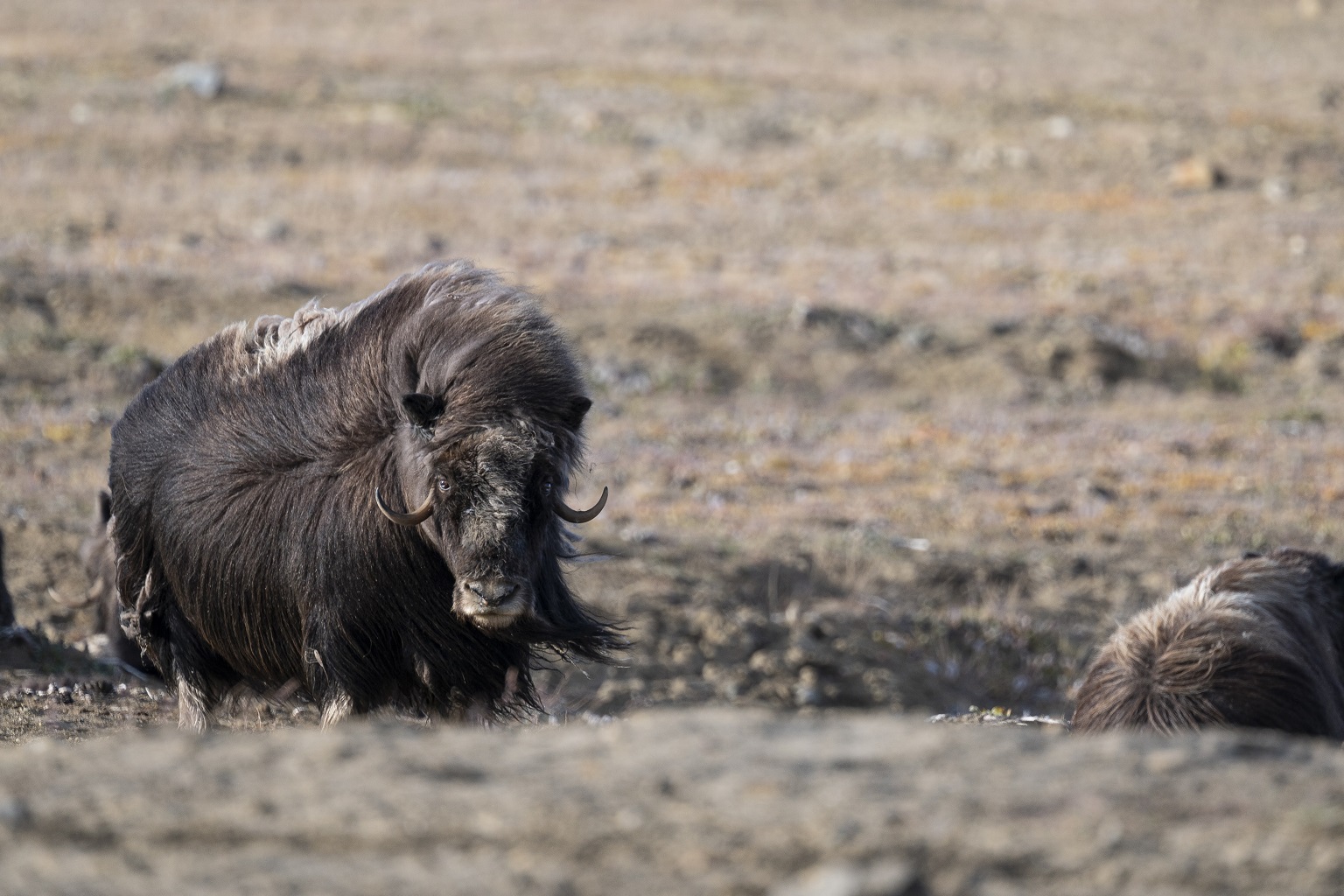
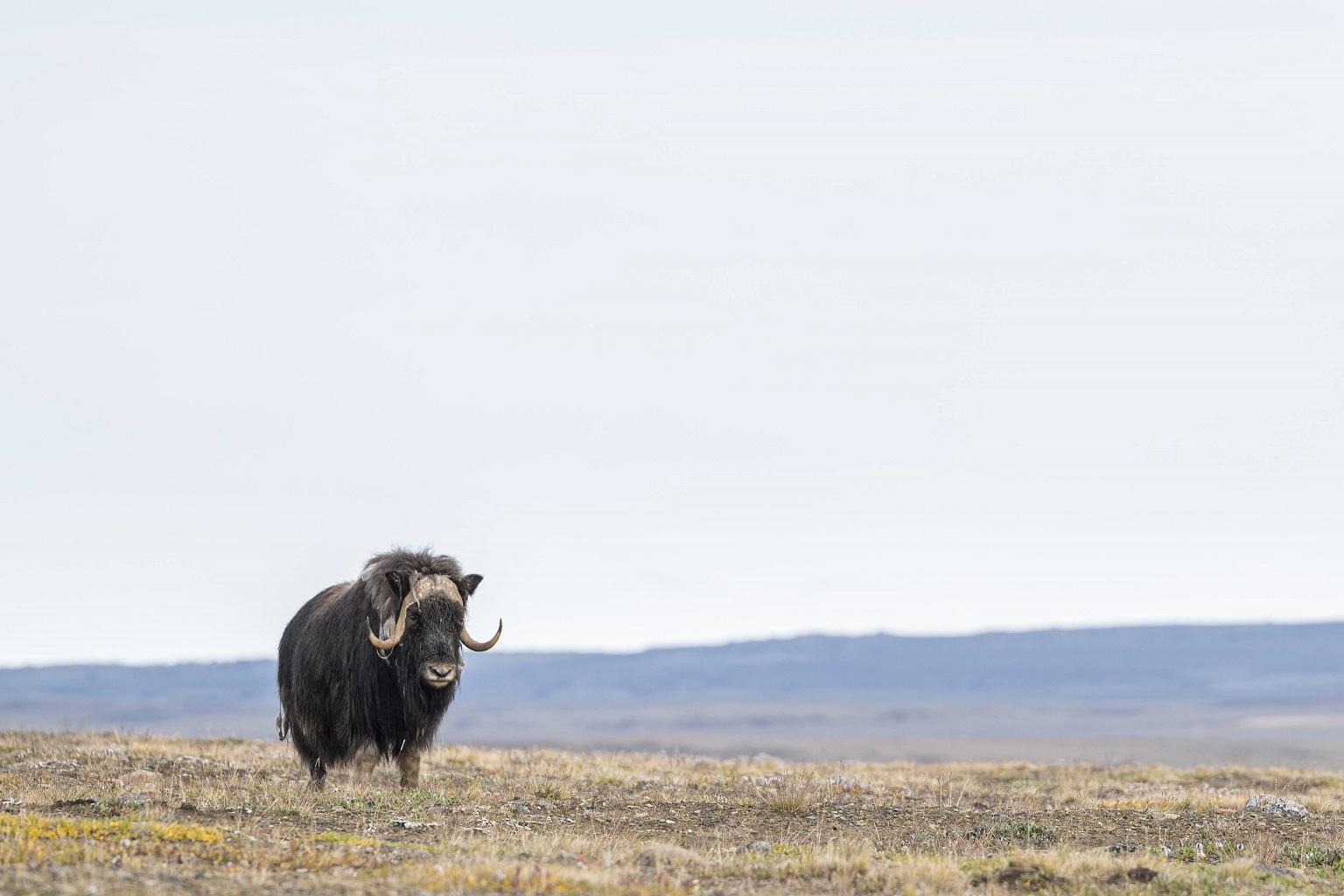 A lone muskox on Ellesmere Island. The Arctic is warming nearly four times faster than the global average. Muskoxen are susceptible to heat stress, with microorganisms in their rumen being very sensitive to changes in temperature. As well, climate change is bringing more “rain-on-snow” and freezing rain, conditions which make it difficult for muskoxen to feed. Image courtesy of McCaide Wooten.
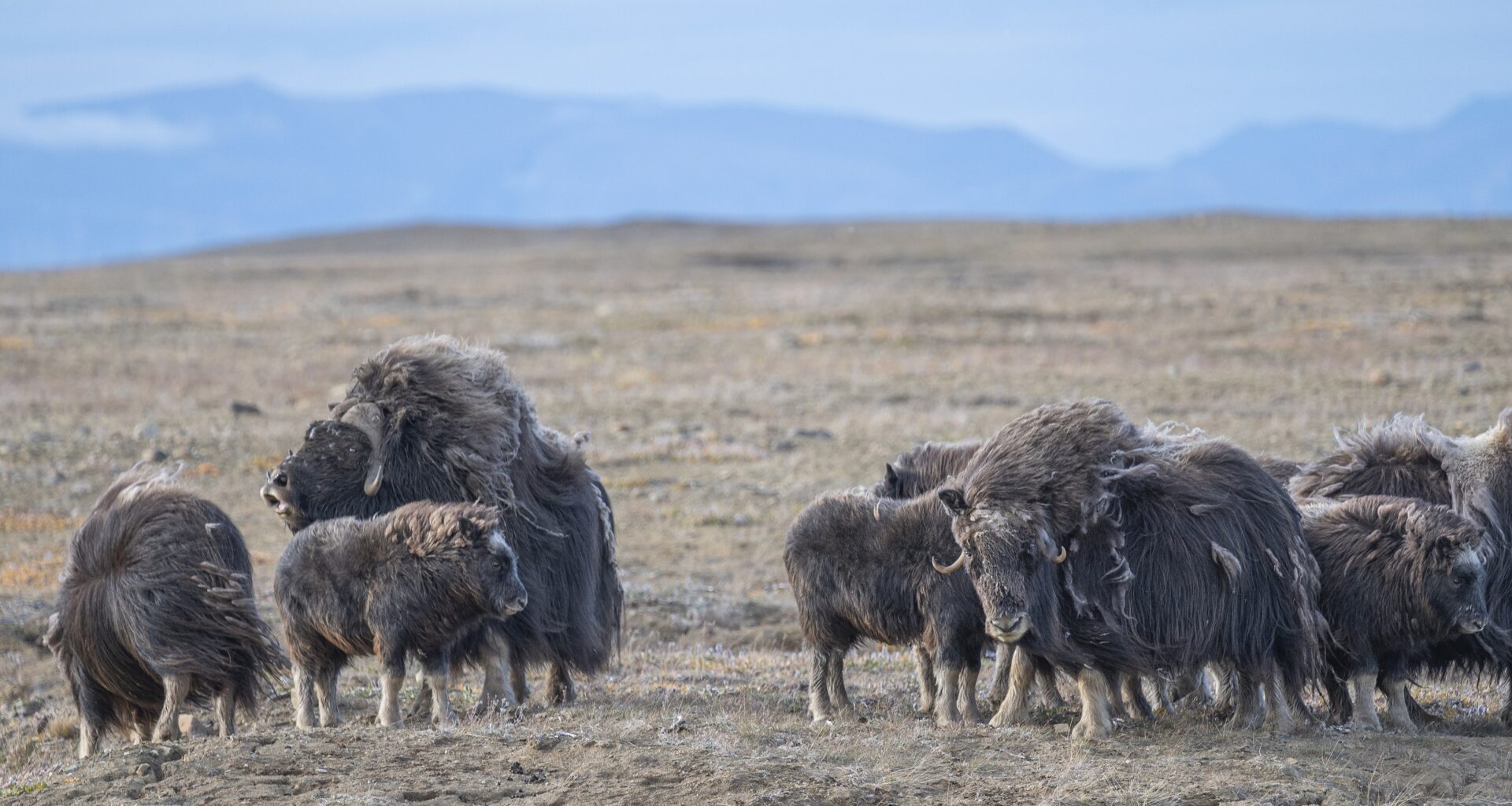
Banner image: Muskoxen on Ellesmere Island. As a species, muskoxen have been around for a million years and are often called “ice-age survivors.” Though they have one of the lowest levels of genetic diversity of any mammal, the full suite of immune-related genes are intact in the species, says muskox expert Anne Gunn. Image courtesy of McCaide Wooten.
Citations:
Ferguson, M. A. (1992). Status and trends of Rangifer tarandus and Ovibos moschatus populations in Canada. Rangifer, 12(3), 127-141.
https://septentrio.uit.no/index.php/rangifer/article/view/1017
Forde, T. L., Orsel, K., Zadoks, R. N., Biek, R., Adams, L. G., Checkley, S. L., … & Kutz, S. J. (2016). Bacterial genomics reveal the complex epidemiology of an emerging pathogen in arctic and boreal ungulates. Frontiers in Microbiology, 7, 1759.
https://www.frontiersin.org/journals/microbiology/articles/10.3389/fmicb.2016.01759/full
Wooten, M. T., Forde, T. L., Roberto-Charron, A., Fredlund, M., Mullin, T., Christensen, O. A., … & Kutz, S. J. (2025). Erysipelothrix rhusiopathiae clone reemergence in association with a multi-year mass mortality event in high Arctic muskoxen (Ovibos moschatus). Scientific Reports, 15(1), 43135. https://www.nature.com/articles/s41598-025-27316-y.pdf
Kutz, S. J., Hoberg, E. P., & Polley, L. (2001). A new lungworm in muskoxen: an exploration in Arctic parasitology. Trends in Parasitology, 17(6), 276-280. doi:10.1016/S1471-4922(01)01882-7
Aguilar, X. F., Mavrot, F., Surujballi, O., Leclerc, L., Tomaselli, M., & Kutz, S. (2024). Brucellosis emergence in the Canadian Arctic. One Health, 18, 100712. doi:10.1016/j.onehlt.2024.100712
Carter, N. A., van Luijk, N., Dawson, J., Parker, C., Grey, K., Provencher, J., … & Wesche, S. (2025). Niqivut (our food)—dimensions of Inuit country food harvesting and significance in Arctic Canada: bountiful, seasonal,“soul food”. Arctic Science, 11, 1-15. doi:10.1139/as-2024-0007
Rantanen, M., Karpechko, A. Y., Lipponen, A., Nordling, K., Hyvärinen, O., Ruosteenoja, K., … & Laaksonen, A. (2022). The Arctic has warmed nearly four times faster than the globe since 1979. Communications earth & environment, 3(1), 168. doi:10.1038/s43247-022-00498-3
Berger, J., Hartway, C., Gruzdev, A., & Johnson, M. (2018). Climate degradation and extreme icing events constrain life in cold-adapted mammals. Scientific Reports, 8(1). doi:10.1038/s41598-018-19416-9
Kafle, P., Peller, P., Massolo, A., Hoberg, E., Leclerc, L. M., Tomaselli, M., & Kutz, S. (2020). Range expansion of muskox lungworms track rapid arctic warming: implications for geographic colonization under climate forcing. Scientific Reports, 10(1), 17323. doi:10.1038/s41598-020-74358-5
FEEDBACK: Use this form to send a message to the author of this post. If you want to post a public comment, you can do that at the bottom of the page.
