
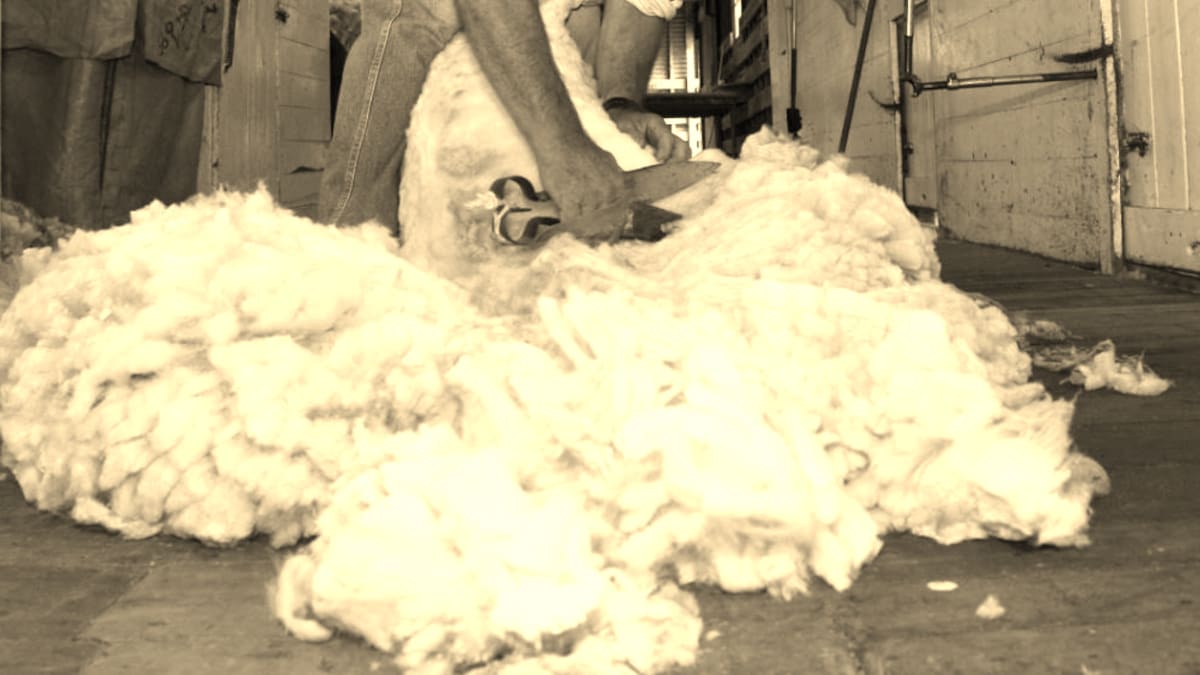
It also introduced a curious note into what was otherwise a serious dispute.
At the same time, the Arbitration Court sought to restrain wage increases for shearers, reflecting wider efforts to hold the line on labour costs in the agricultural sector.
Below are two items on shearers’ pay from 1910, an article from The Colonist, and a letter to the editor of the Poverty Bay Herald.
Shearers and all-wool clothing
(Special to “The Colonist.”)
Christchurch, August 8.
Colonist, August 9, 1910
A prominent member of the Shearers’ Union gave a Timaru reporter particulars regarding an interesting suggestion.
He said if the sheep owners granted the men’s request and raised the rates for shearing to 20s per 100, then the executive would favourably discuss a proposal that its members should wear nothing but all-wool clothes.
He remarked that judging by the attitude of the men, they were thoroughly in accord with the idea, and if things went well he was certain they would carry it out to a man.
The shearers, he said, were like every other class of worker; they were prepared to stand by those who stood by them.
Shearers’ pay
(To the Editor of the Herald.)
Poverty Bay Herald, September 28, 1910
Sir. — The representatives of the Shearers’ Union seem to be getting a fairly general slating in the press for the move they have taken with regard to shearing rates for the coming season.
An award has been made by the Arbitration Court which does not quite meet the workers’ views, and they declare their intention of abstaining from shearing under it.
As the comparatively small body of competent shearers makes a living at other work during the greater part of the year, it seems quite out of place to find fault with them for this action.
Shearing is a luxury which most men, including nearly all sheep owners, find it good to leave severely alone.
Should the regular shearers decide to lead the simple life this season, and forego their accustomed tour, most of them will probably be as well off in health and pocket as they would be if they endured their usual summer torture.
That sheep farmers will be seriously hampered is absolutely certain, for good and fast shearers are not made at a day’s notice.
This matter of shearing rates receive a much greater degree of public attention than the paltry amount involved calls for.
Sheepfarming is an industry which, considering the wealth derived from it, and the quantity and in many cases the quality of the land used, pays a ridiculously small portion to labor, even at the fairly high wages prevailing in this country.
It is, therefore, hard to see why the public should be asked to support the sheepfarmers in a dispute over a prospective increased cost in no case amounting to more than 2s 6d per 100 sheep.
This might mean an extra burden imposed on the best sheep country of one whole penny per acre.
Should trouble, as seems at present not unlikely, ensue over this princely sum, and the attention of the outside world be directed, as directed it will be with absorbing interest, to New Zealand, what a magnificent advertisement for this country.
New Zealand, the land without strikes, the land crying for population, the ideal home for the settler, with her leading industry, which monopolises most of her boasted rich territory, fighting over a penny an acre.
Much wiser to agree without murmur to the terms asked by the shearers, which, after all, were in no way unreasonable.
They have every right to better pay and conditions than they obtained some years since.
The income from sheep country has enormously increased during the last five years.
The cost of living has also increased considerably.
The value, or, let us rather say, the sum demanded and paid for land has gone sky-high — sheepfarmers and would-be sheepfarmers have been falling over each other in their eagerness to pay 100 per cent more for land which is very unlikely to increase in productiveness.
Prices, which mean an extra annual charge to rent or interest of at least 5s per acre, have often been paid for country which cannot possibly be used for anything else but sheepfarming.
Why, then, blame working men for demanding an extra penny an acre from the land, especially as it is not necessarily a fixed charge, while the landlord or the money-lender is bound to have his pound of flesh, come what may.
This inflation in value, too, has rendered it much more difficult and expensive to secure land of any kind.
Men who do any kind of work connected with land should therefore be able to earn more money than they did when land was cheaper and in less demand if they are to have the same opportunities as they had ten years since.
We know that shearers often make very high wages, but that is beside the matter.
It is the small number of men that a huge tract of sheep country supports that is the worst feature of this industry, and sheepfarmers should receive no sympathy in this paltry squabble.
Hoping that this may not unduly trespass on your space. — I am, etc., CINCH.
– Source: Papers Past