
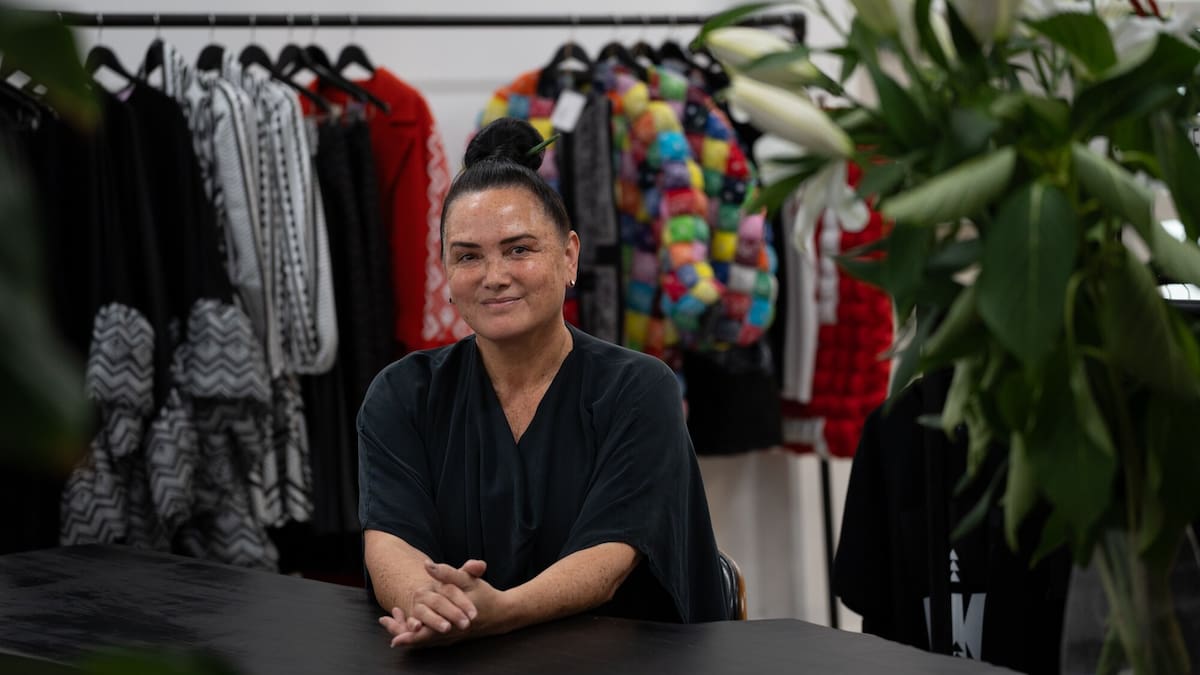
The face of brick-and-mortar shopping is changing. Madeleine Crutchley visits the people behind three local businesses reinventing the sensibilities of department stores with a real purpose.
Many culprits have been blamed for the so-called demise of department stores – generational shopping habits, the growth of
online retail and difficult economic conditions.
Beyond these retail giants, there are local, brick-and-mortar retailers and designers responding to the way customers want to shop. They’re adapting sensibilities of the department store – browsing multiple brands across islands, considering clothing, homeware, art and accessories in one space, consulting grand displays – to suit 2026.
It’s encapsulated in the smallest of moves: this month, Ponsonby’s luxury retail boutique The Shelter picked up designs from Twenty Seven Names (which shuttered its only Auckland store in January), as well as pieces from established and upcoming designers at underground fashion week Te Wiki Āhua o Aotearoa.
Rose Hope and Sarah Firmston, co-founders of Crushes, in their corner Karangahape Rd boutique. Photo / Anna Heath
There have been bigger moves, too: following Crushes’ shift to the corner boutique on Karangahape Rd, its team are set to welcome Thea Matcha into their space and are calling out for tailors, florists, artists and other makers who want to share it.
What model are local retailers, designers and creatives turning to during economic hardship? And why does it matter for customers in New Zealand?
The Keep
For Lela Jacobs, a studio and retail space called The Keep came as a need for change.
The designer was living in an Auckland granny flat and trying to make the small space work “in a crazy way” for her fledgling eponymous label. Jacobs remembers placing a piece of plywood over her mattress to cut materials, and then pushing it aside to sleep.
The set up wasn’t working, so when she visited a historic site going up for lease on Karangahape Rd, she took a leap. Jacobs ran the space as The Keep, enjoying momentum for her own label. But it was a lot to do solo. The many shifts of 2020 revealed more demand for change.
“It was a lot of stress around that time, and I was like, do we keep The Keep? I didn’t want to lose it. It was just too much of an important space.”
The Keepers huddle at their NZFW show.
The answer was to welcome in a collective. The Keep was a site of collaboration for years, and designer Wilbur Hsu had previously signalled interest in the retail model to Jacobs. The two worked to bring other designers into the space – so far, the studio has hosted Emma Jing, Shannen Young and Julianna Jung of Outerlines, among others.
Now, The Keep hums as a collective open showroom. The makers, or “Keepers”, share studio space, lend tools to each other and gather for both gossip and artistic advice.
Each maker is assigned a day to look after the shop, managing the retail trade out the front. It’s taking the pressure off Jacobs and running well: The Keep has just signed the lease for two more years and they’re looking for another maker to join the collective (Rudy hasn’t mastered the sewing machine just yet).
For jeweller Grace Nosworthy, The Keep is infrastructural.
“The really important thing that I found being a [young] maker or creative in New Zealand is that so many creatives leave because there’s nothing here.
“Lela is making this beautiful creative venture for younger makers and I think it also shows other young people ways to be creative here when it’s not conventional.”
The collective also strengthens belief in her work during hard times.
“I’ve been like, ‘oh, I just don’t know if I can do it anymore.’ And someone was like, ‘It’s really great you’re here because you’re taking a chance on yourself.’ Things like that have really stuck with me.”
A runway look from The Keep’s show at Goblin.
And The Keep has impact in our local fashion scene. Last year, as a part of New Zealand Fashion Week, The Keep sold out two back-to-back runway shows at Ponsonby bar Goblin – pieces from all the Keepers were showcased together in a show scored by a theremin. The moment celebrated the surrounding community and showcased the platform in action.
For Jacobs, adaptation has been non-negotiable in remaining open to both makers and customers.
“Unless you’re heavily financed [and] secure, it’s quite impossible to – over the last five or six years – have been running.
“That’s not incredibly romantic but it’s just honest. If you want to keep going then you have to be really smart about how you’re going to do that.”
Gemini Vintage & Dead Man Vintage
A short walk down the road, another two creatives have adopted a similar model.
The blushing boutique houses Helen Olivia Anstis of Gemini Vintage and Kate Buckley’s Dead Man as roommates. A metaphorical line of tape divides the shop into two – separating their collections of New Zealand and international vintage clothing and accessories (eagle-eyed customers will notice the handpainted signage on the window corresponds to each clothing collection).
Helen Olivia Anstis and Kate Buckley, owners of Ponsonby boutique Dead Man and Gemini Vintage. Photo / Sylvie Whinray
The antiquarians first met, they think, in the mid-2000s – Anstis was studying fashion and Buckley was working in film and costume – before both moving to different parts of the US. They reconnected through the Central Flea Markets.
After some “sleuthing” online, Anstis came across the boutique on Great North Rd. The two vintage sellers opened the store in September.
“So we share the space, the overheads, the time,” Buckley says.
“We keep each other motivated and we keep each other creative and we deal with the highs and lows together.”
They each work three days in the shop and share in the need to balance other priorities.
“She’s a mum as well. That’s quite important to me because I have a little kid – she’s sympathetic to that,” Anstis says.
Buckley previously ran Dead Man Vintage in a shop on Ponsonby Rd.
“That whole model of being locked into a really expensive lease and having to pay that rent every month and struggling and if it’s quiet, you’re kind of ruined. It’s just too much in this climate.”
DIY shelving in the Ponsonby boutique. Photo / Sylvie Whinray
The duo took a DIY approach to the fit-out (with the help of family, friends and local makers). They painted the walls a signature pink, learned to thread industrial metal pipes to create racks, built shelves from recycled wood and sewed a lush changing room curtain. The window displays, like a traditional department store, are a big focus.
“We’ve tried to keep it local and recycled to fit in with the ethos of the businesses as much as we can.”
Sharing the space means their collections, usually reserved for markets and online sale, can be accessed by customers at a brick-and-mortar space. They’re both excited to connect with customers and tell the stories of local designers like Marilyn Sainty and Doris de Pont.
Items from the shared collections. Photo / Sylvie Whinray
“Young girls were trying on this [1950s cotton dress], which makes me really happy. They’re, like, 22,” says Anstis.
“That’s stuff that could easily just be in a trunk somewhere or thrown away. To see these young kids come in and buy that stuff, which is 75 years old, is really amazing.”
The Kāhui Collective
Further east, designer Kiri Nathan (Ngāpuhi, Ngāti Hine, Ngāti Maru, Ngāti Hau) is building a crucial point of connection.
In 2017, Nathan founded the Kāhui Collective following a trip to China with five Māori fashion designers – Adrienne Whitewood had asked for some advice in contacting fabric manufacturers and Nathan saw the opportunity for knowledge-sharing.
Kiri Nathan in the new Kāhui Collective store. Photo / Anna Heath
“Initially, the reason that I founded the collective was to build a community. So everyone could share and support each other, because that didn’t exist in the New Zealand fashion industry at the time at all – in any aspect, let alone support for Māori and Pasifika brands.”
Commercial viability for designers, Nathan says, has always been a keystone of the project. In Glen Innes, Nathan is building the permanent location to support it.
The Kāhui Collective toi whakarakei, which Nathan also calls a department store, brings more than 20 designers together under one roof (the goal for the finalised fit-out is 40). Labels include Czarina Wilson, J’ake, Katherine Anne, Temesia.Co, Ivonn, Kaistorst, ARDC and Mitchell Vincent.
The store is currently open, though the fit-out is continuing. Photo / Anna Heath
Within the space, Nathan looks to communicate a firm sense of purpose and place. The space is dressed with tino rangatiratanga kara (flags) and taonga sit behind windows recycled from state housing demolished around Glen Innes.
“We’re in it to shift the space so that Māori, Pacific and indigenous fashion lives and is normalised within the context of the New Zealand fashion industry and the global fashion industry.”
Nathan says the space, which is currently open Thursday, Friday and Saturday, encourages connection between fashion and culture (clothing racks will be punctuated with information tiles about each designer’s kaupapa).
Shona Tāwhiao’s harakeke design is elevated in-store. Photo / Anna Heath
An official launch is scheduled for the end of April, but Nathan has already toured visitors from around the country through the space.
“There were people travelling from the South Island, Far North, all over Taranaki to come here so they could experience it … I don’t think that happens very often in a fashion store. I think people understand the importance of this space being the first of its kind.”
“We talk about the revitalisation of te reo Māori and the only way our language will survive is if everyone is speaking, not just Māori, everyone. It’s the same with kākahu Māori. If everyone is buying and wearing it, then it will survive.”
More local fashion
From city-centric style to slow fashion practices.