
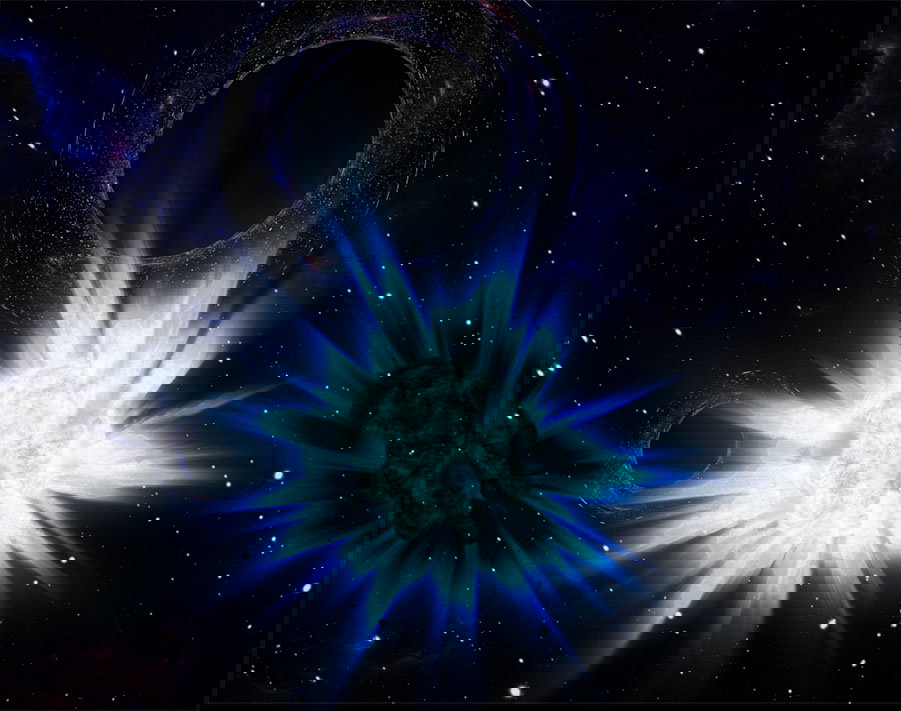
Gravitational waves reveal an explosive “forbidden range” of stellar destruction so powerful that not even a black hole can emerge from these stars’ final moments.
Published in Nature, a new international study led by Monash University identifies evidence of these extremely rare stellar explosions in gravitational wave data collected by the LIGO-Virgo-KAGRA observatory network.
While most massive stars collapse into a black hole after their explosive ends, these gravitational waves tell the story of an end so destructive that nothing remains, resulting in what astronomers call a pair-instability supernova.
The End of Stars
Defying the typical creation of a light and matter-eating black hole, pair-instability supernovae are even more powerful explosions than those normally produced in the death of a massive star. Instead of warping spacetime into the extreme density of a black hole, the star is completely disrupted, with nothing left behind.
Pair-instability supernovae were first predicted by Fred Hoyle and William Fowler back in 1964, yet observing the rare phenomena has remained elusive. Beyond how uncommon such an event is, they are extremely challenging for astronomers to distinguish from the typical supernovae, which produce black holes.
Reading Gravitational Waves
Gravitational Waves carry a record of cosmic events, bringing knowledge of the universe, distant in both time and space, as they travel long and far before reaching our instruments. From observations recorded by the LIGO-Virgo-KAGRA observatory network, astrophysicists can decode these ripples in spacetime.
In this instance, researchers uncovered information regarding black holes and identified an example of the rare “forbidden range” of extremely large black hole masses. The problem with black holes in this range is the scale of cosmic events involved. Massive stars produce massive black holes, yet at a certain critical range, those stellar masses produce an explosion that completely destroys the star instead of causing it to collapse into a black hole.
“The observation is well explained by pair instability; there are no stellar-origin black holes in the forbidden zone because stars are undergoing pair-instability supernovae,” said lead author Hui Tong, a PhD candidate from Monash University’s School of Physics and Astronomy and the ARC Centre of Excellence for Gravitational Wave Discovery (OzGrav). “The only black holes in this mass range are made from merging smaller black holes, rather than directly from stars.”
Gravitational Waves Don’t Reveal What’s Above the Gap
“Stars above the range (if such massive stars exist) are expected to directly collapse into black holes again. Stars need to carefully balance the gravity that is pushing in with their shining light that pushes out against gravity,” co-author Dr. Maya Fischbach told The Debrief. “Above a certain mass, stars experience a “pair instability,” where the core of the star is so hot that the light that is pushing out against gravity decays into pairs of electrons and positrons.”
“This causes gravity to temporarily win, and the star suddenly contracts. If the core of the star falls into the ‘forbidden range,’ this sudden contraction causes the oxygen in the star’s core to explosively ignite, and the entire star explodes like a nuclear bomb,” Fischbach continued. “If the star is above the range, the extra energy goes into ripping apart the atomic nuclei that make up the star, rather than exploding it. In this case, gravity permanently wins, and the star collapses into a black hole.”
Gravitational Wave Confirmation
“We are seeing indirect evidence of one of the most titanic blasts in the cosmos: pair-instability supernovae. At the same time, we are finding that once they are born, black holes can grow via repeated mergers,” Fishbach said.

“It’s a cool result because we are using black holes to learn about the nuclear reactions inside stars,” said Professor Eric Thrane, Chief Investigator at OzGrav. Going forward, the team says that additional data confirming the gap would provide important insights into black hole formation and, more fundamentally, new insights into the dynamics involving the universe’s most massive stars.
The paper, “Evidence of the Pair-Instability Gap from Black-Hole Masses,” appeared in Nature on April 1, 2026.
Ryan Whalen covers science and technology for The Debrief. He holds an MA in History and a Master of Library and Information Science with a certificate in Data Science. He can be contacted at ryan@thedebrief.org, and follow him on Twitter @mdntwvlf.