
Kralicek estimated it would take three years to produce a biosensor chip that could replicate the receptor proteins that insects use for their super-sense of smell.
In the event, it took 20 years. But by 2023, he had a prototype that was good enough to attract $3.5 million in funding from the Bill and Melinda Gates Foundation, which saw potential for the technology to detect malaria.
The Scentian Bio team.
Kralicek said it would take another two years, from that point, to get the technology to the market.
This time, he was right, or as close as you get to it in the timelines of early-stage companies.
Scentian Bio, the start-up that the veteran Institute of Plant and Food scientist founded with one-time Fonterra business development manager Jonathan Good in 2020, is now just months away from commercialisation.
Scentian Bio’s “digital nose” currently takes the form of a palmable sensor on a chip gadget. Its founders see it being one day built into every phone.
To get it over the line, the start-up has just raised $7m in an over-subscribed “pre-Series A” round led by Icehouse Ventures, which now holds a 19% stake after also supporting an earlier seed round.
The raise was also supported by new investors Cultivate Ventures and New Zealand Growth Capital Partners, through the Crown agency’s Aspire fund.
Existing investors Toyota Ventures, Booster, DYDX Capital and Sir Stephen Tindall’s K1W1 also chipped in more funds.
Kralicek’s employer for 19 years of his research, Plant and Food (now part of the New Zealand Institute for Bioeconomy Science), holds an 18% stake.
Scentian Bio chief science officer Colm Carraher.
Kralicek’s goal remains a “digital nose” in every phone, with taste and smell receptors rounding out the five sensors (given your iPhone or Android can already see, hear and sense touch).
But the immediate future is a corporate play, detecting food and beverage quality.
“We’ve got pilots with seven leading global food companies,” Good tells the Herald.
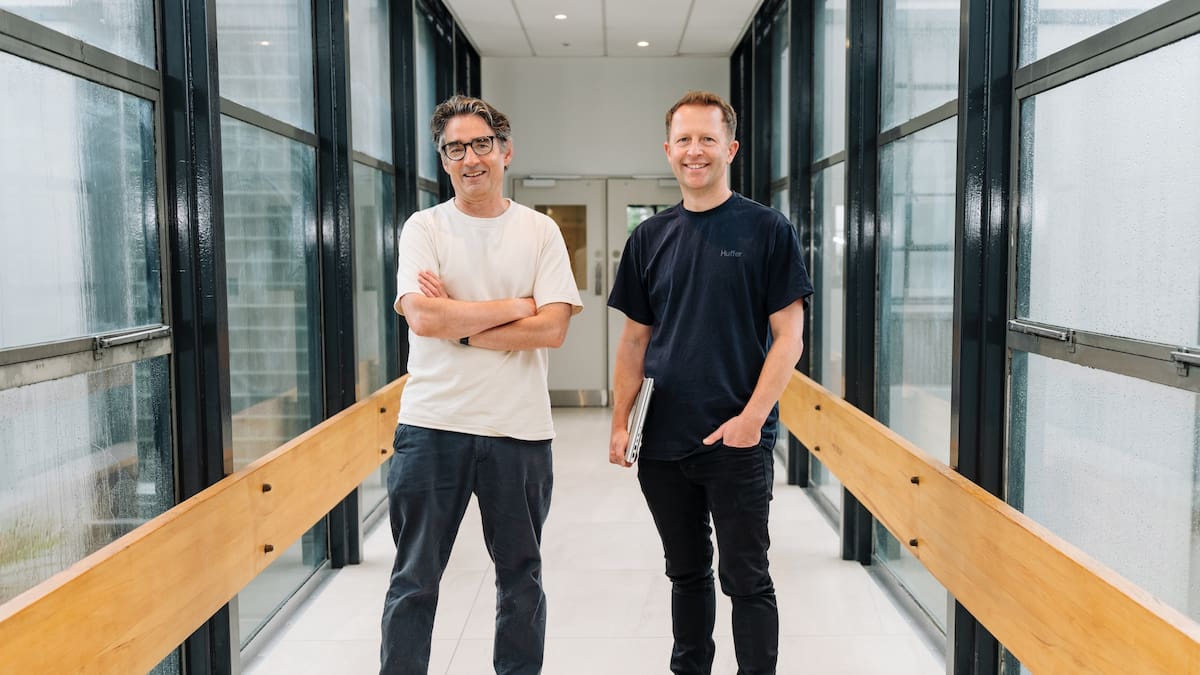
Scentian Bio cofounders Jonathan Good (left) and Andrew Kralicek.
These include: “Food and flavour firms and global leaders in spices and condiments, as well as beverages.”
For food manufacturers and ingredient suppliers, quality issues that show up late can trigger waste, rework, recalls, disputes and reputational risk, Good says.
Kralicek says every organism produces volatile organic compounds (VOCs) – or what most of us would simply call smells, if we could detect them all with our human noses.
There are more than 2000 volatiles on your breath, he says.
There are already sensors that can detect the bad odours that indicate food spoilage and more.
“But they’re either too slow so can’t provide an answer in real time, or not accurate enough because they don’t have the sensitivity or selectivity required, and if they are accurate, they’re hard to access because they’re large machines housed in centralised labs, needing an expert with a PhD to not only run the machine, but also to interpret the data.”
Scentian Bio’s sensor on a chip, on the other hand, can be held with two fingers.
And you don’t need a doctorate to interpret the results. They’re processed in minutes by artificial intelligence (AI).
Kralicek says his eureka moment came when he realised how to replicate insect protein receptors, honed over 400 million years of evolution, on a chip.
He says the accuracy is down to “parts per quadrillion. That’s equivalent to one drop of water in 20,000 Olympic-sized swimming pools. So when we attach insect olfactory receptors to sensors, they are 1000 times more sensitive than a dog’s nose and nose, and a million times more sensitive than the human nose”.
But while the system was incredibly sensitive to volatile organic compounds, it also had to be taught what each combination of VOCs actually meant. That’s where AI training came in. Scentian’s system can now detect and interpret smells that no insect would normally encounter in its lifetime.
Dr Andrew Kralicek (left) spent two decades at the New Zealand Institute for Plant and Food, researching the technology that would become Scentian Bio (the institute holds an 18% stake in the start-up). Jonathan Good’s former roles include business development for Fonterra, chief digital officer for Auckland Airport and chief technology officer for Turners and Growers.
Scentian is initially focused on food, but the underlying sensing technology also has applications across human and environmental health. Technologies with that breadth of application are rare, and it will be exciting to see how this ‘digital nose’ develops,” Icehouse Ventures principal Bex Gidall says.
Its initial food and beverage quality monitoring market is worth around US$8 billion a year.
Good says: “There are lots of other verticals, lots of opportunities.”
Gidall says they include pest detection, disease diagnosis, explosive detection and air quality monitoring.
Scentian uses sensors on a chip to create a “fingerprint” of a captured combination of volatile organic chemicals (or “smells”), which an AI-powered algorithm then analyses.
Could we all be wearing lapels with Scentian Bio sensors built-in, one day?
“Or you could just point your phone in the direction of what you want to analyse,” Kralicek.
That could be some street food in a developing country.
“Or it could be your smart watch tracking metabolites in your sweat.” (Metabolites are molecules produced when food, drugs or bodily tissues break down, and can signal if you’re healthy.)
Chris Keall is an Auckland-based member of the Herald’s business team. He joined the Herald in 2018 and is the technology editor and a senior business writer.