
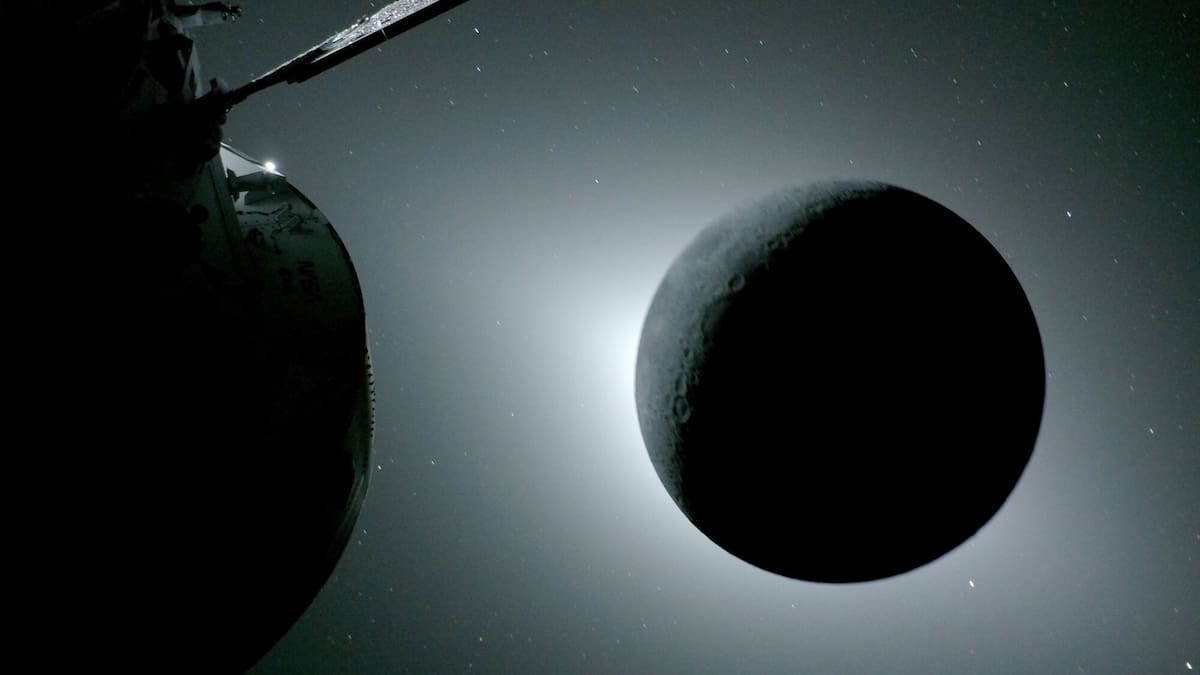
The crew has flown more than 400,000 kilometres from Earth on the astronauts’ historic voyage around the far side of the moon.
New images have been released from the historic journey taken by Nasa’s Artemis II crew, who have ventured farther from Earth than any humans before.
The photos were
released hours after the crew of Nasa’s Artemis II mission broke a record, zooming more than 248,655 miles (400,171km) from Earth in a voyage around the far side of the moon.
The heavily cratered terrain of the eastern edge of the South Pole-Aitken basin is seen with the shadowed terminator – the boundary between lunar day and night – at the top of the image. The South Pole-Aitken basin is the largest and oldest basin on the moon, providing a glimpse into an ancient geologic history built up over billions of years. Photo / Nasa
A view of a backlit Earth as seen through the Orion spacecraft’s window, photographed by Reid Wiseman, commander of Artemis II, on April 2, 2026, after completing the translunar injection burn. Photo / Nasa
Commander Reid Wiseman peers out the window of the Orion spacecraft as his first lunar observation period of the day begins on April 6. Photo / Nasa
Artemis II mission specialist Christina Koch looking back at Earth through the window of the Orion spacecraft on April 2, 2026. Photo / Nasa
‘It is blowing my mind’
Earth draws closer to passing behind the moon in this image captured by the Artemis II crew during their lunar flyby, about six minutes before Earthset. Earth is in a crescent phase, with sunlight coming from the right. The dark portion of Earth is experiencing nighttime. On Earth’s day side, swirling clouds are visible over muted blue in the Oceania region. Photo / Nasa
The original ‘Earthrise’ photo, taken by astronaut William Anders during the Apollo 8 mission in December 1968. Photo / Nasa
SaveShare this articleCopy LinkEmailFacebookTwitter/XLinkedInReddit