
Perfect Teeth
Season 1
Episode 2
Editor’s Rating
3 stars
***
Agnes officially enters womanhood, and suddenly her life starts to change in rapid succession.
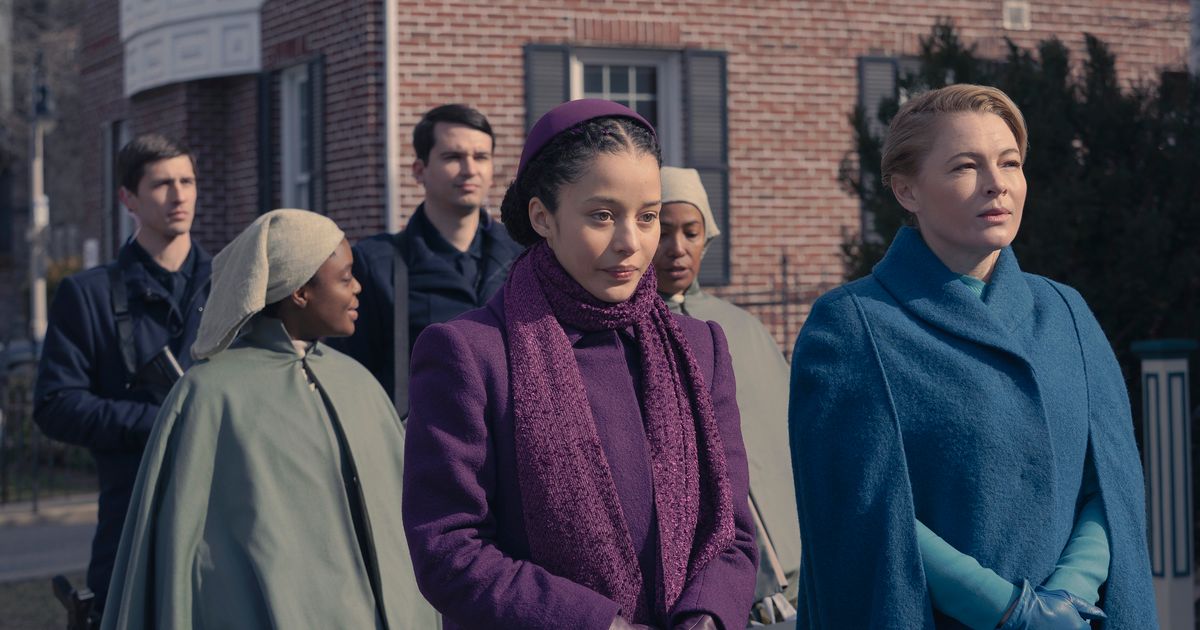
Photo: Russ Martin/Disney
“It’s starting to move very, very fast,” Agnes’s best friend, Becka, told the Plum girls in the cafeteria back in “Precious Flowers.” At first, it’s just your period. Then it’s teeth-whitening appointments and dancing lessons. It’s fittings for your new green wardrobe, tailored to best show off your burgeoning female attributes. Finally, it’s a husband, chosen for you by your father. He could be a neighbor or a stranger from the other side of the country. He could be a Commander or a doctor. He could be a kind, God-fearing man like your own dad, or he could be a total monster. There’s a non-trivial chance that a young Plum’s new husband will be pretty old.
Still, in this world of eroding fertility, Plums like Becka and Agnes can’t take for granted that they will blossom at all. They’ve been taught that a woman’s period is a reward for the goodness of the girl she used to be. God has selected her, specifically, as a candidate for motherhood. When Agnes sees her blood-stained underpants, she’s as ecstatic as she is scared. Changes are coming; events beyond her control. Gilead girls don’t receive a science education, so Agnes can’t understand that she’s swimming with hormones right now. She doesn’t know that a girl can be under the influence of anything but her father and the soul God gave her.
Menarche in Gilead is accompanied by a clichéd series of initiation rites. First, the girls learn a prayer, which they must deliver at the feet of their parents and the Aunts on the blessed day. (Later, the Aunts inspect the girl, just to make sure she’s not fibbing.) At school, the bleeding girl gets to run up the spiral staircase to the bell tower and pull the heavy rope. The rest of the students, excited at the sound of the gonging, immediately congregate on the front lawn, where they wait for God’s special vessel to descend the tower and reveal her identity. Agnes erupts into laughter as she tugs the bell rope over and over again on her big day. The irony, of course, is that she’s never looked more like a little girl.
But that’s no longer how she’ll be seen in Gilead, where menarche equals eligibility. Rosa, Agnes’s favorite Martha, makes Agnes her first cup of coffee that morning: “Isn’t that what women drink?” Agnes wonders to herself, in increasingly ponderous narration, if other people will notice the difference in her today. Will men notice? Garth, who chauffeurs Agnes around and looks more like the lead singer in a boy band than a Guardian, seems to have caught Agnes’s attention. If he doesn’t catch the glimmer in her eye, he’ll surely notice the green and purple brooch that the newly marriageable Plums affix to their lapels.
Getting her period moves Agnes closer to the world of womanhood, and it pulls her away from her fellow Plums, who draw Agnes into a scrummy, excited group hug in the schoolyard after it’s revealed for whom the school bell tolls. At lunch, rabidly curious Hulda offers Agnes her spare meatloaf, for the iron and flavonoids. She asks Agnes to rate the level of soakedness of her maxi pad. Jealous Shu swears that her own breasts are a little swollen these days, so her period must be imminent. “My father always said I was blessed in that department,” she adds, betraying no hint of scandal.
I suppose there is no scandal in commending your own daughter’s perky rack in a state that reveres women’s bodies without respecting women. Here, working wombs are the most precious commodity on earth, which makes men — the holy protectors of wombs — the most important beings on earth. Later, when stepmom Paula takes Agnes to the dentist, who is also Becka’s father, he lightly fondles his daughter’s best friend as he lays the protective X-ray apron across her chest. He knows he doesn’t need to pretend that the brush of his hand is an accident. He’s done this to hundreds of Plums. Maybe thousands. It may not be “allowed,” but Agnes’s body is his body, too.
The Plums are still in the cafeteria, chatting about all things menstrual, when the Aunts haul them to the side of school reserved for the Aunts’ stale quarters. (There’s a lot of hauling on Testaments.) The Aunts’ quarters are also where the ominously named “corrections” take place. Daisy, mistakenly believing that Agnes intended to rat her out for last episode’s blasphemy, turned herself in first. How pious. Now, the Plums are expected to dole out Aunt Vidala’s punishment in a classic call-and-response. When Vidala says “dirty words come from …,” the rest of the Plums shout “dirty girl” in Daisy’s face until she breaks. It takes an unimpressive 12 seconds of ritualistic berating before Daisy takes Agnes down with her: “She was there!” I guess Shu was right when she warned Agnes against Daisy — you really can’t break the law with a Pearl Girl. Vidala pushes Daisy and Agnes into the bathroom, where the girls are forced to wash out their own mouths with ashy homemade soap and horse tooth brushes.
Initially, the pageantry accompanying Agnes’s first period and the pageantry of Daisy’s punishment struck me as contradictory. The Plums showered Agnes with love, and an hour later, they were shouting hate at a person they hardly knew. But both are spectacles of repression — the Aunts using girls to control each other through envy and scorn. Gilead has perfected the art of weaponizing women against each other to the point that they crave it. When Agnes says, in her retrospective voice-over, “I’m ashamed of how much I miss it,” she’s not talking about the moments of sisterly communion. She’s talking about the chances she was given to let her rage.
Daisy does eventually apologize for her treachery, but Aunt Lydia’s buddy system clearly isn’t working. In fact, I’m starting to wonder why Daisy attracted special consideration from Lydia in the first place. She appears to be some kind of spy, and yet she seems totally unsuited to the task. On her second day of school, she alienates the closest thing she has to an acquaintance. That night, another Pearl Girl will catch Daisy as she sneaks around the dorm room at night, scribbling maps with burnt matchsticks and making a racket.
Meanwhile, at MacKenzie Manor, Agnes is in the throes of a distressing nightmare about her wedding night. What’s even worse is — jump scare! — that she wakes up to the sight of Aunt Lydia hovering over her bed. The period parade continues, I’m afraid. Lydia puts a Green cloak over Agnes’s small shoulders and hauls her to the school pool for a candlelit baptism, a secret initiation before an audience of Aunts and the other Plums who are in the process of going Green. I do want more Ann Dowd from Testaments, but this gorgeously shot scene is a retread of what’s come before. We get it! Girls are dirty. Menses is godly. Blessed be the fruit.
“I feel like I’m still drowning,” Becka tells Agnes as she helps her friend dry off after the ceremony. Becka divulges that she doesn’t want a wedding or a husband, but the reality is that there is no other path for a Green. It’s a sin to waste a womb. Agnes claims not to understand, but our girl’s not immune to wanting either. She wants Garth, the Guardian. “Sometimes you couldn’t help but want,” Agnes tells us, in voice-over. “But there was no point to it. All that wanting.” There is so much that is terrible about these girls’ lives but the misery of that line stuck with me: to be on the cusp of adulthood and already convinced of the futility of your own desire.
When Agnes arrives home, her father is back from wherever it is that Commanders go. He’s sitting in the parlor with his Commander friends — no doubt finalizing some nefarious plan — when Agnes walks in in her Green cloak and her wet hair and kneels at his feet to recite the period prayer. When she’s done, the men all shake Commander MacKenzie’s hand. He must be so proud of Agnes. He has raised her to be good enough to be fertile. He, himself, is everything a man in Gilead ought to be: rich and powerful, a husband and a father. Still, his daughter, like all daughters, is just fresh meat to the pervy men in this room who don’t bother to hide their leering.
And one gets the sense that Agnes won’t be on the marriage market for long. Commander MacKenzie appears disinterested in her, and Paula is eager to be rid of her. The evil stepmother has been revealing herself to us in snippets. In episode one, we learned about her hard-scrabble, horsey childhood. This week, Paula lets slip that no one helped her when she first got her period. No one sat down with her and explained how the wings of a menstrual pad work, like she does for Agnes, another woman’s daughter.
Perhaps things would be different for Agnes if Tabitha, the mom who raised her in Gilead, were still alive to protect her. Paula gives Agnes a menstrual pad pouch that Tabitha embroidered for her before she died. (A weird gift, but let’s just assume it’s another ritual.) Holding something that her mother made for her sends Agnes into a twisted reverie. She’s a little girl lying by the water as Tabitha tells her a story about an enchanted castle full of sweet girls under the spell of wicked witches. Tabitha used a magic ring to rescue one girl, and that one girl was Agnes.
Given what Handmaid’s viewers know of Agnes’s arrival in Gilead, the sickly sweet story is nauseating. But still you can hear in it the earnest love Tabitha felt for her stolen daughter. It’s hard to imagine the woman from Agnes’s daydream handing her little princess over to the first old man who offers to make Agnes MacKenzie his second wife. It’s hard to imagine Tabitha sending Agnes off to school on her special day with the stone-cold wisdom that Paula offers, true as it may be. “Womanhood is a lifelong test,” she tells her. Especially in Gilead, where women’s rights have been traded for an endless succession of women’s rites.
Sign Up for the Vulture Newsletter
Entertainment news, for the pop-culture obsessed.
Vox Media, LLC Terms and Privacy Notice