
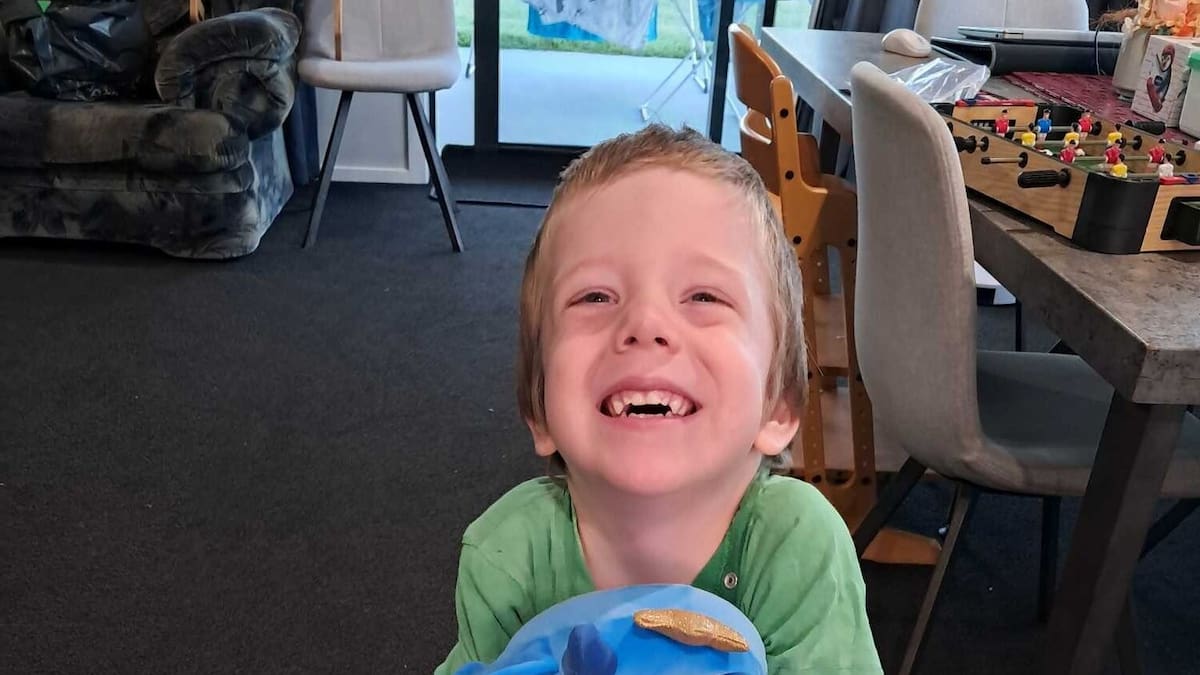
Xavier lives with a combination of rare genetic conditions and cannot tolerate natural sugars, meaning he relies on a feeding tube for nutrition.
“He’s 3 and already has nine diagnoses. Four of those are rare, and two of them you’re not meant to have together,” Dobbs said.
As he approached his first birthday, his mother pushed for a permanent solution.
“He was pulling the [feeding] tube out multiple times a day. His face was raw from the tape.”
”That’s not quality of life.”
She said the public waiting list for the procedure was at least 18 months.
“I couldn’t wait that long.”
The family turned to private health insurance, where the procedure could be done within weeks — but their claim was initially declined.
Dobbs said the device was classified as an implant.
“You can get the diagnosis, you can have the clinical plan, but you’re still fighting to access what your child needs.”
She said the decision made no sense.
“They told me it falls under an implant because it’s not something the body naturally has.
The feeding tube was eventually approved after her surgeon provided further documentation.
Beads representing either anaesthetic, an admission or a test. Xavier is up to 12 general anaesthetic visits.
A fight for basic care
Health New Zealand said waiting times for procedures varied depending on clinical need, with patients prioritised based on urgency.
A spokesperson said clinicians assessed each case using nationally consistent criteria, but demand for some procedures could exceed capacity.
Dr Alison Scott, a paediatric surgeon with the Royal Australasian College of Surgeons, said most children referred for gastrostomy had complex needs and often required multiple procedures under the same anaesthetic.
She said priority was given to children whose treatment depended on the procedure, including those needing cancer care or organ transplants, as well as patients with intestinal failure.
Scott said while gastrostomy improved quality of life, a nasogastric tube could be used as an alternative, though it could be difficult for families to manage.
She said some hospitals were adding additional operating lists to reduce waits, but progress depended on staffing and resources.
Dobbs said one potential medication option for her son was not publicly funded and had to be taken orally, something she said was not possible.
“When your child has an allergy to natural sugars and doesn’t eat orally, how do you give them something like that?”
How coverage is decided
Andrea Brunner, chief operating officer of Southern Cross Health Insurance, said medical devices were assessed based on how they were used clinically, whether they were temporary or long-term, and whether they were integral to a surgical procedure.
She said devices may be considered implants when inserted during surgery and were intended to remain in place, particularly if they appeared on the insurer’s list of prostheses and specialised equipment.
“In some cases, including certain feeding tubes, classification depends on the clinical context and supporting information from the treating specialist,” she said.
Brunner said there were situations where medically necessary treatments might not be covered if they fell outside policy definitions or eligibility criteria.
“These boundaries are important to ensure policies are applied consistently and fairly across all members.”
She said the claim in this case was initially declined after being assessed as medical equipment but was later approved following review.
“New clinical information can materially affect how a claim is assessed.”
Brunner said classification-related declines made up a small proportion of claims, and fewer were overturned.
She said decisions were reassessed when additional clinical details were provided, with input from clinical and claims teams to ensure consistency.
“We understand how stressful it can be when a claim is declined, particularly when someone is dealing with complex or serious health issues,” she said.
“Our intent is never to place barriers in the way of care, but to apply policies consistently.”
Barriers to medicines
Pharmac director advice and assessment Dr David Hughes said the agency could only assess treatments once it received a funding application.
He said specialist committees reviewed applications and ranked them for funding, while doctors could apply for individual patients in exceptional circumstances.
Hughes said Pharmac recognised the challenges faced by people with rare disorders and had introduced measures to improve access, including a broader definition of rare disorders and a dedicated advisory committee.
Rare Disorders NZ chief executive Chris Higgins.
Families falling through gaps
Rare Disorders NZ chief executive Chris Higgins said families still faced significant barriers.
“People can spend years going back and forward between GPs and specialists without getting the right treatment.”
He said access to care remained inconsistent, particularly for those with complex or multiple conditions.
“There’s often a lack of clear care plans and not enough guidance for clinicians. People fall through the cracks.”
He said early intervention was critical.
“The longer you delay that, the more likely someone’s condition is to deteriorate.”
Tom Eley is a multimedia journalist at the Waikato Herald. Before he joined the Hamilton-based team, he worked for the Weekend Sun and Sunlive. He previously worked as a journalist at Black Press Media in Canada and won a fellowship with the Vancouver Sun.