
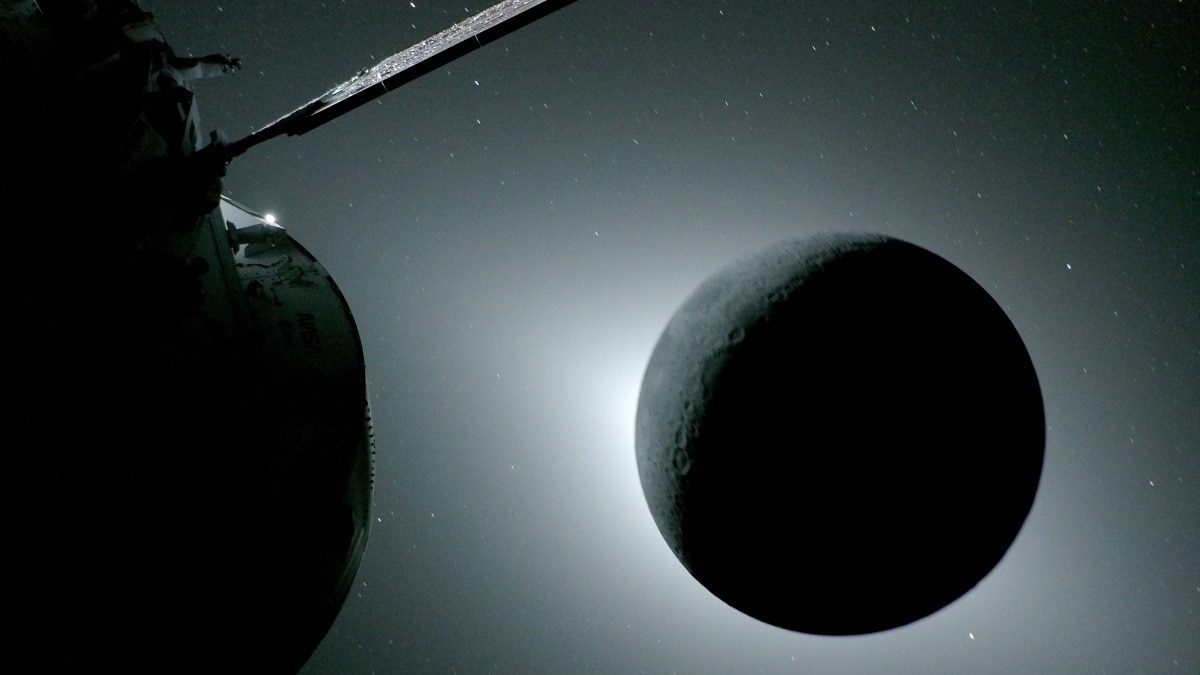
A newly released video from Nasa’s Artemis 2 mission has offered a rare glimpse into one of the less glamorous but essential aspects of human spaceflight, waste management.
The footage shows astronauts aboard the Orion spacecraft safely disposing of frozen human waste, including urine and feces, into space as they continue their journey back to Earth after a historic lunar flyby.
The Orion capsule, designed for deep-space missions, does not have the same long-duration waste recycling systems seen on the International Space Station (ISS). Instead, it relies on a more simplified storage-and-disposal approach suited for shorter missions like Artemis II, which lasts around 10 days.
Life imitates art. The Artemis II crew shows us this view outside the Orion spacecraft, which is very reminiscent of the astrophage scene in Project Hail Mary, over the planet Adrian. Except in real life it’s Earth, and a massive waste dump! pic.twitter.com/XTrZXPNHQd— Owen Sparks (@OwenSparks) April 9, 2026
During the mission, astronauts store bodily waste in specially designed containers that prevent leakage, odour, and contamination within the spacecraft.
Once sealed, the waste is exposed to the vacuum of space, where extremely low temperatures, often below -100 degrees Celsius, rapidly freeze it.
The video shows the mission crew releasing this frozen waste away from the spacecraft in a controlled manner, ensuring it does not interfere with the vehicle or pose a hazard.
The science behind this process lies in the unique conditions of space. In a vacuum environment, liquids such as urine quickly undergo a process called sublimation, where they transition directly from liquid to vapour or freeze into solid ice crystals.
Solid waste, meanwhile, becomes completely dehydrated and sterile due to the absence of atmospheric pressure and microbial activity. This makes disposal relatively safe and minimises biological risks.
Experts say such methods are practical for short-duration missions but would not be viable for longer journeys, such as future crewed missions to Mars. In those cases, closed-loop life support systems that recycle water and waste into usable resources will be critical.
Nasa has emphasised that all disposal procedures are carefully planned to avoid creating space debris or contaminating sensitive environments. The waste is ejected in trajectories that ensure it will not recontact the spacecraft or interfere with other orbital assets.
While the visuals may surprise many, the video highlights the realities of living and working in space, and the engineering solutions that make human exploration beyond Earth possible.
– Ends
Published By:
Sibu Kumar Tripathi
Published On:
Apr 9, 2026 12:56 IST
Tune In