
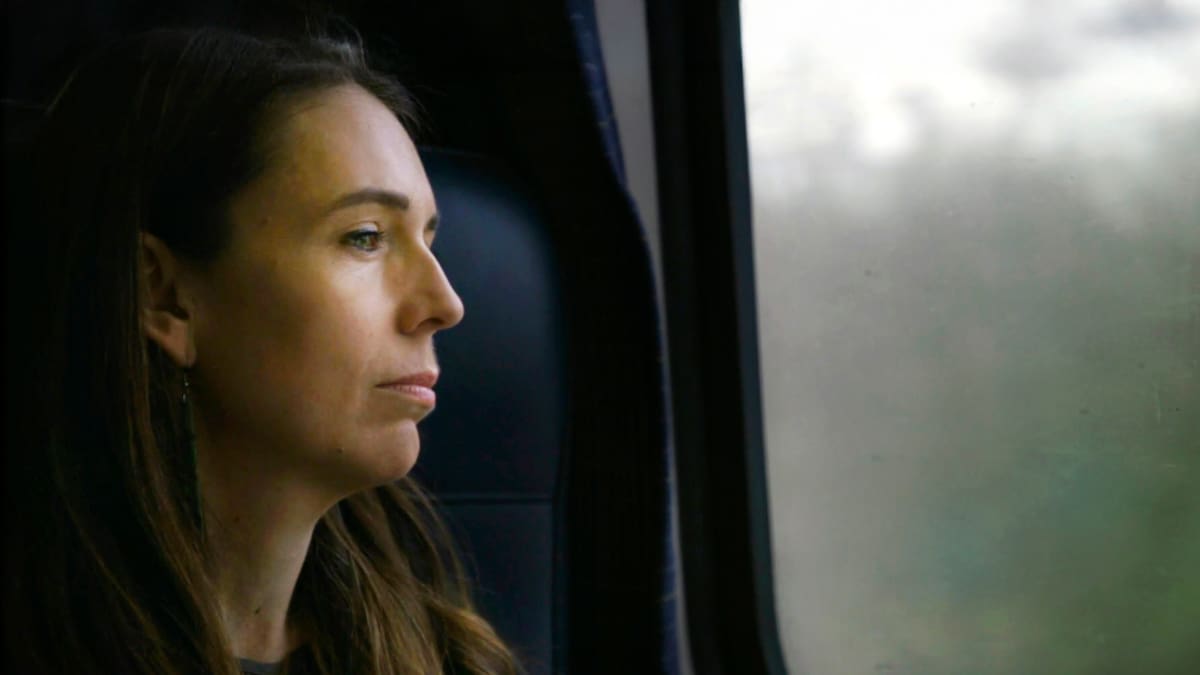
Much of the Ardern interview focuses on the contrasting freedoms for the vaccinated and the unvaccinated, which were a central part of the Covid response as it shifted from elimination to suppression. The Government was seeking to protect people from the harsher outcomes of the Delta variant, while also allowing life in locked-down Auckland to open up.
The “traffic light system” in the Covid Protection Framework came into effect in early December 2021. Certain settings and groups required attendees to have vaccine passes, for which anyone aged 12 or over needed two doses of the vaccine.
Under the “red” setting, for example, people could not go to a cafe, gym or hairdresser without a vaccine pass showing two doses.
From early December 2021, certain settings required a two-dose vaccine pass for access for anyone aged 12 and older. The passes were axed at the start of April 2022. Photo / Brett Phibbs
Ardern conceded to the Herald at the time that it essentially created two classes of people, but that the public health benefits outweighed the costs. There was also polling indicating majority support for different rules for the vaccinated and unvaccinated.
Her comments to the Royal Commission about this being the lesser of two evils – the greater one being unnecessarily risking lives – followed questions about the vaccine passes and the impact it had on social cohesion.
The commission had heard from people who felt their lives had been unfairly restricted. Commission chair Grant Illingworth, KC, said to Ardern: “It would be remiss of me not to put this question to you: You divided the nation.”
Ardern replied: “In what regard? Because if we chose not to have any of that, there would have been those on the vaccinated side who said you took away our freedoms [in the lock-down levels of the alert-level system] even though we were vaccinated.”
She was also asked in the same session whether her goal of keeping people together had ever been achievable.
“I’d love there to be a case where we had neither. Neither someone who felt somehow excluded by society, and no one who saw an unnecessary loss of life,” she said.
“Your [the commission’s] job, I guess, is to find what that sweet spot was. And I’ve thought about it a lot, and I cannot tell you what it was.”
Grant Illingworth KC, chair of the Royal Commission of Inquiry Phase Two into the Covid-19 pandemic response. Photo / Covid 19 inquiry via RNZ
We considered the unvaccinated – Ardern
Over several months, the commission quizzed Ardern, her former ministers and former health officials, including Sir Ashley Bloomfield, about other options, such as rapid testing and more mask-wearing, and whether they could have enabled fewer restrictions for the unvaccinated.
Ardern told the commission she considered testing as a way to ease such restrictions, but PCR testing had a long lag time, and rapid antigen tests (RATs) were not as reliably accurate; the Phase Two report found that moving to RATs was delayed.
She also noted the ways in which unvaccinated people – or businesses that didn’t want to use vaccine passes – were not restricted in the traffic light system. Some businesses could choose whether to use them, for example, and under “red”, private gatherings for the unvaccinated were permitted as long as there were fewer than 25 people present.
Ardern said she still understood why it was framed as “this huge exclusion of unvaccinated people from daily life”.
“I remember in its design thinking, ‘How do we not have that be the case? How do we respond to the demand we have from vaccinated individuals who are saying, ‘I have done my bit [by getting vaccinated], I want to go back out into the world in a way knowing that I’m around other vaccinated people.’
“We wanted to mitigate against that whilst also not creating a situation where fundamentally an unvaccinated person had no engagement with everyday life. That wouldn’t have been right either, so we were trying to balance those competing issues.”
She accepted she’d failed in her goal of keeping people together (her first was to save as many lives as possible).
“It was not without effort. We did not give up on the idea that we could try and keep people together.
“I think some people have taken a very binary view that somehow those who chose not to be vaccinated, that we didn’t have them in mind, that we weren’t thoughtful about those impacts. We were, and we did.”
Former Prime Minister Jacinda Ardern with former director-general of health Sir Ashley Bloomfield, in 2021 during the Covid pandemic. Photo / Mark Mitchell
Consider the counter-factual
There was also the alternative to consider, she added.
A 2023 study said 20,000 people would have died had New Zealand had the same Covid mortality rate as the United States, while a modelling study suggested that vaccination saved 6650 lives and 45,100 hospitalisations in New Zealand between January 2022 and June 2023.
Ardern suggested that tens of thousands might have died if she hadn’t put in place the protection systems she did.
“We may have then not had an occupation [on Parliament’s grounds in early 2022], but we would be having a very different conversation now, where I imagine the people appearing before you would have been those who would consider that our negligence had led to the loss of their loved ones’ lives.”
Bloomfield was asked about future pandemics, and the value of the vaccine pass at a point when the vaccination rate of the eligible population was already very high; it hit 90% about a fortnight after the system was implemented.
“It really depends on what the nature of the virus will be and what that future pandemic looks like,” he replied.
“Flexibility, regular review, clear decision-making, good process. These are the pillars, I think, of a good response: really, really good communication.”
Asked if she had anything to add since her hearing with the commission, a spokesperson for Ardern referred to her previous statement where she accepted the overall findings and recommendations of both the Phase One and Phase Two reports.
The Phase Two report said that New Zealand “did well” in how it responded to the pandemic, and the decisions taken and methods used were “considered and appropriate”.
Where it could have been better included being more responsive to changing circumstances, such as when dealing with later variants. It made 24 recommendations.
“At a time when speed was often critical, some decisions had to be made without enough information and data, or without sufficient consideration of all the impacts that might arise, or without important checks and monitoring [such as the number of unvaccinated people who lost their jobs].”
The report followed Phase One findings that vaccine requirements – in workforce mandates or vaccine passes – were reasonable in 2021, but “the public health case for requiring it was weak” in early 2022, after Omicron arrived.
Immunity was waning, and vaccination, while helping to protect the vaccinated person, was less effective in preventing Omicron transmission compared to previous variants, thereby offering “less protection to others”.
“Some workplace, occupational and other vaccine requirements were applied too broadly and remained in place for too long, which caused harm to individuals and families and contributed to loss of social capital.”
Ardern and her former finance minister Grant Robertson accepted the overall findings and recommendations in both reports.
“We got a lot right. More than most. But there are areas that could have been better,” they said in a joint statement last month.
“The Commission’s observation – ‘there is no scenario in which NZ – or any other country – could have confronted the pandemic without some cost’ will be just as true for the next time. Our best safeguard is to ensure we are as well prepared as we can be.”
Derek Cheng is a senior journalist who started at the Herald in 2004. He has worked several stints in the press gallery team and is a former deputy political editor.