
Williams Corporation has been prolific builders throughout Christchurch – in particular the central city. Photo / supplied
But the developer’s initial plans could be blocked by Christchurch International Airport (CIAL), which has informed it that it disapproves of the proposal, as it stands.
“Having regard to the nature, scale and intensity of residential development proposed, CIAL does not support the application as lodged and does not provide written approval for the proposal,” the CIAL said in a written response to Williams Corporation’s initial proposal, which has been seen by the Herald.
CIAL says the area is zoned for medium-density housing and estimates the parcel of Kirkwood Ave land is large enough for only a third of the dwellings proposed under current guidelines (Plan Change 14).
“While CIAL acknowledges the applicant’s proposed building-level acoustic mitigation measures, CIAL’s concerns are not limited to internal noise attenuation within individual units,” the airport said.
“Rather, they relate to the nature, overall scale, and intensity of residential development proposed within the noise contour and the cumulative noise exposure and reverse sensitivity implications associated with development of this nature.”
Canterbury University’s halls of residence. Student accommodation is at a premium in Christchurch. Photo / Supplied
Reverse sensitivity refers to the vulnerability of an established activity to objections from new sensitive land uses that locate nearby. In this instance, it is seen as a risk that residents of the apartment complex may object to air traffic noise. That could potentially jeopardise CIAL’s ability to continue its current services within its approved operating hours.
Matthew Horncastle, managing director of Williams Corporation, says CIAL did advise him on how the project might proceed with Williams’ support.
“The first part of it was they wanted it under single ownership and essentially what they’re saying is if I sell it to the university, the university is controlling it and the people [tenants] won’t object,” Horncastle said.
“Or if I sell it to like a central fund, that person’s controlling it, and you don’t have a homeowner there objecting to the flight path, right?
“They said, if I put a covenant on it, that I’ll only use it for university accommodation or short-term accommodation, they would support it.”
Blair Chappell and Matthew Horncastle, founders of Williams Corporation. (Image: Supplied)
Horncastle isn’t happy with any of those proposed options.
“Essentially, what they’re saying is if the accommodation’s transient, you’re not going to have someone living there complaining about the airport. Why shouldn’t I be able to have an employee of the university living in the development next to the university?” he said.
“Would the majority of customers be students? Of course. Because they’re studios next to the university, but I have a fierce, fierce, fierce opposition to unelected government officials telling private property owners what they can and can’t do with their property.”
A spokesperson for CIAL told the Herald it was a matter for Christchurch City Council to decide.
“We will play an appropriate role in that process,” said the spokesperson.
“Christchurch Airport is supportive of the university and its accommodation needs. Our concern here is large-scale residential development that sits outside the District Plan framework.
“The plan already provides for significant growth in this area, including within the university’s specific purpose zone and through recent intensification provisions.
“We have engaged constructively with the applicant and identified a potential pathway that would tie the proposal to student accommodation and the existing framework, which currently it does not.”
Christchurch International Airport. Photo / George Heard
Christchurch City Council is the majority (75%) owner of CIAL with central government owning the remainder.
Mayor Phil Mauger has been outspoken on the need for more student accommodation – recently suggesting that the soon-to-be decommissioned Apollo Projects Stadium could be suitable.
Christchurch City Council’s head of planning and consents, Mark Stevenson, says that whilst the final decision remains with the council, CIAL does have some say.
“The District Plan includes provisions that, in certain circumstances, require either written approval from CIAL or that an application be notified to them as an affected party. In those cases, CIAL’s role is to provide input on potential effects on airport operations,” says Stevenson.
Despite being an obvious beneficiary if the project goes ahead, a UC spokesperson told the Herald that it was not for them to comment on.
University of Canterbury has seen a surge in student numbers year-on-year. Photo / University of Canterbury
“As this development is privately led and not affiliated with the University of Canterbury, we have no comment on this.”
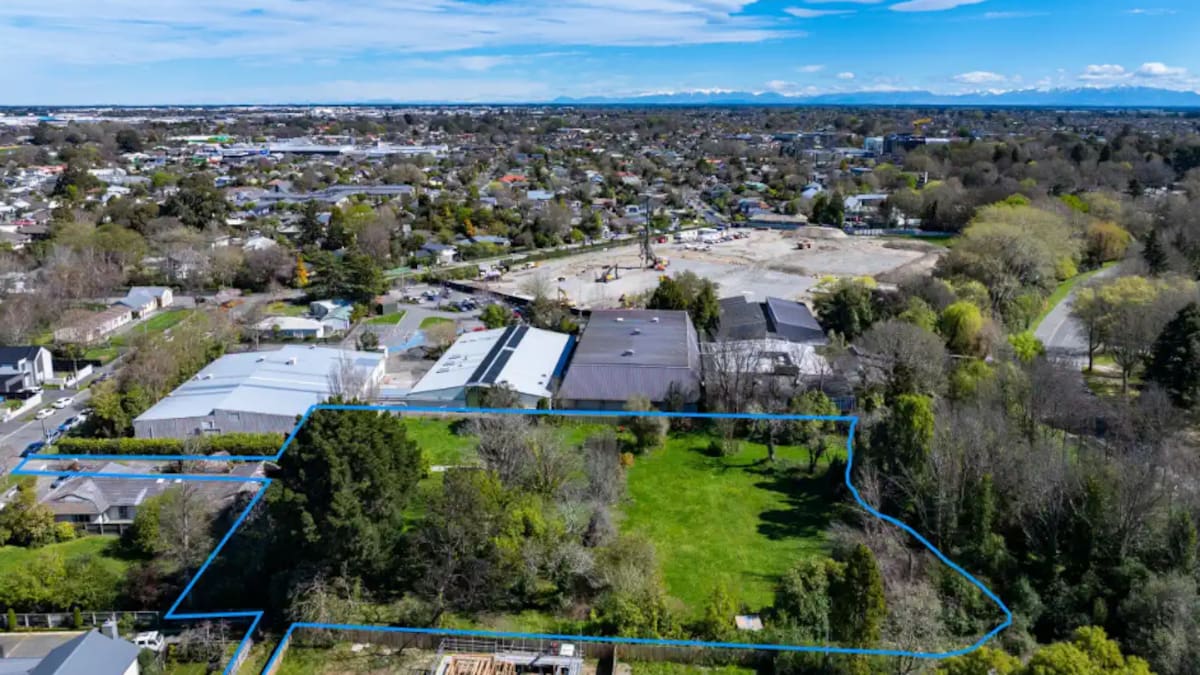
14 Kirkwood Ave is a 7823sq m section and was marketed as the last remaining large-scale site immediately adjoining the University of Canterbury.
Horncastle says he is determined to fulfil the project out of principle.
“And it’s not about me doing this deal and making money because I’ll just do another deal and make money,” says Horncastle.
The development remains at the resource consent stage.