
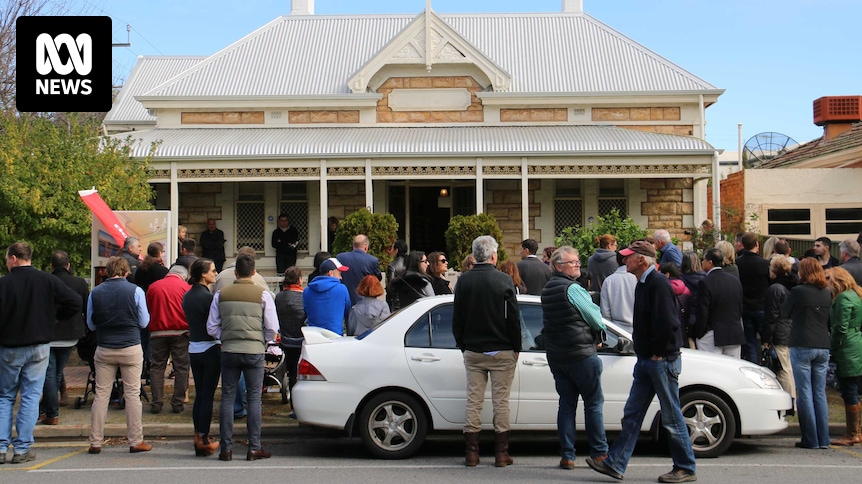
Australia’s entire economy is built on housing, and operates on a “myth” that we can keep generating wealth by constantly inflating housing prices, argues the head of Australia’s largest super fund.
Paul Schroder, the chief executive of AustralianSuper, has issued a stark warning that our nation must rethink its over-reliance on real estate.
He said he’s calling out the “central truth” that Australia spends way too much on housing and “not anywhere near enough” on productive investment.
Home owners see equity surge despite rising interest rates
He said many Australians say they want improved housing affordability and lower house prices but it’s “nonsense” to expect that those things will occur under our current policy settings, because the “entire construct of the Australian economy” is embedded in the housing mortgage book.
AustralianSuper is Australia’s largest superannuation fund.
It manages the wealth of more than 3.7 million Australians and has more than $410 billion in assets under management, making it one of the 40 largest asset owners in the world.
“You know how they say in casinos ‘The house always wins’?” Mr Schroder told the ABC.
“I would say that in the financial sector, in the Australian economy, the ‘house’ always wins.
“And the reason why the ‘house’ always wins is that housing prices, and housing valuations, underpin the entire banking system,” he argued.

Paul Schroder is the CEO of AustralianSuper. (AAP: Bianca De Marchi)
Australia’s inflated housing wealth
Mr Schroder made his comments on today’s episode of That’s Business with Alan Kohler, the ABC’s new business podcast published every Friday afternoon.
He said Australia needed to have a serious conversation about its capital allocation, because the inflated level of our housing wealth was extreme compared to the size of our economy.
Loading…
He said the nominal value of gross domestic product (GDP) in the United States is US$31.4 trillion and the value of US housing stock is US$55 trillion.
By comparison, Australia’s GDP is worth $2.7 trillion and its housing stock is worth $12.3 trillion.
He said the “whole show” in Australia was built on housing and it couldn’t continue this way.
“John Howard said nobody wants their house to drop in value,” he said.
“For the last 25 years, all of our additional wealth has gone into inflated housing prices that you can’t really do anything about because you’ve got to move from one house to another house.”
Australia dealing with damage from ideas about housing
He said our conversation about capital allocation and housing affordability had to be genuine, too, because nothing will change unless everyone was serious about changing things.
“Is it embedded in everybody’s model that we genuinely want housing to be a smaller proportion … of GDP?” Schroder asked.
“Is that a thing we would like because we’d rather earnings capital, we’d rather turn wealth into investible job-creating things?
“Is it just a kind of polite conversation or is it really serious [enough] that we’re prepared to re-set the expectations, the measures, the targets, the valuation process?” he asked.
The super industry could help Australians buy a home
Mr Schroder said Australia’s superannuation industry had a big role to play in this conversation.
Alan Kohler wondered if the super industry could help Australians to purchase homes in more innovative ways, asking:
“Have you thought about something like, when someone joins AustralianSuper, one of the options would be that you would build them a house and they would pay it off during the course of their working life, and so by the time they, as part of their super savings … would pay off the house, and by the time they retired, they would own it?
“So you’d actually go and build houses for your members that they pay off during their working life?”
Mr Schroder said there were probably creative ways in which houses could be built in more intelligent ways.
“I think it could happen at the fund level, [but] there’d be a couple of things we’d need to protect against,” Mr Schroder replied.
“One is, you’ve got to make sure that other [superannuation] members aren’t paying something that they’re not getting a benefit from. It’s really important for us to have equity between members.
Unnecessary interest rate cuts derailed the national housing affordability project
“And the next part is, you’d have to make sure that if we were to embark on something it’s not just some sort of money-wasting white elephant.
“[But] I think there are ways to have ‘super and housing,’ not just ‘super or housing’,” he said.
However, Mr Schroder said he was worried about the more extreme end of the political debate where people were saying that super should be used “for” housing.
He said that’s not what the discussion should be about.
“We need super and housing,” he said.
“And I reckon there’s a sweet-spot where super could fund things, or help fund things, that might help people be housed more quickly,” Mr Schroder said.