
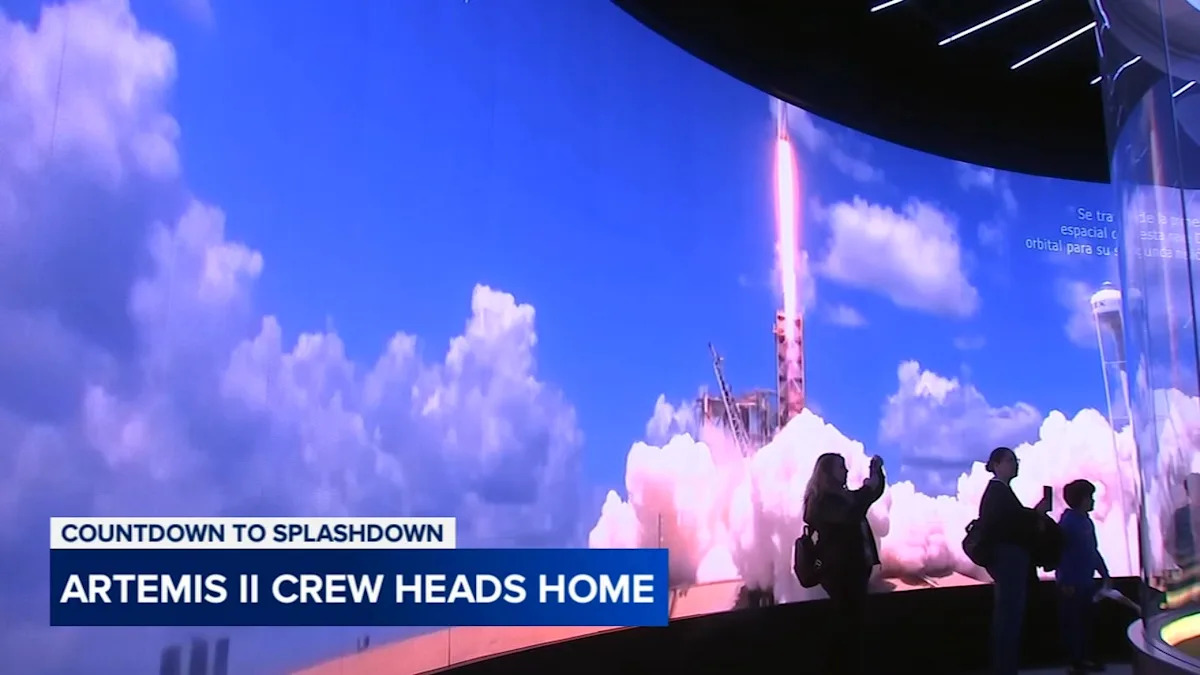
Artemis II’s astronauts will splash down in the pacific ocean off Southern California at approximately 7:07 p.m. CT Friday.
Space lovers across the Chicago area are counting down to splashdown.
For one University of Illinois professor, this has been a full circle moment.
LIVE COVERAGE | Artemis II’s grand moon finale has Pacific splashdown to cap NASA’s lunar comeback
University of Illinois Aerospace Engineer Professor Dr. Joseph Gonzalez, a Chicago native, worked on the Artemis program for almost 10 years. This mission is now inspiring his students and other young scientists in the making.
“I believe in the mission,” Dr. Gonzalez said. “I believe in what we’re trying to do in terms of going back to the moon, establishing a habitat, establishing our astronauts on there to stay and not just visit.”
For Dr. Gonzalez, watching Artemis II’s journey has been incredible.
Gonzalez grew up in Little Village. He worked on the Artemis program for nearly a decade.
Last week, he took his students to see the Artemis II launch at NASA’s Kennedy Space Center.
“This orange section of the rocket all the way down to engine that’s called the core stage. That’s what powers up the rocket, in addition to the outside ones the solid rocket boosters. So I was part of the team and the systems engineering person for this part of it,” Dr. Gonzalez said. “I’ve done materials engineering. I’ve done fluids testing. I’ve done production support system engineering, and then also served on the chief engineering board for the program.”
SEE ALSO | Chicago-area space center following Artemis II crew’s historic mission around the moon
He and many others were anxiously waiting for Artemis II to splashdown in the Pacific Ocean off the coast of San Diego Friday evening.
That excitement was felt at the Griffin Museum of Science and Industry and Adler Planetarium in Chicago.
“Maybe the most interesting is the descriptions the astronauts had of what they were seeing out the window,” said Andrew Johnston, Adler Planetarium Vice President of Museum Experience and Collections. “These people went around the far side of the moon and back and they saw the view that no human has ever seen before.”
Dr. Voula Saridakis, Head Curator and NASA Solar System Ambassador at the Griffin Museum of Science and Industry, joined ABC7 to discuss the Artemis II splashdown.
Dr. Voula Saridakis, Griffin Museum of Science and Industry Curator and NASA Solar System Ambassador, joins ABC7 to discuss the Artemis II splashdown.
“The fact that they were able to capture this data, capture these images that they’ll eventually share with the world is going to be absolutely stunning,” Dr. Saridakis said.
The mission is inspiring future engineers, like Adler Planetarium visitor Nevan Mcilwee.
“I’ve been interested in space since I was a child,” Mcilwee said. “But seeing the return, seeing us return to the moon its definitely been inspiring me to look into opportunities that are available for me to get involved.”
The diversity of the crew on the mission has also been inspiring for the elementary school students of Heidi West, who was also visiting the Adler Planetarium.
“They’re really loving seeing that representation of cultures, different cultures, different nationalities, coming together and just exploring the beauty of the universe,” West said.
As for what’s next for Dr. Gonzalez, he says he enjoys teaching but is not ruling out becoming an astronaut one day. He welcomes the opportunity to visit space.
SEE ALSO | Chicago-area company made equipment used on Artemis II mission to the moon