
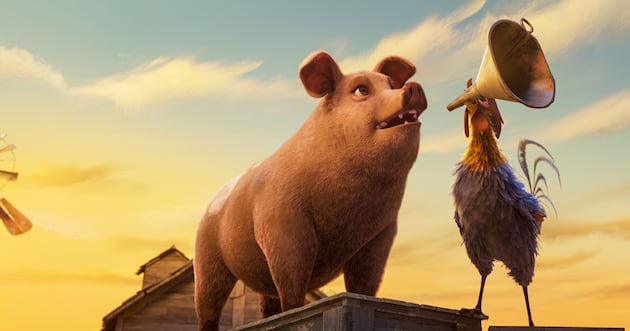
“Animal Farm” is getting a happy ending — and not everyone is happy about it.
In the final scene of George Orwell’s 1945 satirical novella “Animal Farm,” animal workers watch through a window as their ruling pigs and the human farmers drunkenly play cards, and they can no longer tell them apart. The moment is grim and impactful.
The image exposes the cracks beneath Marxism’s utopian promise.
The upcoming animated adaptation of “Animal Farm,” directed by “Lord of the Rings” actor Andy Serkis, transforms Orwell’s sharp critique of communism into a lighthearted, family-friendly story — and casts capitalism as the villain.
After 14 years in development, “Animal Farm” premiered at the Annecy International Animation Film Festival in June and secured distribution from Utah-based Angel Studios.
A cast of Hollywood heavyweights bring the animated characters to life. Seth Rogen plays the power-hungry boar Napoleon. Kieran Culkin voices Squealer, Napoleon’s deceptive right-hand pig, and Woody Harrelson is Boxer, the loyal workhorse.
In Orwell’s “Animal Farm,” a group of farm animals overthrow their human owner and create “Animalism,” a new political philosophy promising equality for all. But the pigs soon seize control, becoming as tyrannical as the humans they overthrew and betraying the revolution’s ideals.
Orwell’s chilling warning of authoritarianism is “still relevant today,” Serkis said, while adding that his adaptation presents a “contemporized” version, he told the “Flip Your Wig” podcast in September.
“We’ve couched it in such a way that it feels like a family film, but the darker themes are all there. They’re all present,” he continued. “The Orwellian nature of it is incredibly powerfully sort of under the surface, but we’ve smuggled the politics in so that it’s a debate that can be opened up between young people and families and old.”
Some of Orwell’s material remains intact in the animated version, but Serkis shifts the story to warn against the dangers of capitalism and corporate greed, giving human characters a larger role to embody these ideas.
In Serkis’ adaptation, after the animal revolution, Napoleon seizes power and begins scheming with rival farmer and billionaire Frieda Pilkington — a character created for the adaptation — who lures him with human luxuries to execute her ultimate plan: taking over the farm, the last piece of land she doesn’t own, and building a profitable dam.
Unlike the novel, the film concludes on an optimistic note, where the animals revolt and focus on building a hopeful future.
“This adaptation isn’t just a story for entertainment — it’s a reminder that democracy, freedom, and integrity are fragile, and must be watched over,” Serkis said in a statement about the film.
“My hope is that audiences walk away moved, thoughtful, and inspired to stand up for the values that matter. I’m honored that Angel and the Angel Guild are willing to bring this film to big screens around the world.”
Online comments and reviews from critics who saw the film at last year’s festival highlight the movie’s tonal shift, particularly how satirical moments from the book are replaced with juvenile humor, abandoning Orwell’s core message.
“When power-hungry Napoleon tries to stand on two legs, flatulence erupts, amusing the kids and reminding adults how low Serkis will go to get a laugh,” wrote Variety.
One commentator wrote, “When I learned Andy Serkis was making an animal farm movie I assumed it would A) be motion capture, not the 2000s straight to DVD animation we got and B) be darker and grittier than your average kids movie like his ‘Jungle Book’ instead of goofy fart joke central.”
When I learned Andy Serkis was making an animal farm movie I assumed it would A) be motion capture, not the 2000s straight to DVD animation we got and B) be darker and grittier than your average kids movie like his Jungle Book instead of goofy fart joke central
— Will Mavity (@mavericksmovies) June 10, 2025
Another said, “Andy Serkis has remade Orwell’s stark fable ‘Animal Farm’ — only he says he’s made it ‘accessible’ (as though it wasn’t already), not ‘overtly political’ (could that have the slightest value?), and ‘suitable for a modern audience’ (his version has a happy ending).”
Andy Serkis has remade Orwell’s stark fable ‘Animal Farm’ — only he says he’s made it ‘accessible’ (as though it wasn’t already), not ‘overtly political’ (could that have the slightest value?), and ‘suitable for a modern audience’ (his version has a happy ending).
— John Simpson (@JohnSimpsonNews) December 14, 2025
One commenter criticized Hollywood, writing, “Hollywood is incapable of critiquing anything other than capitalism.”
Why Angel Studios is distributing ‘Animal Farm’
In the wake of backlash to “Animal Farm,” Angel Studios defended its decision to distribute the film.
“As social and mainstream media respond to incomplete or erroneous information, it’s important to get the facts straight. There are four,” Angel said in a statement. “Angel is the distributor of this film, not its producer, nor with creative control. Angel Guild members viewed the film and voted heavily to support it.”
“While the title is the same as the classic book, updates were made to make it relevant to a broad-based, values-centric, family-friendly audience,” the statement continued.
“This is an anti-communism film, and the Angel Guild will ensure that it stands by the principles of our members.”
The company’s Angel Guild is a group of subscribers who get to vote on which projects Angel Studios should produce and distribute.
Members of the guild are provided with samples of potential films or television shows and get to vote on whether or not they believe Angel should move forward with the project. Selected films typically align with the studio’s mission to share “stories that amplify light.”
In a separate statement, Brandon Purdie, executive vice president of theatrical and brand development at Angel, said that this is a “project of tremendous heart.”
“Andy Serkis’ visionary direction, combined with this powerhouse cast, creates a film that feels timely, urgent, and deeply human — even though the protagonists might be pigs, donkeys, and horses,” Purdie said. “We’re confident that moviegoers will see not just a story of farm animals, but a mirror held up to our world today.”