
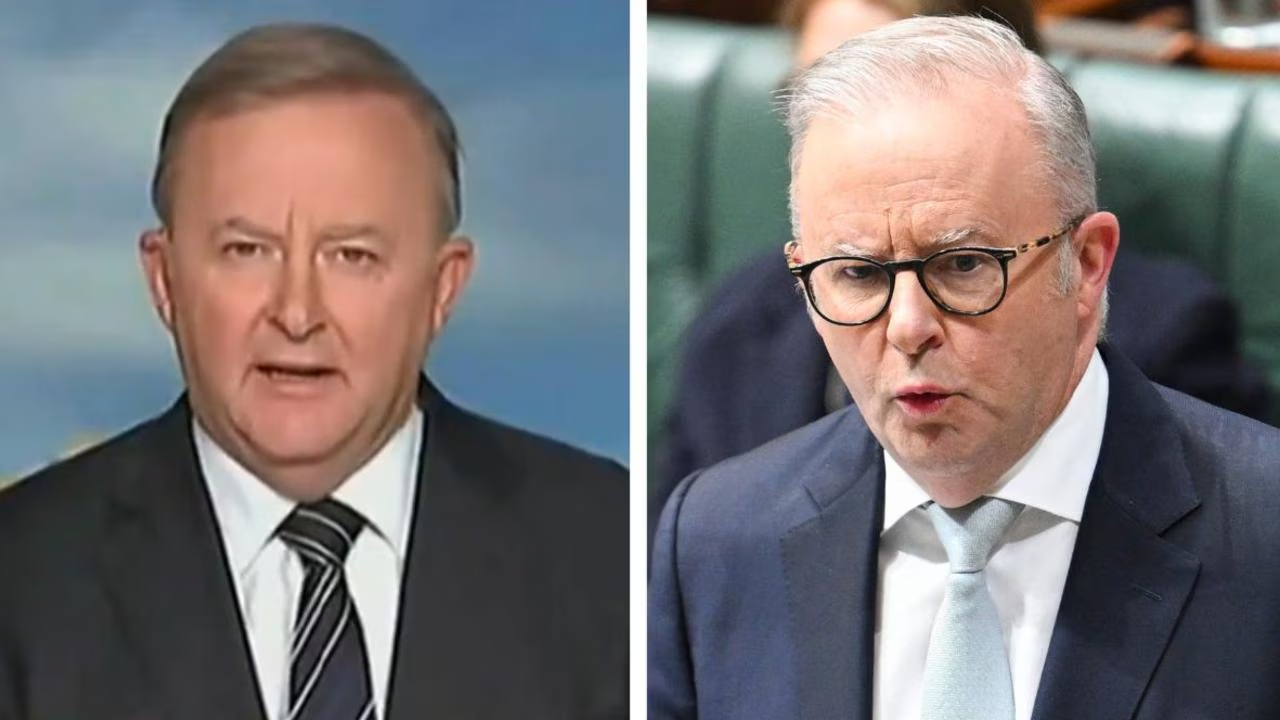
Anthony Albanese’s bold prediction of a fuel crisis in Australia sparked by a military conflict has come back to haunt him after voters dug up his own remarks half a decade ago.
As he battles the ongoing fallout of fuel prices, an old TV interview has revealed how the Prime Minister raged against government inaction way back in 2020.
“The point of our international obligations is that Australia should have here 90 days available of liquid fuel reserves, so we are significantly in breach,” Mr Albanese said in the interview.
“We shouldn’t be dependent upon circumstances which are which may be beyond our control, as you say, terms of any particular international incident, be it military conflict or other issues, will mean that we run out of fuel.”
You can see the clip in the video player above
MORE: How petrol price spike could hit home values
In the 2020 interview, Mr Albanese also predicted an international conflict could trigger a crisis.
“If there’s a sort of international conflict or issues that provide disruption to sea lanes that may well occur at some stage in the future, then that is why nation states need to have this fuel capacity’’ Mr Albanese observed in 2020.
“It’s an issue of national security, and having something in the United States doesn’t provide for our national interest to be protected in the way that it should, and the government needs to emerge with a plan for our refining capacity, for storage here, and they’ve had now they’ve been there for seven years. years.”
How many days of fuel does Australia currently have?
Half a decade after he made those remarks, Australia still has around 38 days of fuel, not 90 days as suggested.
Speaking in Sydney, Energy Minister Chris Bowen confirmed on Saturday that Australia now has 38 days’ worth of petrol, 31 days’ worth of diesel, and 28 days’ worth of jet fuel.
“That’s up two days for diesel, down a day for petrol and down two days for jet fuel,’’ Mr Bowen said.
MORE:Warning: Major bill for petrol ‘panic’ buyers
“I can also confirm that we currently have 57 tankers on the way to Australia with some form of fuel — jet fuel, diesel, petrol, crude oil — coming to Australia. That’s a good thing.
“I can still say that we have roughly as much, if not more, fuel in Australia today than we did when the bombing of Iran started. That’s a good thing.”
Crisis will have a long tail
Mr Bowen predicted the crisis would have “a long tail.”
The government has consistently argued that’s a significant improvement that the system under the previous government.
Asked this week about his calls for Australia to become self-reliant on fuel, the Prime Minister denied he had failed his own test.
“No, it doesn’t at all. We have the largest reserves in 15 years,’’ he said.
“We’ve made sure on our watch no refineries are shut. The two, we’ve made sure that they’re secure going forward as well.
“And when it comes to the strategic fleet, that’s something that’s been considered by the Government. We’re working those issues through to make sure that they’re delivered. That’s an important component. I stand by those comments.”
Self-reliance is the goal
It was a message the Prime Minister reiterated at the national press club address last week.
“We have to be more self-sufficient and less vulnerable,’’ he said.
“We had, fortunately, at the beginning of this global crisis, the largest fuel reserves that we’d had in Australia for 15 years. And importantly, our fuel reserves were here, not in the United States.
“Now, six of our refineries were open when we left office in 2013. When we came back in 2022, there were two.”
At the 2019 election, former Labor leader Bill Shorten had a policy to restore fuel stocks to 90 days in accordance with the IEA requirement.
“Well, just bear in mind that the 90-day reserve considered by the IEA isn’t a reserve for domestic use,’’ Mr Albanese said.
“It’s a reserve, as we’ve seen at the moment, for a global crisis to be released. So, that’s why it’s there.
“One of the things about Australia, because of the size of our continent, is that the cost would be around about $20 billion annually. And the other thing is because fuel can’t be just kept, it has to be topped up, then the challenge for us is very different from a smaller country in Europe, for example, that has a larger population.
“We certainly will consider what we can to increase our fuel security. We’ve been doing that. That’s why at the beginning of this crisis, we had the largest reserves in 15 years.”
‘There’s a war on’
Mr Bowen said voters understood the reasons behind the rising prices.
“There is a war on. I think most Australians understand it,” he said.
“Everyone understands it, I think, except the Opposition, who think there should be some magical wand to stop it all happening.
“I’m not going to pretend that that’s not happening. No one should. And that, as I said in the answer to the previous question, is going to hang around for a while.”
“And the best way we can ensure prices come down is this war ends.”
Read related topics:Anthony Albanese