
By publication, the Northland Regional Council (NRC) competition had collected almost 10,000 moth plant pods, with about a month remaining.
Northland is New Zealand’s moth plant epicentre because it is warm, frost-free, windy and coastal.
The invasive vine became established in the wild in the early 1900s, giving it endless opportunities to spread and reinvade.
The competition began on February 23 and ends on May 15.
NRC biosecurity officer pest plants Graham Norton said in the biggest single entry so far, 6368 pods and vines with roots had been collected.
“Going on the numbers of pods and vines collected so far, the community will be having a real impact on reducing numbers of this invasive vine,” Norton said.
Each moth plant pod can produce up to 1000 wind-borne seeds, allowing the vine to spread long distances and smother native vegetation.
Waimahanga Track Action Group co-ordinator Chrissie Stephenson on the shared coastal walking and cycling track in Onerahi, with some of the moth plant pods and vines the group collected in the effort to preserve local ecosystems. Photo / Susan Botting
The plant’s sticky nectar can trap and kill insects such as monarch butterflies.
Competition entries rose almost 40% in a week around Easter, reaching 114, up from 82 on March 25.
Norton said these came from across Northland, with teams from families, communities and schools.
He said it was pleasing to see the number of pulled vines. They were included in the competition because their removal had a larger impact on the moth plant population.
Moth plant is widespread across Northland. Whangārei Heads has the region’s biggest problem, followed by Kerikeri and the Mid-North, with lower but emerging risks in the Far North, Whangārei urban areas and inland Kaipara.
In Whangārei city, Onerahi, including where it slopes to Whangārei Harbour, Riverside, Otangarei, Morningside, Tikipunga, Te Kamo and Raumanga are the main hotspots.
A huge community effort has been under way at Whangārei Heads for more than 20 years to tackle the invasive weed, where the biggest infestation covers several rugby fields.
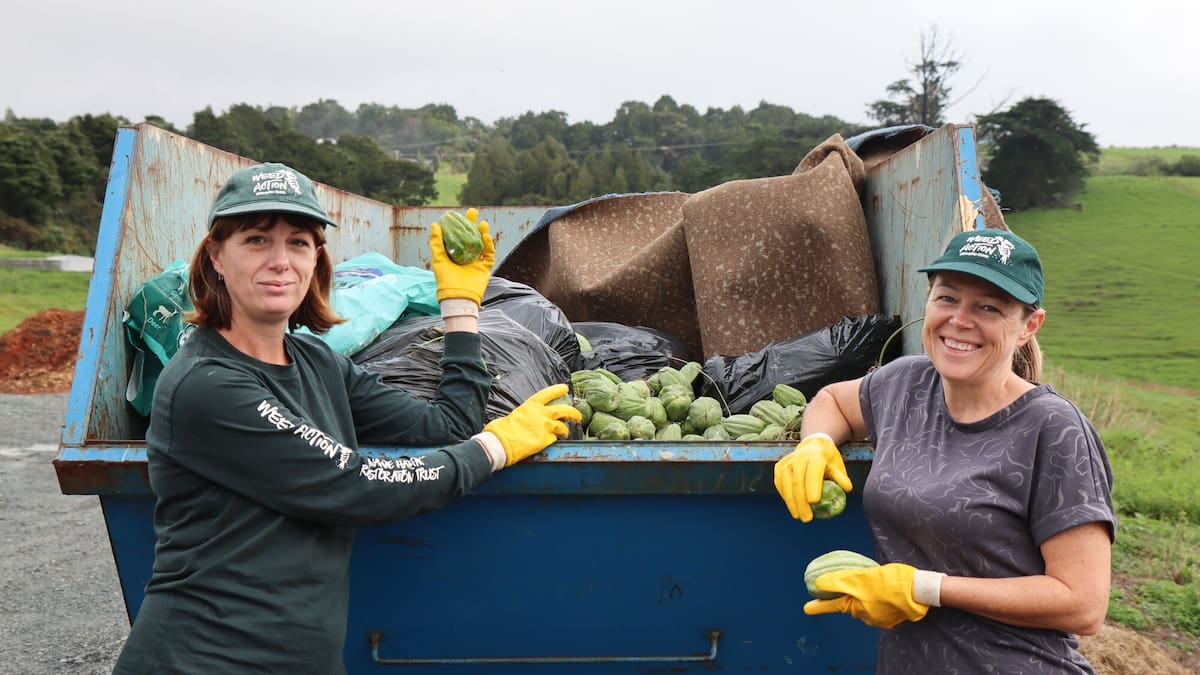
The invasive moth plant vine is more than a handful for the Whangārei Heads mega moth plant movement, these four pods being among hundreds collected by the community in the past three months. Photo / Karina Cooper
Locals are now also fighting the pest through the five-year Whangārei Heads mega moth plant movement project started in 2024.
Project co-ordinator Kate Hardcastle said it was good to see NRC’s new region-wide competition bring more attention to the invasive pest.
Hardcastle said a three-month community collection outside Parua Bay community hall had filled a 6cu m skip bin – roughly the size of a family car – with moth plant pods.
The group also runs an annual stop-the-pods competition in early summer, focusing on removing vines before they form the hand-sized pods.
Next year it will repeat a moth plant pod weigh-in competition with Whangārei Heads School’s March funky fish event.
Ocean Beach resident Rupert Newbold likened moth plant vines to triffids.
He said he had been dealing with the pest on his Whangārei Heads farm for 15 years, removing about 15,000 plants.
“People underestimate moth plant through lack of knowledge. But they need to take it seriously, otherwise it will take over the whole of the North Island,” Newbold said.
Moth plant vines smother native trees, dominate forest margins and reinvade sites rapidly through long-distance, wind-borne seed dispersal.
They infest coastal cliffs and islands through to urban reserves, roadside margins and home gardens, which elevates their threat above many more localised weeds.
Another Whangārei Heads resident, Geoff Pike, has been fighting the “extremely invasive” moth plant for 20 years.
He has taken out about 20,000 vines from his coastal farm between Taurikura and Ocean Beach and is not yet on top of the problem.
Pike said it was great to see the NRC competition, but wanted the council to springboard from there to develop a supported regional plan to attack the invasive pest plant head-on.
■ LDR is local body journalism co-funded by RNZ and NZ On Air.