
The dairy operations have several support blocks growing maize, grazing heifers and lambs.
Setting up a sheep dairy operation appealed to McPherson, and he said the numbers stacked up.
“We’d been talking about diversifying and considering more sustainable options for our farming business, and I felt that it was something different from the other things we were doing that I could grow into a good business and career.”
The sheep dairy
In 2020, Spring Sheep Milk’s supply manager (now chief executive), Thomas MacDonald, came out to assess the farm for suitability.
The farm suited the Spring Sheep business model, and the family business signed a contract with them.
Work started in December 2020 and continued to August 1, 2021, when the first 650 Zealandia sheep arrived.
“We had an old decommissioned 16 ASHB shed already, plus land for the 60-hectare sheep dairy platform and lamb rearing sheds.
“The old dairy shed was gutted and made into a 42 ASHB for sheep, with a rapid exit system.
“Sheep and lambs especially need fencing with more wires and battens, so we fenced in a central straight race with paddocks running either side for easy access to the dairy shed.”
Two polytunnel lamb rearing sheds were put up for lambing season.
Day-to-day operations
In the first season, McPherson ended up milking on his own, as they were a staff member down, but said it was pretty straightforward and each milking took around an hour.
In the 2022 season, they milked 800 sheep, 900 were milked in 2023, 1000 in 2024 and 1200 in 2025, with McPherson as manager and three full-time staff plus part-timers over lambing times.
The sheep have a grass-based diet, and that is always the priority for the rather picky Zealandia sheep, which like the best leaf tips.
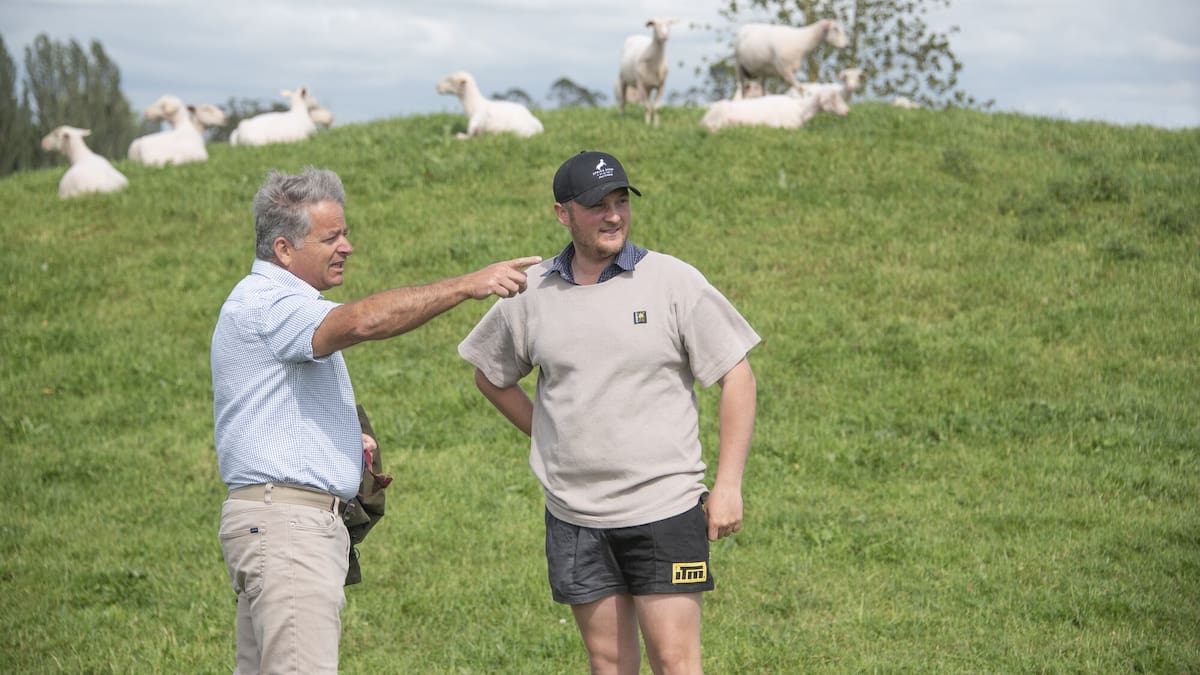
Ryan McPherson ensured the infrastructure for the new sheep dairy made bringing the sheep in easy for both himself and the sheep. Photo / Catherine Fry
“Grazer cows follow through behind the sheep and reset the paddocks, and help reduce worm burdens in both animals,” McPherson said.
“We also have in-shed feeding of a canola meal pellet for extra protein and minerals.
“We grow around 16 hectares of chicory for the sheep over summer.
“During winter and early lambing, I use seven hectares of maize.”
Last winter, 1500 sheep were wintered, but only 1200 were milked.
The flock is sheared twice a year, and McPherson uses Jack Fagan’s gang.
With a 220% lambing rate in the 2024/25 season, most ewes are having twins or triplets.
All lambs spend four days with their mum and then five weeks in the rearing shed once trained to use adlib feeders.
“Spring Sheep genetics are protected, so all male lambs are band castrated and given away for free,” McPherson said.
“Many go to ‘mow’ lifestyle blocks, some become pets and others are reared for meat.
“Our females are our replacements, but excess may be reared for meat.”
Zealandia milking sheep enjoy the best grass tips. Photo / Catherine Fry
Spring Sheep collect and process all milk and supply the genetics for mating.
Zealandia rams are used for mating, and farmers can pick their rams.
“Last season, we averaged 62 kg/Ms per ewe, which is towards the higher end of production, and we are on track for this figure in the 2025/26 season.”
McPherson is looking forward to working with Spring Sheep on his flock’s genetics over the next few seasons, with a view to averaging 75 kg/Ms per ewe and milking 1500 sheep.
Keeping it green
McPherson has put in measures to lower the sheep operation’s carbon footprint.
He said sheep were a more sustainable farming option; there was less pugging in the paddocks and less urine volume, reducing leaching issues.
The milking shed has solar panels, which provide power for chilling milk or running the shed in the afternoon.
Excess power goes into the grid, and the farm is paid for it.
An electric farm bike is effectively reducing fuel consumption.
Lowering the farm’s carbon footprint will be an ongoing project for this sheep business.