
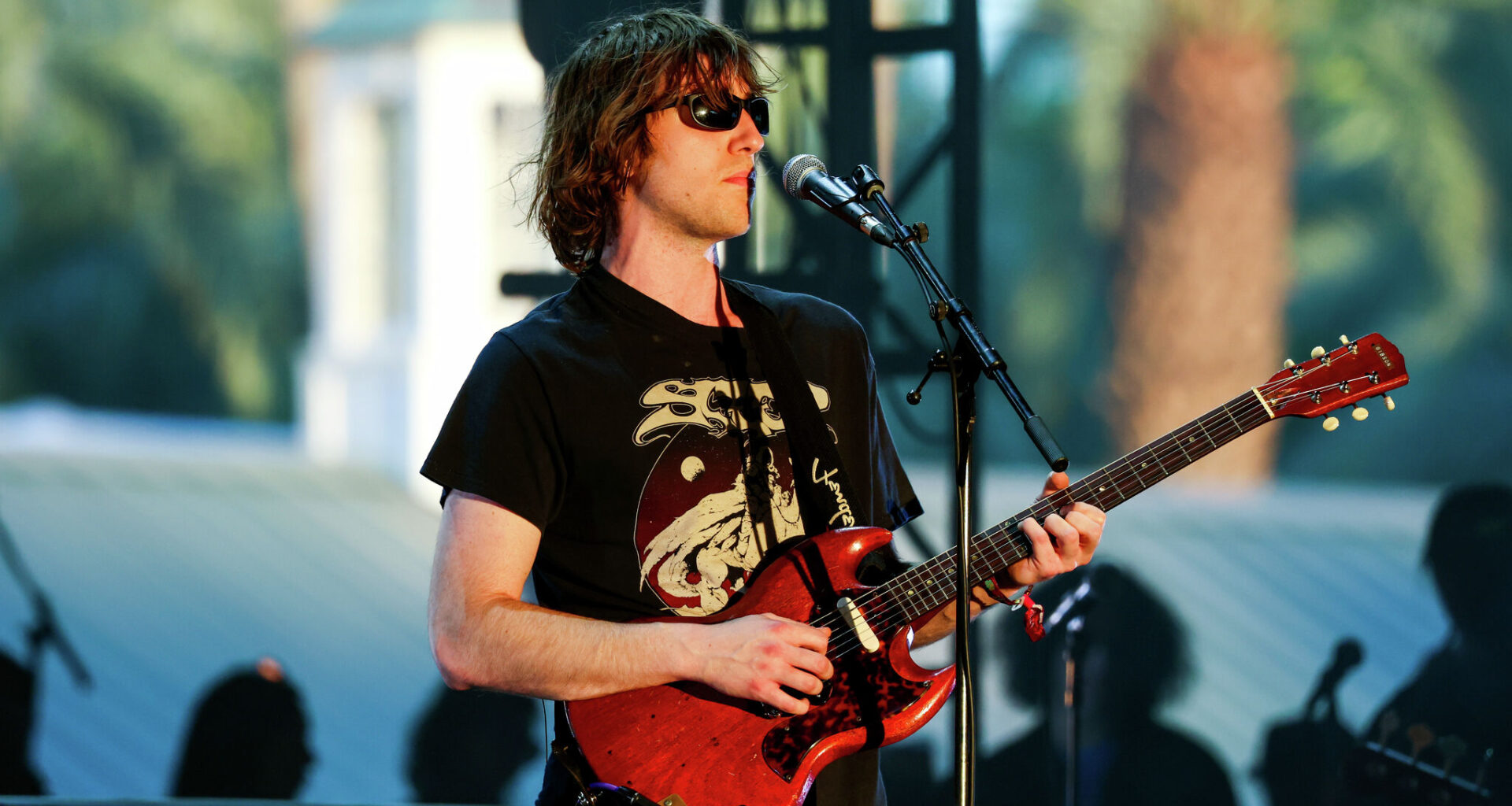
Cameron Winter of Geese performs at Gobi Tent during the 2026 Coachella Valley Music and Arts Festival at Empire Polo Club on April 11, 2026 in Indio, Calif.
Kevin Mazur/Getty Images for Coachella
INDIO, Calif. — Geese are covering “Baby” by Justin Bieber, just hours before the pop star’s headlining Coachella set. “I know you love me, I know you care,” Cameron Winter sings, his oily hair falling over the sides of his sunglasses. Transposed into Winter’s signature squawks, the lines sound silly, with the goofy, mismatched energy of a child dressing up in his father’s suit. Emily Green, the band’s guitarist, twangs along like she’s playing on a surf rock record.

Then, at Winter’s last cry of “Baby,” Max Bassin pummels his kick drum, cranking the BPM by several notches, and Geese launch into “2122,” a jagged, proggy number. (No relation to the Rush album.) Played live, it almost sounds like a thrash metal song, and the crowd reacts like it’s at an Anthrax concert.
Article continues below this ad
It’s Saturday, and Geese are playing Coachella’s Gobi stage. In its 45-minute set, the band mostly sticks to tracks from its newest album, “Getting Killed,” save for “2122” and “I See Myself.” I spot Jack White, who performed earlier in the day, watching the band from the wings.
If you’re reading this, you probably know about Geese already. They’re the band with the singer who bellows like a bagpipe with a face attached, but who still managed to sell out Carnegie Hall instantly. They’re the ones your cousin who lives in Brooklyn won’t shut up about, even though he only heard about them for the first time last fall.
In the months surrounding the release of the New York indie rock band’s newest album, “Getting Killed,” in September, the critical consensus shored up quickly: Geese would be the next big rock band, the act that would shake the dust off of a stale and fractured genre.
Make SFGATE a preferred source so your search results prioritize writing by actual people, not AI.
Add Preferred Source
This “Baby” moment, like so much else about the way Geese’s style, teeters on the edge of s—tpost territory. At one point, “Family Guy” visuals flash on the screen behind the band. In between songs, Winter mutters something about how the palm trees are fake and it’s all a lie; it’s a bit hard to follow.
Article continues below this ad
It’s a testament to their sound, then — the angst in Winter’s voice, in particular — that these hundreds of fans take them so seriously, leaning back as they scream the words to “Au Pains du Cocaine.” Geese’s sound feels like something genuinely new. It’s true that Winter’s voice draws Tom Waits comparisons, and the guitars on “Trinidad” sound like they leaped out of a ’70s psych rock record. But these elements combine into a fresh formula, songs that mutate the verse-chorus structure into one long, slow build.
Take the band’s opener, “Husbands.” It begins simply, just the slow, insistent pulse of a drum and a few held bass notes. The song’s intro is not so much a lull as it is foreshadowing: a promise that those same elements, benign as they appear now, will in a few minutes return to beat the listener over the head.
The build is gradual, piece by piece: A guitar line here, a cymbal there. The weight grows heavier and heavier. By the end of the song, the crowd shouts along with Winter, who stretches the last word of every line, filling it with air: “You know what I meaaaaaannnnnnn.”
Article continues below this ad
Collectively, Geese’s greatest talent is this control of tension. The band’s songs last three or four minutes, but feel twice as long; they ratchet in intensity, bar by bar, until they threaten to roll off the edge of a cliff. They sound like they’re made to be played on a miserably hot day.
This Saturday is not a miserably hot day. The crowd, which includes many boys, does not smell as bad as expected, even a few paces away from the inevitable mosh pit.
Geese’s performance climaxes with “Trinidad.” At the track’s first guitar twangs, a few enterprising fans turn an already big mosh pit into a truly ridiculous one, which gapes across most of the front of the crowd. Something about a mosh pit at a show like this feels silly; the tones of Geese’s guitars are fit for a blues song. Take its presence and size as signs of these fans’ devotion, and the feverish enthusiasm they have for these songs.
Article continues below this ad
Green’s opening guitar lines creak like an old machine kicking into gear. Winter lets loose a few subdued moans of “I tried,” his voice cracking slightly. Then he drops the anvil.
“THERE’S A BOMB IN MY CAR,” he screams. Everybody screams, really. On cue, bodies flood in to fill the empty space on the floor, and arms fly. I try to film the band, but get knocked off balance; I think someone’s head bangs into my spine. I give up, and let the song carry me.