
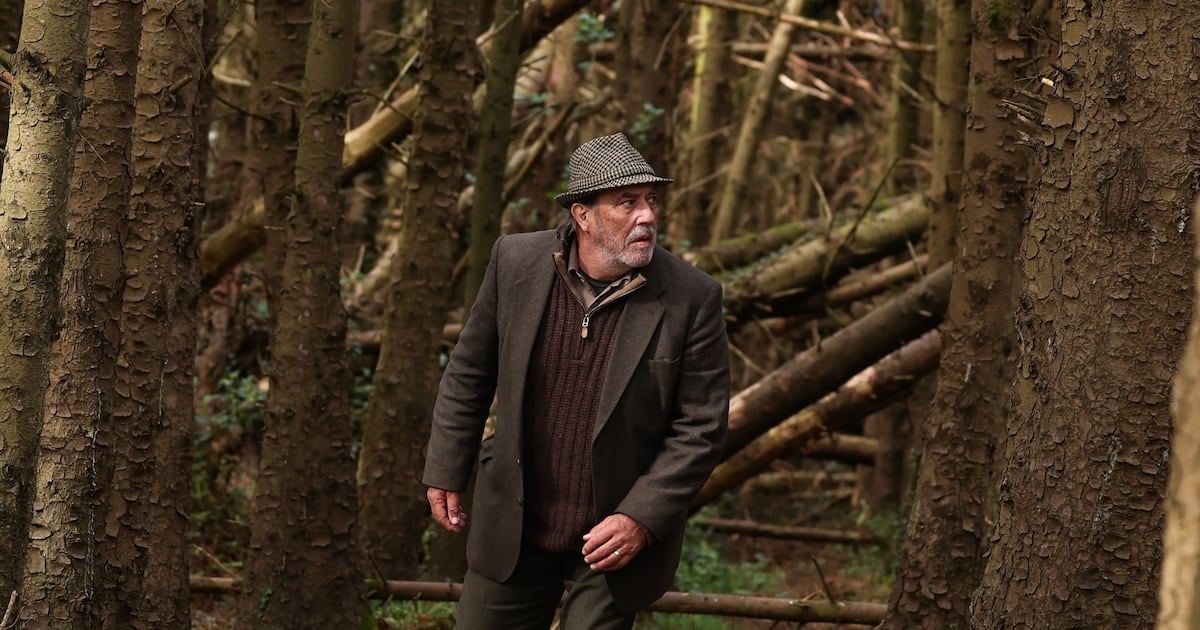
As I meet Ciarán Hinds, the most hearty and unaffected of actors, he is taking a day’s rest from filming in Co Wicklow.
“I’m working on Walk the Blue Fields,” he says. “The Claire Keegan adaptation by Conor McPherson, with John Crowley directing.”
Ah, yes. After An Cailín Ciúin and Small Things Like These, another Keegan story gets the big-screen treatment. The cast is stacked. Who else is in the Netflix production?
“Somebody called Emily Blunt?” he says in mock confusion. “A guy called Andrew Scott?”
He chortles to himself, as if flattered to be in such exalted company. In truth Hinds is rarely far from an “all-star cast” these days. A busy actor since leaving Belfast for the Royal Academy of Dramatic Art, in London, in the early 1970s, he has, in his golden years, happened upon a truly exhausting run of fecundity.
Only a few weeks ago he was, opposite Lesley Manville, in our cinemas with Midwinter Break. Just before that he starred as Will Arnett’s dad in Is This Thing On? You can see him in Netflix’s version of John Steinbeck’s East of Eden later in the year. He has just finished shooting Tom Ford’s Cry to Heaven, a period epic with Aaron Taylor-Johnson and Colin Firth. I could go on.
“Over the last year or two I decided to slow down and just more or less choose – if I had the choice, which I don’t often – to get involved with things if I found them interesting. And certainly I found a few things that were very interesting to me. And they just seem to have arrived at the one time.”
Here is a question. In 2022 Hinds received an Oscar nomination in the best-supporting-actor category for Kenneth Branagh’s Belfast. Has that been a contributing factor to the run of high-profile jobs? Maybe that is a question for his agent.
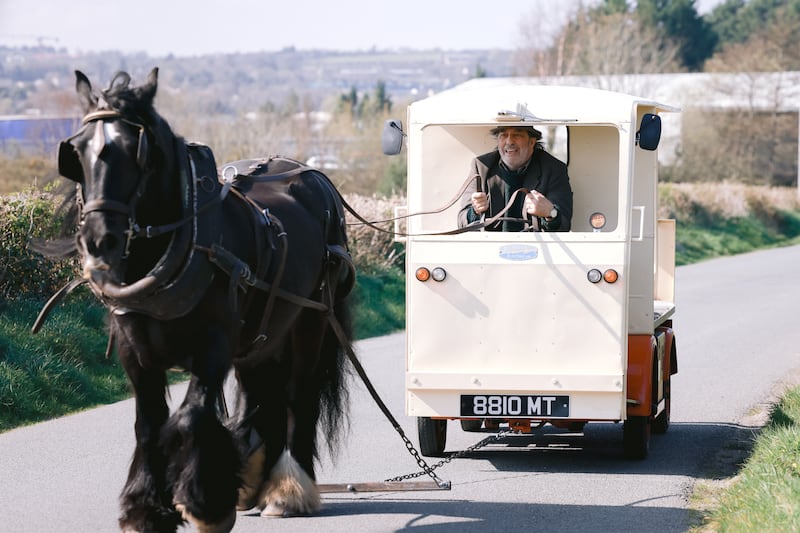 The Three Urns, in cinemas this April, has Ciarán Hinds playing an Irishman travelling, with the ashes of his late wife, from France to his old home in Ireland
“You’re right, Donald. My agent and I work very intimately,” he says. “He knows what my taste is. Sometimes he says, ‘This is a paid job. This is probably something that you’d like to do.’ And we work on a very direct and personal basis.
“A couple of things came after the Oscar nomination – to turn up in action films playing the old crabby guy. Ha ha! No, I don’t need that. There are proper adventures to go on.”
But those action flicks come with perks.
“I think they might do. But I’m at a certain age where I’m not chasing perks.”
You will be more likely to see Hinds in something like this month’s The Three Urns. Directed by John-Paul Davidson and Stephen Warbeck, the lively, folksy comedy has Hinds playing an Irishman travelling, with the ashes of his late wife, from France to his old home in Ireland.
I would guess that part of the attraction was meeting up with old chums. The cast features such domestic legends as Lorcan Cranitch, Lalor Roddy, Sinéad Cusack, Jim Norton and Lisa Dwan. Quite a gang.
“I said, ‘Can I make some suggestions, if I’m going to be at the heart of it, about people I’d love to work with – to come up for a day, or a day and a half, and do two scenes?’ And they said, ‘Yeah’.
“It was good for me to be able to ask Jim Norton or Sinéad – people that I’d worked with – and say ‘Would you make your way up and get a decent bed for the night and decent dinner? Then we can go to work.’ It was really lovely.”
The story he has just told suggests he likes film sets to be social occasions. He looks to have the same attitude towards the promotional gauntlet. Stories amble into one another. Anecdotes wind their way around opinions. There is never a sense of him feeling under obligation to toe a line or act as salesman. Hinds just seems to enjoy being himself.
He was born, 73 years ago, in north Belfast to a doctor dad and a mum who did a bit of acting. Talking to him over the years, I have got the sense that he finds little to complain about in his childhood. These were the years before the Troubles kicked off, a period that is now rarely mulled over. Did it come as a shock when the violence began?
“It did come as a shock,” he says. “I went to St Malachy’s, a Catholic grammar school, and we weren’t taught ‘our history’ and ‘their history’. We were taught just history: European history, British history, Irish history.
“My parents were middle-class liberal Catholic, I guess. But they were open, and they mixed it up. Because my mom did a bit of drama herself. So they were mixing with people. They weren’t segregated.
“And my father, being a doctor, his practice was on the Springfield Road. So his patients all came from the Shankill and the Falls. We were brought up with no awareness of the huge tribal divide.”
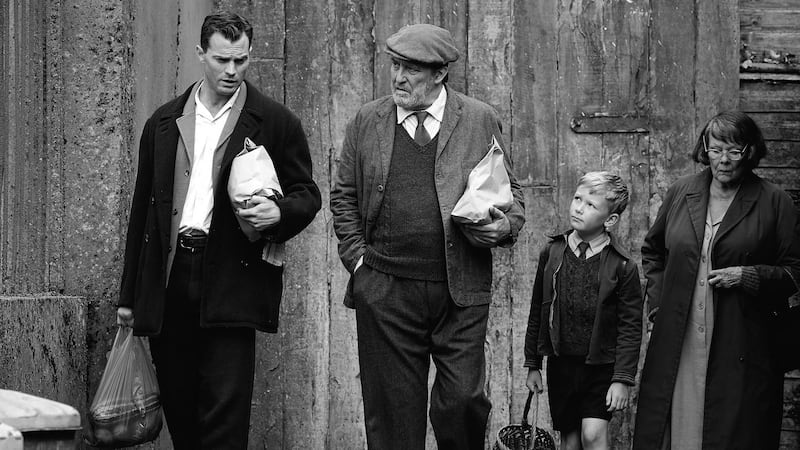 Jamie Dornan, Ciarán Hinds, Jude Hill and Judi Dench in Belfast. Photograph: Rob Youngson/Focus Features
A lot more history has passed between then and now. Belfast is buzzing in a way that he (and I, for that matter) could barely imagine during the 1970s and 1980s. Is he still connected to the old manor? Does he have a sense of those social changes? He still has family there.
“I’m aware of it,” Hinds says. “I think about this younger generational thing, about getting rid of all the orange and green history and saying ‘Can we please, for the generations to come, move the f**k on?’
“Yeah, and that’s great. That’s how it should be. But there are still chippy people up there at it again. That’s why the whole integrated-education thing is so important. We can all work together.”
There is certainly a large part of the younger generation who don’t care about the old divisions. It’s a demographic you don’t hear enough about.
“It is getting on for 30 years,” Hinds says, looking back to the Belfast Agreement. “You need to move forward – for the future of people you purport to love and care for. If you can afford to, can you not just get out more and be more open-hearted? The Fleadh Cheoil is going to Belfast for the first time this year. I think that should be a great event for everybody.”
The young Hinds briefly studied law at Queen’s University Belfast before lunging towards the acting lark. I can see him as a barrister. He has the bearing. He has the voice. Does he ever consider an alternate path where he practised that profession?
“I don’t think I had it in me to be the lawyer type,” he says. “It’s more of an intellectual pursuit.”
He had enough raw talent to make it into Rada in London. That was an exciting place to be in the aftermath of the 1960s. But there is pressure too. I imagine competition between the hungriest young actors of the era.
“There were 21 students. And they did seven terms,” Hinds says. “Kevin McNally was there. He was the brilliant one of our generation. He gave a remarkable Falstaff at the age of 19. Wow! You knew he was very special.”
McNally, still with us and still busy, became an unavoidable character actor. But others fell away. The breaks weren’t there. They maybe realised they didn’t have what it took.
“I don’t know what it was in our time, but most of them gave up when nothing was happening and retired. But before us there were wonderful actors. Alan Rickman was there. After us, then it all started. You had Kenneth Branagh and Fiona Shaw and so on. I was gone by the mid-1970s.”
It is an oddly shaped career. You could reasonably argue that, for a decade or so, Hinds was an “actor’s actor”. That is to say he worked consistently but wasn’t hugely well known outside the profession. Like Liam Neeson and Gabriel Byrne, he got an early break in Excalibur, but that did not immediately lead to movie stardom.
“I was doing theatre in Dublin,” he says. “Jim Sheridan was running the Project Arts Centre there. Jim took me into the company, where I met the wonderful actors Peter Caffrey and Johnny Murphy. John Boorman was looking around for young actors to be in Excalibur. But then I went back to the theatre. I really didn’t do much television work until the 1990s, I guess.”
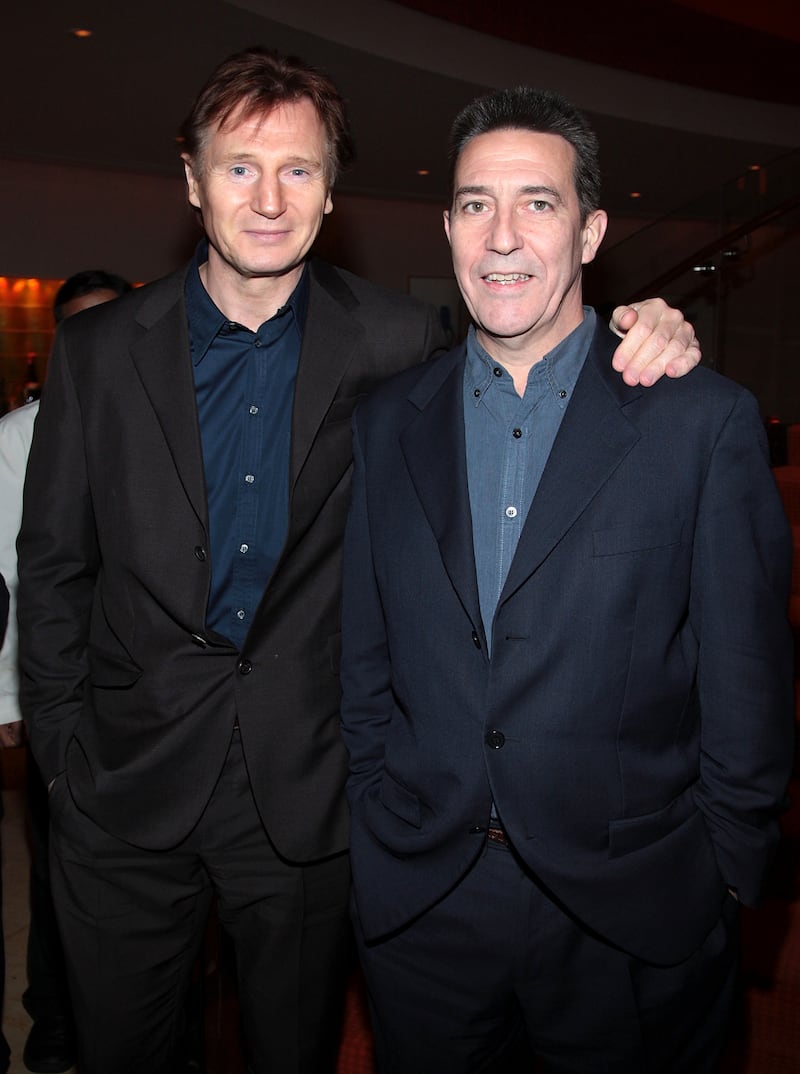 Liam Neeson and Ciarán Hinds at the premiere of There Will Be Blood in 2007 in New York City. Photograph: Stephen Lovekin/Getty Images
Did he ever look at how, say, Neeson surged after Excalibur and wish he too could be swanning about Hollywood?
“No, no. Liam is a great friend, and I always knew Liam had it in him,” he says, amiably. “He wanted to have a go at being a film star. I didn’t have that in my DNA.”
In the mid-1980s he toured the world in Peter Brook’s legendary production of the Hindu epic Mahabharata. It was there that he met his wife, the actor Hélène Patarot (who plays his character’s lover, Mina, in the RTÉ dramedy The Dry), and they have remained together ever since.
Does having another actor in the house help? Do they bounce ideas off one another?
“I sometimes help Hélène if she wants help with dialogue,” he says. “It just turned out that I worked more than Hélène.”
Hinds laughs his self-deprecatory laugh.
“It’s strange. The opportunities she has, she goes more for quality than quantity. I’m a bit more about quantity.”
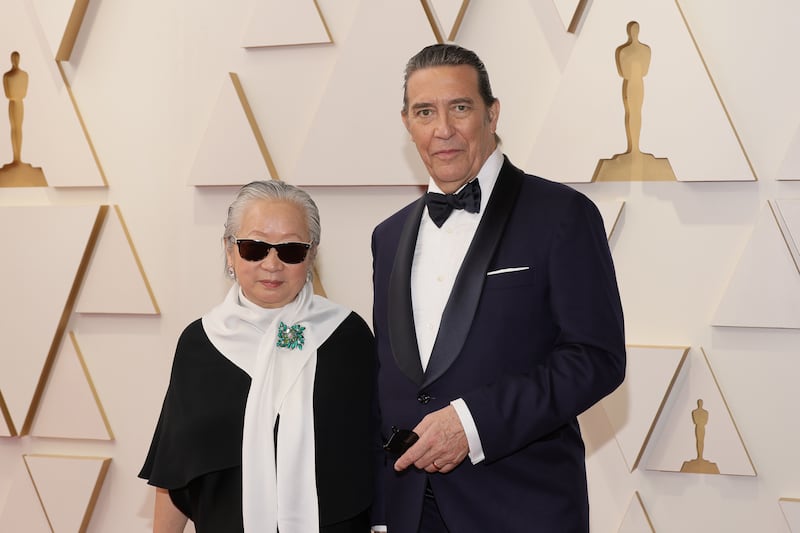 Ciarán Hinds and his wife Hélène Patarot attending the 94th Annual Academy Awards in 2022.Photograph: Mike Coppola/Getty Images
I’m not sure that’s true. There were endless highlights throughout the 1990s. He was in the first production of Patrick Marber’s controversial Closer, at the National Theatre in London. He played Richard III at the Royal Shakespeare Company for Sam Mendes. It is often overlooked that he was hugely touching as Captain Wentworth in Roger Michell’s 1995 film of Persuasion – a first shot in the late-1990s Jane Austen revival – for the BBC.
“It was a beautiful thing to be involved with,” he says. “You realise, as you get older, it’s a tricky thing to take great pieces of literature and transfer them into another medium and give it the grace and the depth.”
As the decades progressed Hinds became an increasingly unavoidable face on film and television. He is in Game of Thrones, There Will Be Blood, Munich and (of course) a Harry Potter film.
I get no sense that the greater visibility has much changed him. His daughter, Aoife Hinds, is now a busy actor. He and Patarot share their life between Paris and London. I can understand that. Hinds is a man of international tastes, but the Belfast in him remains strong. How is his French?
“Well, I did it up to A-level,” he says. “Suddenly these words unlock themselves – with the aid of some red wine. Ha ha! The neighbours are always very kind to me. I have enough to get by and converse.”
That matters. He always has a great deal to say.
The Three Urns is in cinemas from Friday, April 17th