
Punches were thrown and, in a video taken on a cellphone at the time, voices could be heard yelling “f***ing Mongol c***s”.
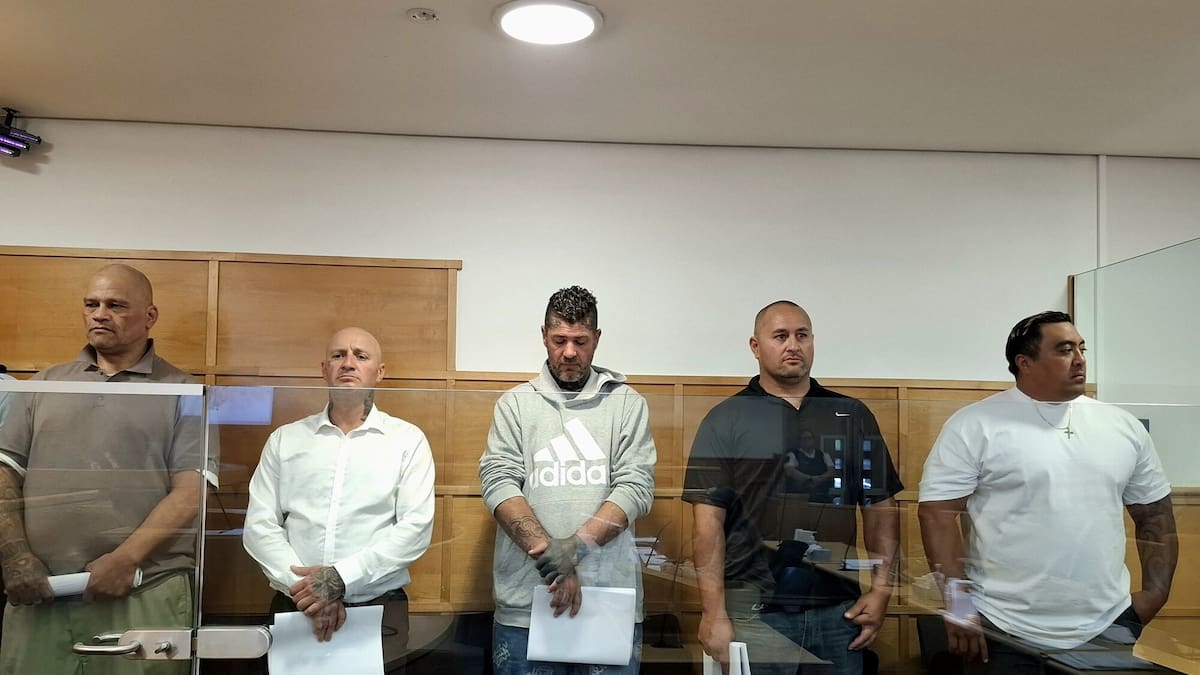
Now, five men, who are all patched Greazy Dogs MC members, are defending charges in a judge-alone trial in the Tauranga District Court.
Jay Kiwi, Jesse Fisher, Paul Carmichael, William Palmer and Wayjo King face a range of charges which include rioting, assault with intent to injure and wounding with intent to cause grievous bodily harm.
King is also charged with aggravated robbery, for allegedly robbing complainant Neville Kingi, a Mongols member, of a Nissan Navara.
Some of the charges allege specific actions by particular defendants, but the men are also charged as parties to some of the charges.
Section 66 of the Crimes Act 1961 defines who is considered a party to and guilty of an offence, and has two subsections.
The first, subsection one, covers those who commit, aid, abet or incite an offence; subsection two focuses on a “common unlawful purpose”.
Crown prosecutor Larissa Mulder said in this case, the common unlawful purpose that underpinned all the charges was that the defendants went to inflict violence on members of the Mongols Motorcycle Club, for wearing gang regalia on the Greazy Dogs’ gang territory.
The judge-alone trial before Judge Melinda Mason began on Monday morning, with Mulder setting out each charge and whether each defendant was charged as a principal offender, or a party.
The Crown spent much of the first day playing the same CCTV footage, but with a different defendant circled on the footage each time it was played.
Detective Carolyn Crawford, the officer in charge of the case, narrated the footage and described the defendants’ clothing and what the police allege were their actions, as it corresponded to the various time codes on the footage.
She described where each defendant was standing at different points, relative to the violence they may not have been directly involved in.
Sometimes the footage was zoomed in on the fighting, which took place in the middle of Maunganui Rd and on the grass median strip, but when the view pulled out, traffic could be seen backed up in both directions.
At one point, a man in a black hoodie, who Crawford described as an “unidentified male”, smashes the windscreen and headlights of one of the white utes, spraying glass all over the road.
At another point, she described the knuckle dusters allegedly worn by Palmer.
Different interpretations of CCTV footage
While the Crown points to the violence and injuries, as happening in continuous action with all the defendants essentially working together, the defence lawyers are focused on the individual actions of each defendant, and challenging the police interpretation of the CCTV footage.
Defence lawyer Bill Nabney, who represents Kiwi, Palmer and Fisher, cross-examined Crawford, asking her about Fisher’s alleged actions.
He suggested Fisher wasn’t always the aggressor, that his actions hadn’t caused the wound to complainant Devin Gibbs, and that he was seen backing away from other altercations.
Crawford said she couldn’t say what injuries had been caused by which actions, but Mulder addressed the judge to clarify the Crown’s position.
She said the Crown alleged that Fisher was part of the actual course of events that may have caused the wound to Gibbs, and therefore is charged as a party under subsection one of Section 66.
Another Greazy Dogs member, Stacey Te Tatau Adam, has already pleaded guilty and been sentenced as a principal offender in causing the wounding, which related to him slamming the ute door on Gibbs.
Nabney also cross-examined Crawford about the actions of his client Palmer and said while it was alleged he was wearing knuckle dusters, there was no evidence that the man he was alleged to have assaulted with them suffered an injury.
Crawford said the CCTV showed that Palmer struck a complainant while wearing them, but she accepted the knuckle dusters might not have connected, and it could have been just his arm that made contact.
Carmichael’s lawyer, John Wayne Howell, also cross-examined Crawford about his client’s actions, suggesting a different interpretation.
He suggested Carmichael was only focused on a Mongols member who had a machete.
“Is Mr Carmichael preventing the Mongols member with the machete from moving forward?” Howell asked the detective.
He suggested it could be interpreted as Carmichael stopping further violence, by confronting those with weapons.
“That’s not how I interpret it,” she replied.
She said her interpretation was based on the fact that the Greazy Dogs were the initial aggressors, and had waited until they had enough numbers to confront the Mongols.
Howell said Carmichael had confronted Mongol members with weapons, putting his own safety at risk, to prevent them using weapons against others.
“His personal safety was at risk the moment he turned up at a gang fight,” Crawford replied.
King’s lawyer Georgia Warwick said King pleaded guilty to a single assault, where he threw a Mongols member to the ground, but beyond after that her client was just “walking around”.
She said the CCTV had no sound, and there was no evidence King had been shouting or saying anything to encourage other violence.
‘Get there now’: Greazy Dogs president
Most of the charges are underpinned by Section 66, but it’s particularly relevant to the charges faced by Kiwi, the Greazy Dogs president.
He faces all charges, except the alleged robbery of the car, but he was not at the scene on June 21.
He does not feature in the CCTV footage, but a video of the confrontation was found on his phone and has been used in the trial.
The case against Kiwi is primarily underpinned by a text he allegedly sent out at 9.12am to 96 “Greazy” contacts.
“Brothers the boys are heading to Mt McDonald’s. Mongols are there. 10 of them. Get there now”.
The Crown says that when he sent this message, Kiwi was encouraging the violence and unlawful actions that unfolded that morning.
Nabney questioned Crawford about the communication.
“There was no further messaging from him saying, ‘take weapons, beat them up, smash the cars up’ nothing like that, was there?” Nabney said.
Crawford confirmed there were no further messages at that stage.
It’s understood that the Crown will call a gang expert to give evidence about gang communications, and how they can be interpreted.
The trial before Judge Mason continues, and is expected to take three days.
Hannah Bartlett is a Tauranga-based Open Justice reporter at NZME. She previously covered court and local government for the Nelson Mail, and before that was a radio reporter at Newstalk ZB.