
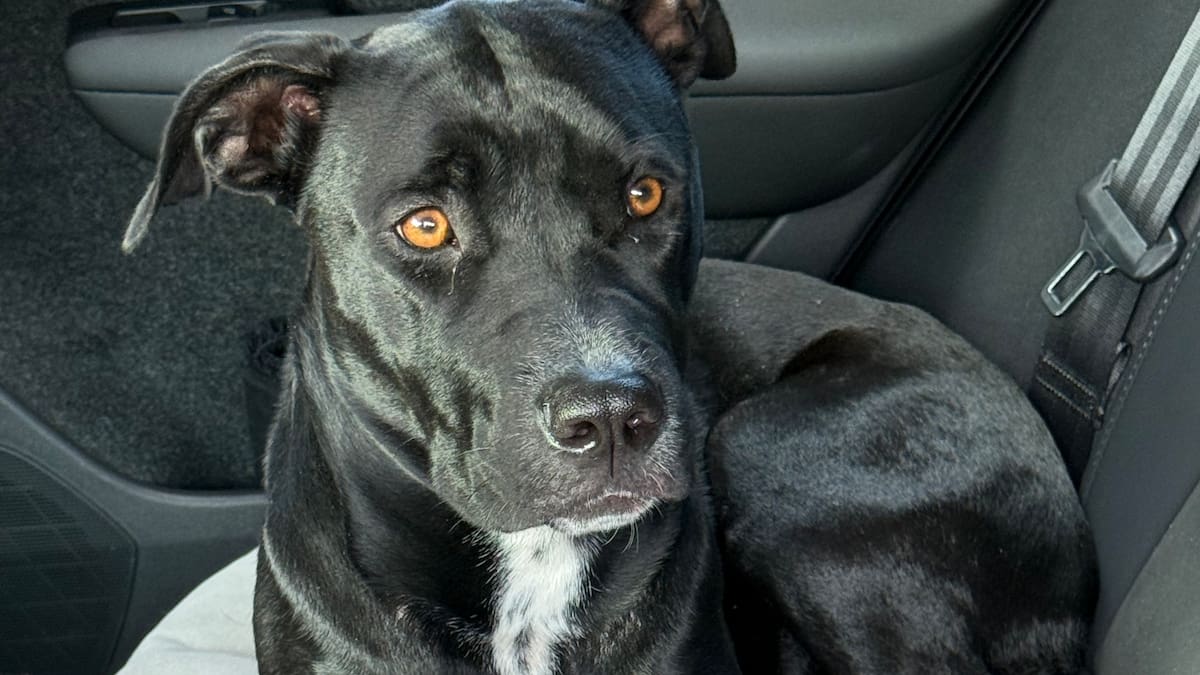
Yee would eventually find out that the dog had been impounded, on March 9, after no microchip was found.
She said she and her sisters made at least three phone calls and emails to the Auckland Council to express their interest in adopting the dog themselves.
On the last call, on March 20, one of her sisters was given the devastating news that the dog had been put down two days earlier.
“I was so gutted. Oh, I was devastated. I was shocked. Three of us rang them … all saying that we were interested in this dog,” she said.
The dog Auckland woman Corinne Yee found injured outside her Mt Welllington home. Photo / Corinne Yee
“I don’t know whether the right hand wasn’t talking to the left hand, or what was going on, because that seemed odd to me that they would put down a dog that there was interest in from the community.
“It was a beautiful, beautiful dog.”
Yee said they were told that the animal had been euthanised because tests showed it was nervous on the lead.
But she believes that had more to do with the environment the dog found itself in – namely at a noisy pound surrounded by other dogs.
‘She wasn’t given a chance’
A photo of the dog was posted on the Auckland Council website, looking for its owner.
In a letter she wrote to the council after discovering the dog had been put down, Yee told authorities of the family’s upset.
“I feel deeply sad that she wasn’t given a chance. Even if it was the truth – that she was put down because she was nervous on a lead – I don’t think that’s a good enough reason to put a dog down.
“I understand that you are overwhelmed with dogs. But this [was] one dog which was able to be homed and loved.
“I hope in future that a dog like this, with an interested and invested potential owner, could be given a chance.”
Last year, it was reported that more than 6000 impounded dogs were put down in the year ending in June, with shelters filled with unregistered dogs with behaviour issues and no one claiming them.
Auckland Council spokesman Robert Irvine said animal management officers and shelter staff were all animal lovers. Seeing dogs they have cared for euthanised was the hardest part of their job, he said.
“They understand how the customer who cared for this dog will feel.”
Irvine said that when dogs were brought in, staff observed them closely for any temperament issues. If no concerns were noted, a dog would go through a temperament test to determine suitability for adoption.
“Unfortunately, the majority of dogs that come through our shelters have not been properly socialised or cared for by their owners and are not suitable for rehoming due to behavioural issues – which mean they can pose a risk to people or other animals if we released them.”
In relation to this particular dog, a shelter manager told Yee in an email that their team worked hard to achieve positive outcomes for dogs, including rehoming and fostering.
“Unfortunately, there are situations where, based on assessment outcomes and risk, euthanasia is considered the most responsible course of action.”
Sign up to The Daily H, a free newsletter curated by our editors and delivered straight to your inbox every weekday.