
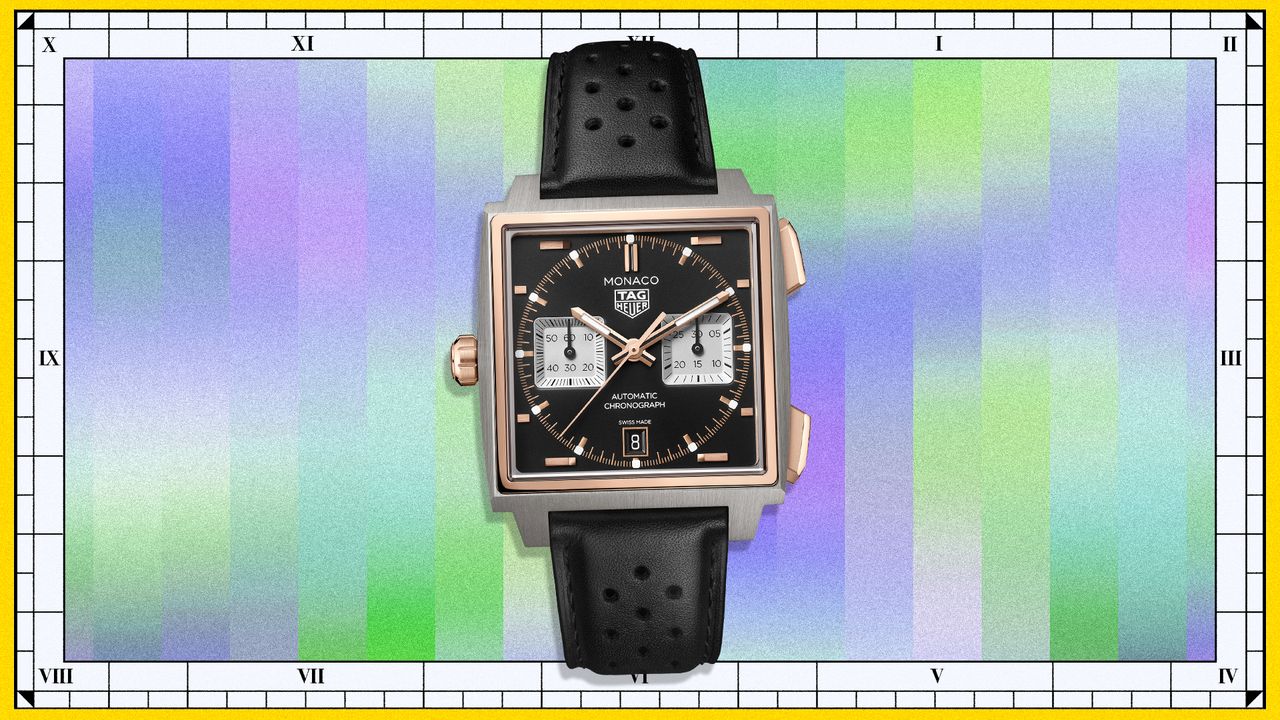
The TAG Heuer Monaco is big, square and uncompromising. It’s “a Marmite watch”, brand heritage director Nick Biebuyck freely admits. But, as with Marmite, sometimes something bold really hits. The Monaco was launched in 1969 to commemorate the Grand Prix of the same name, hence its chronograph function and car dashboard-style subdials. Motorsport creds were further embellished a couple years later, when Steve McQueen wore his TAG Heuer Monaco in the 1971 racing film Le Mans.
Classic menswear moodboards have never been the same since. And with Formula 1 bigger than ever, it makes sense that the moment also belongs to the Monaco. “Walk around the track on a Formula 1 weekend,” says Jeff Stein, founder of the online vintage Heuer archive OnTheDash, “and you will see the Monaco – on enthusiasts’ wrists, as an oversized track clock, and on the podium.” Notably, on the wrist of Max Verstappen, who has an armoury of high-spec, one-of-a-kind Monacos. “We are Formula 1,” says Biebuyck. “To be honest, it’s a total waste of time for any other watch brand to put any money into it.”
To reassert this, if it needed any reassertion, TAG Heuer has got two big new Monaco releases for this year’s Watches and Wonders. First up is a refresh of the core Monaco Chronograph model, which hews much closer to the original 1969 design than in recent decades. “Monaco was introduced in 1969,” says Biebuyck, “but then discontinued in 1974 because it was a total commercial failure. No one understood this watch. It was like an alien spaceship had arrived, three years before the [Audemars Piguet] Royal Oak [and] seven years before [Patek Philippe’s] Nautilus. [There were] no other real ‘shaped’ watches in the marketplace.”
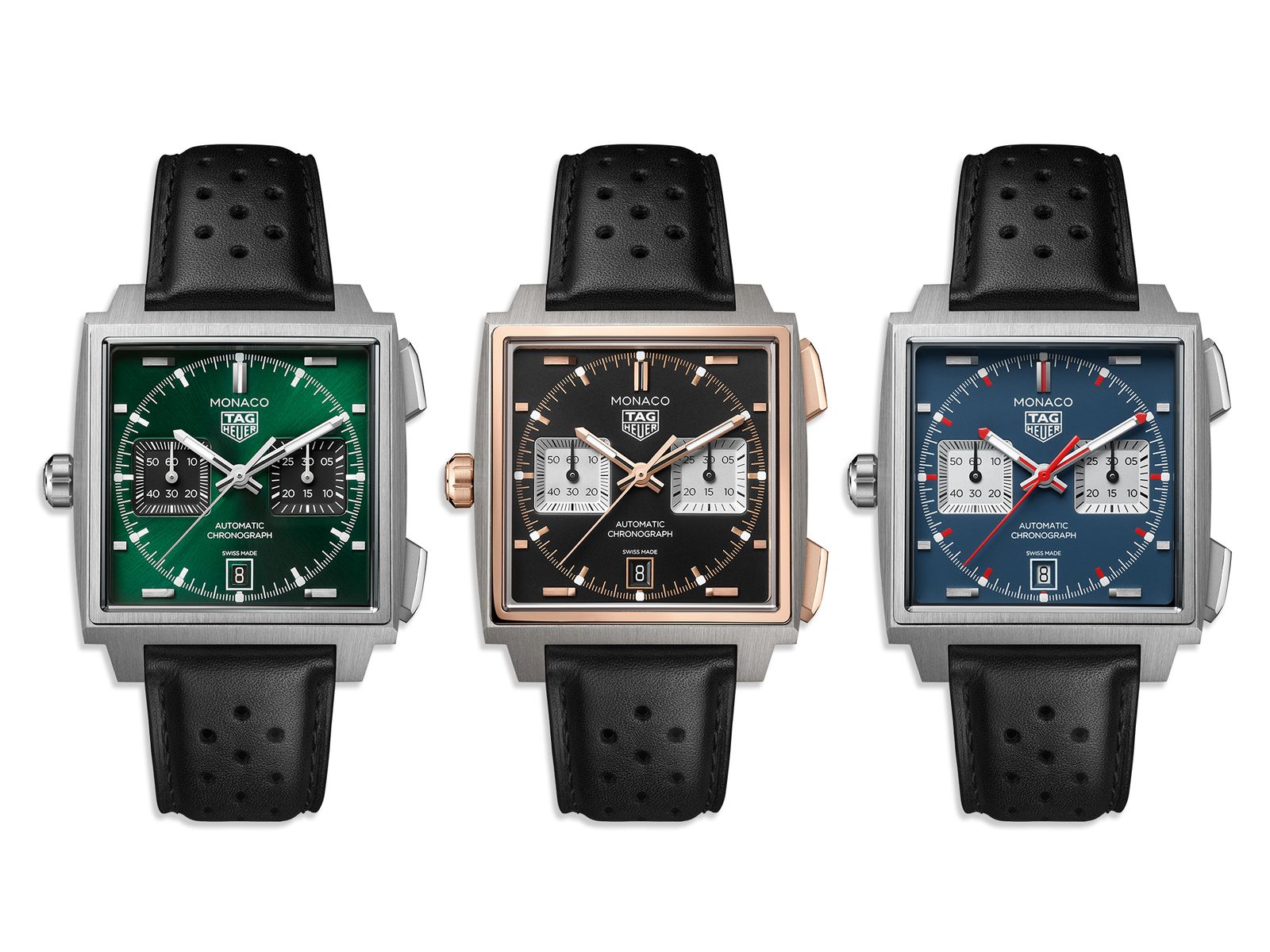
The 1990s reissue had a case “that had nothing to do with the original. It was just like they saw a picture in a book. As a result, it’s not that ergonomic.” But this new one copies the original’s design tricks – including a tapered convex caseback, and the crystal taking up “a decent chunk of the height” – so it wears a lot lighter than its size would suggest. The colour options include, naturally, a classic McQueen-style blue dial, plus one in racing green, and a natty two-tone number in titanium and pink gold.
But the release that Biebuyck is really excited for – that he’s wearing for our interview, in fact – is the Monaco Evergraph, a hyper-technical, skeletonised design that puts TAG Heuer in the arena with all the ultra-high-end watch brands. To zoom in on one aspect of the very impressive mechanical specs: it uses what’s called “compliant mechanisms”, which abruptly buckle back and forth, like squeezing a playing card, rather than the swinging motion of a spring. It means “much less wear, much less friction” than a traditional chronograph, explains Biebuyck. “You basically don’t ever really need to service it.”