
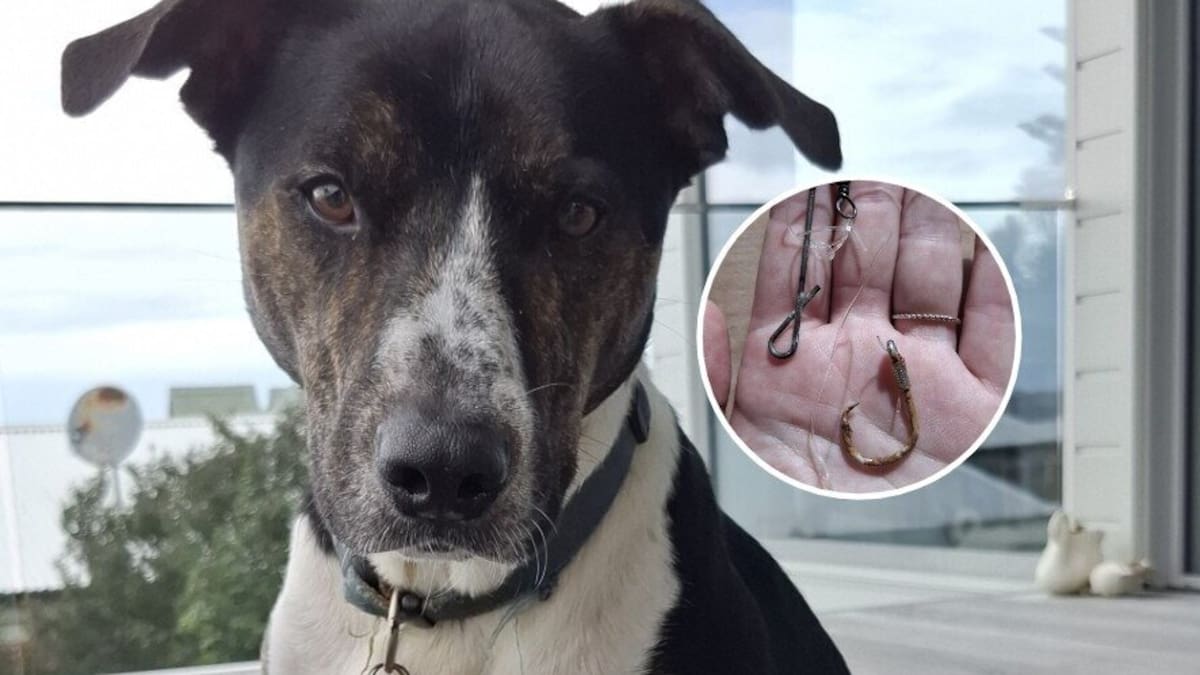
When the family returned a few hours later, the fishermen had left, and Pax was no longer leashed.
It was at this point that Muller‑Ward believed Pax swallowed the hook.
“With a longline, how many hooks are on there, and so as they come in, they have to unhook them all, and I think they’d just obviously dropped one and then not checked behind them.”
When she checked Pax’s mouth, Muller‑Ward said the hook was still visible.
She saw the metal clip, swivel and nylon line attached to the hook, lodged at the back of his throat.
The fish hook that was retrieved from Pax’s stomach. Photo / Supplied.
“He did try to vomit it up; he was gagging and vomiting for a short time, but then he managed to swallow the whole thing down.”
With no local vets able to perform the specialised endoscopic procedure to remove the hook, the family holiday was cut short.
Caroline’s husband, Hamish Ward, drove Pax directly to Auckland, the nearest treatment centre.
After they arrived at the emergency clinic, an X-ray confirmed the hook had reached Pax’s stomach.
Fortunately, she said, timing was on their side.
The hook had not lodged in his throat or reached his intestines, where it could have caused serious damage.
A specialist had arrived at 7pm, and the procedure continued until 2am on Easter Sunday.
They removed the hook in stages, first cutting it from the attached metal clip before retrieving the remaining pieces.
X-ray of the fishhook lodged in Pax’s stomach. Photo / Supplied
Muller‑Ward said that without the specialist, Pax would have faced major surgery.
The hook would have required removal by cutting directly into his stomach, leaving a significant wound and weeks of recovery.
“He just walked in, went to sleep, had a bad dream, and walked back out.”
The ordeal split the family over Easter, with Ward staying overnight in Auckland while Muller-Ward stayed in Waihī with their children.
She said waking up on Easter Sunday without half the family underscored how serious the situation had been.
Pax is now fully recovered and back to his normal self.
Although the experience highlighted for Muller-Ward how dangerous discarded fishing gear can be, not only for pets, but also for wildlife and children.
She said she saw a bird recently with a hook and nylon hanging from its mouth, tangled in dried seaweed.
“It’s not going to be able to feed, and it’s going to die a horrible death.”
Muller‑Ward urges fishermen to take responsibility for their equipment, especially when using longlines with multiple hooks.
She hopes that by sharing their story, it will encourage greater care on beaches to help prevent similar incidents.
“Please check carefully that you remove all of your equipment and rubbish when you leave. Lives depend on it.”
Zoe Blake is a multimedia journalist at the Bay of Plenty Times and Rotorua Daily Post.