
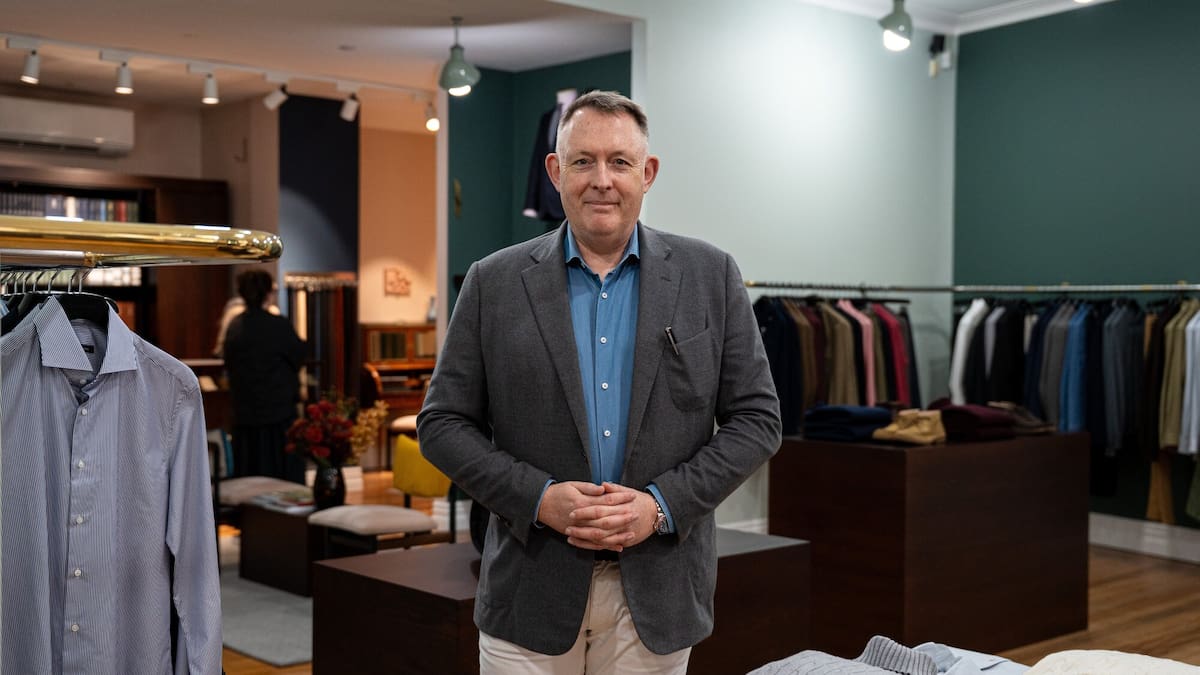
The Crane Brothers owner-operator loves a suit but will also offer advice on the alternatives.
A suit has caught Murray Crane’s eye.
He’s perched on a stool in his High St store, ready to talk about the next era of Crane Brothers (renovations are hammering away in the background).
The street is busy. But mid-interview his eyes flick away – to that familiar beacon within a medley of mufti.
He tells Viva that while some in neo-tech and banking sectors enjoy incorporating outdoor and casualwear into their office attire, he predicts the suit will endure.
“I think at some point they’ll want to move away from that and the old rules will apply.”
He always wears one. The owner-operator’s namesake suiting store Crane Brothers has been a fixture of High St since 1999, offering premium menswear and precise tailoring in the inner city of Tāmaki Makaurau Auckland. In recent years, the store has also found a foothold in Ponsonby and Ōtautahi Christchurch.
This year, Crane made moves to bolster his firm presence on High St even further – he’s passionate about the place.
“I would argue that this is the CBD even more so than Queen St now. I mean, it’s dynamic, it’s busy.”
In January, he renewed his lease for another 25 years – doubling down on the first quarter of a century he’s spent retailing in the inner-city. In the same month, following the closure of Ruby’s High St store, which sat next door to the fine suit and menswear store, Crane negotiated with the landlord to incorporate and renovate the space.
“The store got bigger. We’d always wanted to expand and we’d always had it in our thinking that if we could get our hands on the Ruby lease that we would take that space.”
The refreshed Crane Brothers store on High St. Photo / Alyse Wright
This transformation took place over Easter weekend. Protective plastic boxes carried neatly folded ties and garments up and away into storage, while old walls came down and new ones went up.
The expansion increases the size of both the store and storage space. There are two new huge windows framed with Crane Brother’s signature brass frame – to catch the eyes of those strolling past.
Who specifically is he looking to catch? And how do they want to dress?
The Crane Brothers customer is broad right now, Crane says.
“Our core client base are 25 to 65. Most of them are working professionals, or self-employed entrepreneurs in creative industries and tech.”
Many have a strong interest in expressing themselves through clothing.
“People that are a little more considered about how they look. For a lot of them, the way they dress is a part of their personal brand.”
Photo / Alyse Wright
Crucially, Crane will also be using the extra real estate to better display his offering of knitwear and footwear. They are two growth categories for Crane Brothers, reflecting increasing cravings for casual menswear dress codes in the office, which Crane notes was accelerated by hybrid working styles during Covid lockdowns.
This shift is notable on the Waitematā waterfront near some of Auckland’s glossiest offices – puffer vests layered over collared shirts, sneakers paired with trousers, blazers worn with jeans.
“It’s gone from being a very narrow boundary … Men wore a suit, they wore a tie,” Crane says. “Whereas now, [there’s] smart-casual, no jacket policy, work-from-home, dress for your day. There’s so much noise out there.”
Crane notes a resulting confusion amongst customers.
“There’s the anxiety around getting it wrong, I guess. Turning up to the office in a shirt where all their colleagues go ‘what are you wearing? Are you going to a disco?’”
In the changing room, this means Crane and his suited staff are offering more styling advice. He explains how to choose shirting designed to be worn without a tie, how to layer knitwear and how to incorporate trousers and jackets with softer structure.
“I think it’s taken a while for people to find their rhythm. The pendulum definitely swung too far the other way.”
Most are receptive, trusting of this menswear institution – some customers are closer to friends, having visited Crane Brothers repeatedly through the years.
With this trust, Crane enjoys introducing customers to something new.
“We generally nudge them a little bit. Whether it’s introducing them to colour a bit more … It’s always a hard sell when you’re trying to break someone away from something they feel very comfortable wearing.”
Crane is incorporating some more casual wear into his wardrobe. Photo / Karen Inderbitzen-Waller
These are the interactions Crane enjoys – and he says part of the reason for Crane Brother’s longevity. His early mornings, late nights and working over holiday weekends come from a genuine enjoyment of his job.
“I think a lot of people that are in retail don’t like retail. That’s the problem. They don’t like dealing with difficult customers and they don’t like their hours.
“I think if you’re going to run a successful retail business, you need to be prepared to work those hours, you need to enjoy interacting with people. You need to have a high tolerance for a high level of patience, all those things.”
Even in difficult times, Crane has remained strong in his passion for the sector. However, he says there is some weight in the turbulent market right now.
Murray Crane on High St. Photo / Karen Inderbitzen-Waller
“I’m probably feeling a little bit less bullish now, just with what’s happening with the global economy. But, I’m still confident and still happy with our choices, where we are, what we’re doing.
“I don’t feel like anything fundamentally [has] changed, really. It’s just a slightly more challenging environment, but I think when you’re doing what we’re doing – selling high-end menswear in a small market – you’re always kind of at that alert status because it’s never easy.”
So, what’s the plan? How does a suiting shop continue to appeal to a customer base amid changing dress codes?
Well, first, you notice and embrace the swings. Crane says, perhaps in response to various uncertainties, his customers are gravitating back towards suiting – seeking reassured and authoritative dress.
“For me personally, [I see] a return to more tailoring.”
The expanded storefront on High St. Photo / Alyse Wright
Secondly, you stand staunch in the experience and cultural capital provided by brick-and-mortar retail. Crane champions the interaction, tangibility and credibility of the model.
“That’s why you’re seeing record stores, bookstores, clothing stores, anything tactile and to do with the senses, whether it’s sound or sight or the way things feel or taste. They are really becoming the currency.”
More on local fashion