
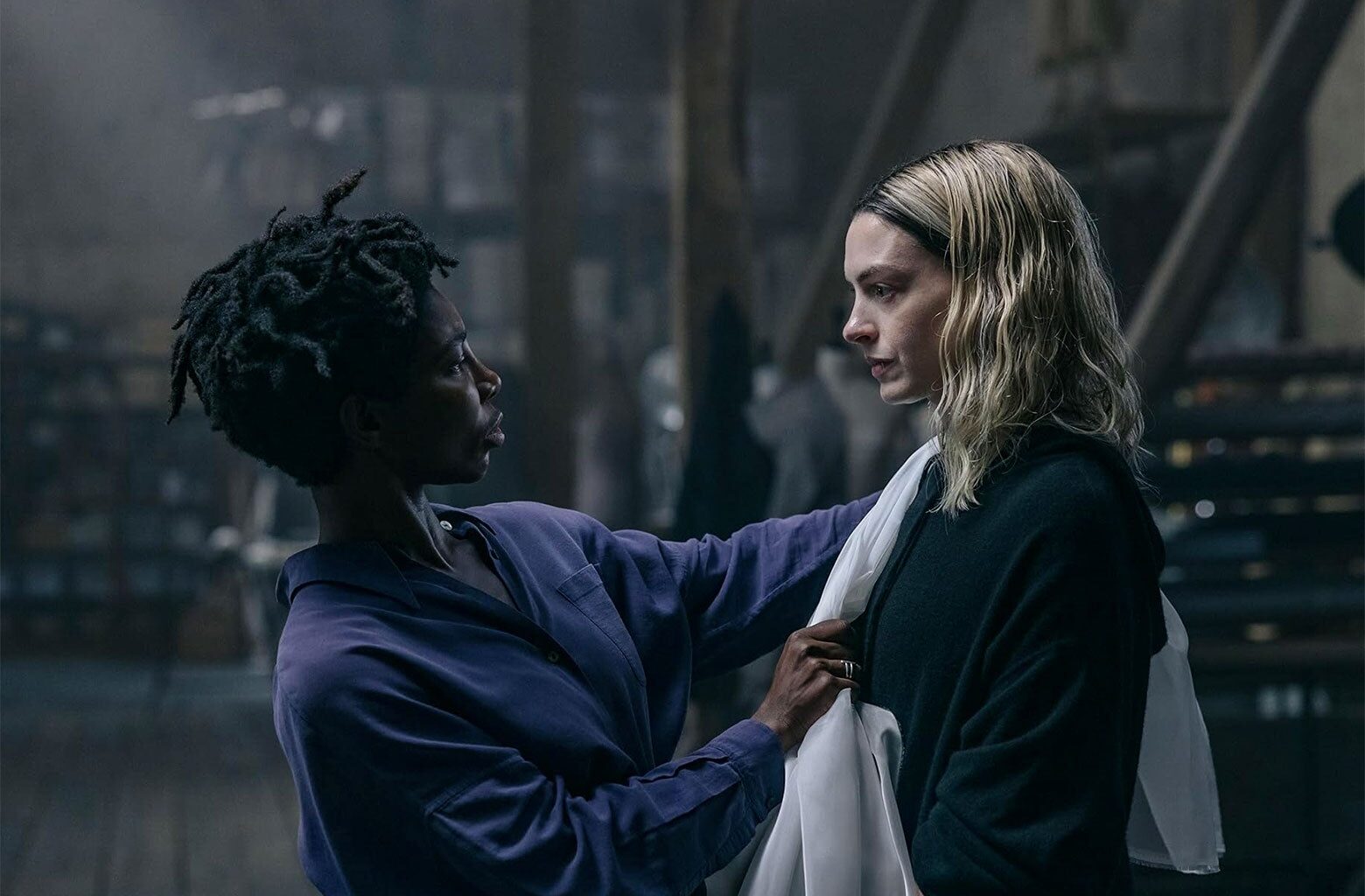
Writer-director David Lowery (Pete’s Dragon, The Green Knight) has now made two movies that center on a ghostly presence signified only by flowing cloth. In A Ghost Story (2017), Casey Affleck’s eponymous specter was nothing but a long white sheet with two eyeholes, a classic child’s drawing of a ghost whose comical-yet-spooky appearance brought a sense of playfulness to that melancholic parable about grief. Now, in Mother Mary, the ultra-basic male ghost has made way for an extra-fancy female one: a billowing bolt of crimson fabric that haunts both the movie’s main characters. This eerie, free-floating shape appears to them at crucial junctures in their lives, serving as a warning, a temptation, and a reminder of the literal and figurative threads that bind them.
The Mother Mary of the title (Anne Hathaway) is a pop star who hasn’t performed or recorded a note since suffering a severe accident onstage during a world tour 15 years ago. Sam Anselm (Michaela Coel) is the superstar’s former designer and stylist—and, to judge by an old snapshot of them mugging for the camera, her ex–best friend. (Were they ever lovers? Lowery’s screenplay never tips its hand, but the intensity of the bond the two share renders the question almost irrelevant.) Determined to return to the stage with a new stripped-down persona, Mother Mary shows up unannounced, bedraggled, and soaking wet at the rustic English estate that serves as headquarters for Sam’s cutting-edge fashion house.
The designer is both furious at her onetime bestie (for reasons we’ll find out, or at least glimpse obliquely, later on) and intrigued by the chance to oversee the self-reinvention of a pop icon. The overused icon really is the right word to describe Mother Mary’s appeal to her worshipful fandom; we learn that her signature look in her heyday included a Byzantine-style gilded halo, while her austere stage presence suggested a saintly purity beneath the thigh-high boots and the dominatrix strut. Now, though, Mother Mary wants to show the audience a rawer, more elemental part of herself—a part, as she makes clear in her terse appeal to her former friend, that no one but Sam has ever understood.

Nadira Goffe
A New Rom-Com Was at the Center of a Debate Before It Was Even Out. Luckily, the Result Speaks for Itself.
Read More
Lowery has said that his main inspiration for the character of Mother Mary is Taylor Swift—specifically the documentary of the Reputation tour, which the writer-director watched over and over in preparing for his own shoot. But Mother Mary’s aura of chilly remove is a far cry from Swift’s onstage warmth and self-deprecation (however rehearsed that persona may also be). For all her high-art aspirations and high-Gothic iconography, Hathaway’s pop diva isn’t quite the equivalent of a Gaga or a Madonna either. What we see of her past performances never fully makes plain why she had such a vast and besotted fandom; though Hathaway sings and, especially, dances with consummate technical skill, Mother Mary isn’t a figure who connects with her audience through personal charisma. She’s an icy, regal goddess, contrary to the maternal warmth suggested by her stage name (the only one we’re given for the character). The concert scenes feature original songs by Jack Antonoff, Charli XCX, and FKA Twigs, who also appears in a small but crucial role as the spirit medium who first puts Mother Mary in contact with the lady in red. Mother Mary’s music is plausible but unmemorable shimmery dance pop; I could imagine hearing any of the songs she sings on the radio or at a club but would be hard-pressed to hum a bar of one.
In dreamlike flashbacks to Mother Mary’s superstar days, her concerts seem to be taking place in darkened cathedrals rather than in stadiums, the audience rendered as an abstract field of individual glowing lights. This technique lets Lowery evoke stadium-sized performances on a modest budget, but it also communicates the intense loneliness of a life lived at that scale of fame. In an unforgettable montage late in the film, Lowery imagines the brutal grind of a yearslong world tour as a series of staircases to and from the stage that Mother Mary ascends and descends in an ever more alarming state of depletion, the performances themselves seeming to disappear.
These glimpses of Mother Mary’s past stardom are seldom balanced out by scenes that explain what Sam was doing during that same period, leaving this would-be two-hander feeling distinctly lopsided. As is also the case in her other film currently in release, The Christophers, Coel’s guarded demeanor and the sculptural quality of her face are left to do a lot of work that the script could have helped fill out. If Mother Mary’s characterization is a bit one-note—she’s famous! She’s lonely! She’s stylishly haunted!—Sam is a downright cipher about whose motivations we learn almost nothing. Both women have a tendency to speak in vague philosophical abstractions: “These metaphors are exhausting,” Hathaway’s character complains at one point, provoking a chuckle from my audience. It’s hard to imagine these two tortured artists clowning for the camera the way they do in that old photo on the wall, much less taking a break from their all-night psychodrama session to, I don’t know, order some takeout. Investing in the repair of their friendship is tough when we get so little sense of why and how they grew close in the first place.
About that silken red ghost I mentioned up top: I won’t discuss her further so as to leave the movie’s middle stretch, with its swerve into psychological horror, a mystery. But I’m not sure I ever really grasped what her recurring presence meant, either to the two women haunted by her or to the filmmaker who seems to regard this floating shape as both his movie’s antagonist and its guiding spirit. Lowery’s reluctance to assign a fixed meaning to this diaphanous bolt of fabric can be maddening, and I can understand why some viewers might reject Mother Mary as a muddle of undeveloped visual and thematic ideas. The painfully literal ending struck me as a somewhat risible disappointment, and though I admired the movie’s imagination and ambition, I can’t say I ever entered wholeheartedly into its story. Still, the creature, if you can call her that, is a triumph of design, somewhere between a textile and a gaseous cloud, seductive and sinister at once.
How Stephen King Made The Shining Even Scarier
The solemnity with which Mother Mary treats the act of celebrity self-styling can at times feel fatuous—this is the furthest thing possible from a show-business satire—but Lowery’s deep respect for art and artists is often moving in its sincerity. In a stunning early sequence, Mother Mary shows Sam the choreography for a solo dance she’s rehearsing for her upcoming tour. Sam insists that the dance be done without music, since she has taken a vow to never again listen to a song by her former collaborator. For a few minutes, the only sound to be heard is the slapping of Hathaway’s feet—and, eventually, the slamming of her entire body—against the wooden floor. (The startlingly visceral choreography, like the group dancing in the concert sequences, is by Dani Vitale.) In that quiet moment, more than in the stylized flashbacks to past performances or the present-day exchanges of somberly mystical dialogue, we can sense this anguished performer’s longing to express herself to an audience, as well as her desperate need for the critical judgment of her former collaborator and friend. The red ghost is nowhere to be seen in this wordless scene, but the connection she seems to symbolize—between two artists who need each other to do their best and deepest work—is never more in evidence.
Get the best of movies, TV, books, music, and more.