
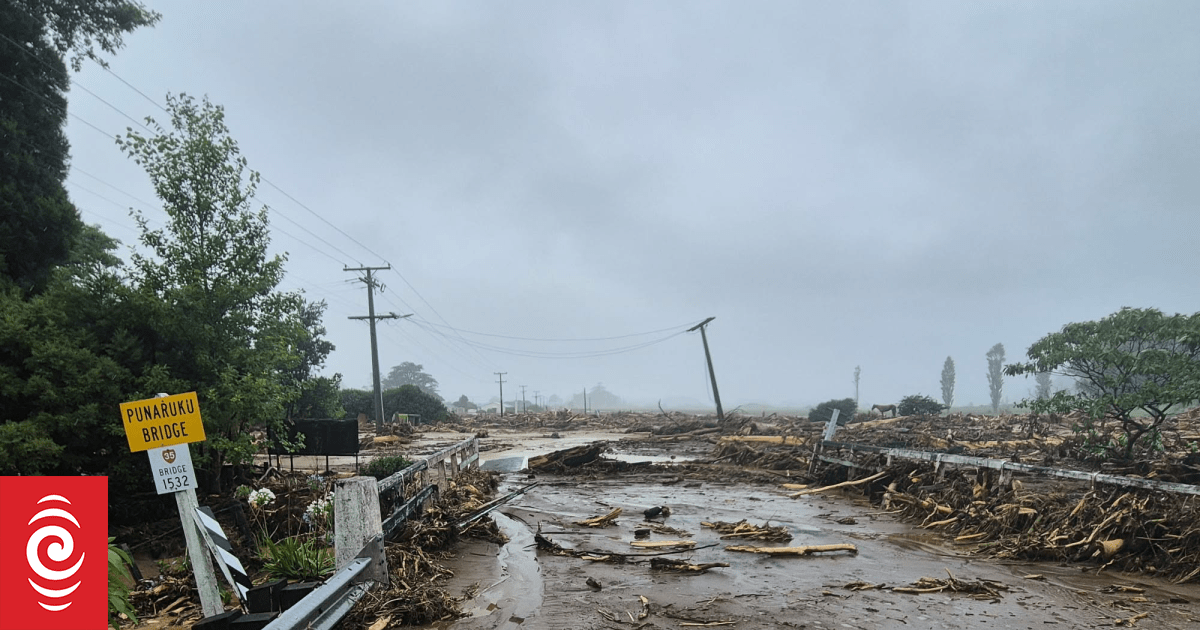
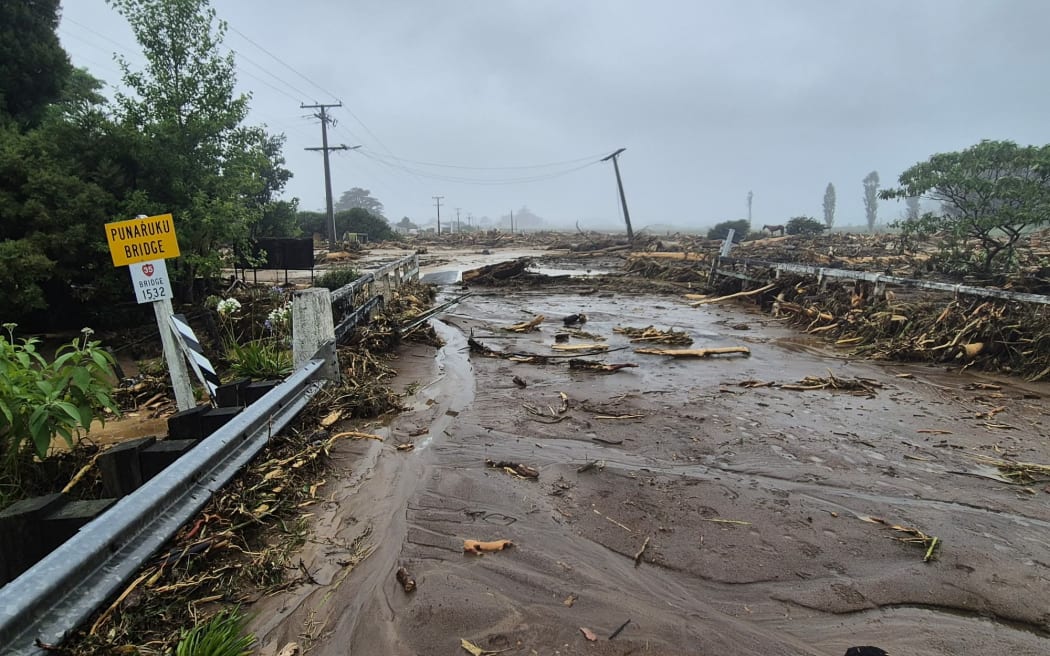
Onepoto, Wharekahika and Te Araroa were hit badly in the late January storms. The whole of the East Coast was cut off.
Photo: SUPPLIED
New Zealand communities confront the financial, cultural, and spiritual costs of staying by the sea – and of leaving
For generations, the Kiwi dream for many has been simple: a home by the water.
But for a growing number of communities, that dream is now quietly ebbing away.
Across coastal New Zealand – from Westport to the East Coast to low-lying pockets of South Dunedin – the same question is swirling: how long can we stay?
Rising seas, more intense rainfall, and back-to-back extreme weather events are exposing the vulnerability of many coastal settlements.
On top of this, insurance is tightening, and repairs are becoming more expensive and repetitive.
So, in the current climate, The Detail asks: is managed retreat – or coastal relocation – unavoidable in New Zealand?
“The short answer is yes,” says Victoria University Professor Jonathan Boston, who specialises in climate change, including managed retreat and coastal relocation.
“Given the evidence we have in the scientific community about the kinds of impacts that climate change will have – both on the more severe weather events… but also as a result of sea level rise over the coming centuries, probably, we are going to be faced with increasing numbers of properties and communities and towns, particularly on coasts but also in riverine areas that are going to be increasingly exposed to significant risk.”
In simple terms, managed retreat means moving people out of harm’s way – before climate-related disaster forces the issue.
The government is involved in the move and management, and usually buys out properties. The costs can go into the billions, and the moves can take years.
But Boston says relocating a community isn’t just a logistical exercise; it’s an emotional one.
It means not only leaving homes, but also schools, streets, neighbours, memories, and in many cases, especially for Māori, land that holds generations of meaning.
“I think the emotional and psychological dimensions of this are absolutely crucial,” Boston tells The Detail.
“And one of the things we need to come to terms with is that we are going to be faced with very significant loss.
“A loss of very valuable cultural assets – it may be cemeteries, urupā, or it may be a very special place from a spiritual perspective in terms of some significant event or where a marae has been based for a long time or where a church has been based for a long time.
“There are going to be very significant losses that we are going to have to come to terms with. We will simply lose prominent landmarks that people have valued over very long periods of time.
“That is something as a society we need to talk about and address, upfront in my view, and be very, very honest about.
“And, indeed, coping with that loss – the loss of place – is really a fundamental part of this really tragic problem that we are grappling with. I don’t see any easy answers.”
Boston says government frameworks are still evolving, with ongoing debate about how costs should be shared between central government, councils, insurers, and individuals.
He says we need a “really well-developed, integrated, holistic, systematic planning process, which is inclusive, participatory, and involves people, and which has really good, rich information available to people” about all options and risks.
“If we don’t have that kind of planning process, in which people feel involved and have some sort of sense of ownership of their future, then I think that will be very, very bad.
“And as part of that, if we don’t have adequate funding instruments that enable people to have a secure future, rather than simply losing everything – losing their business, losing their home, maybe losing their farm – if we don’t have a planning process and a funding process that facilitates people being able to move on and get on with their lives, then, well, we will simply have colossal maladaptation and a great deal more harm and suffering than would otherwise be necessary.”
Tai Rāwhiti on the East Coast has repeatedly been battered by cyclones and flooding in recent years, with the district isolated again this week after Cyclone Vaianu.
On Monday morning on Morning Report, Prime Minister Christopher Luxon talked about relocating East Coast communities.
“I was surprised because I have not been part of those discussions,” Gisborne Mayor Rehette Stoltz tells The Detail.
“If you take a look at Gisborne or Tai Rāwhiti, in the last four or five years, we are rushing from one event to another.
“We are, at this stage, not having those longer-term discussions. At this stage, it feels to me a little bit like whack-a-mole, where we are, as a nation but also as a region, addressing issues as they pop up and dealing with them.”
She wants more investment and more resilience built into the national network.
“I am very, very angry, and I’m just getting more and more angry that, overall, it feels to me that we have not invested in the resilience [of] our region. We always just keep things together with a bit of spit and a sticky plaster. And we also need proper investment in our state highways… so it’s easy to say we might need to evacuate, but I do think we need to be honest and say ‘have we really invested well in the last 50, 60 years’.”
Boston says while the price tag of managed retreats will be enormous, the cost of doing nothing could be far higher.
And perhaps now is the time for a national conversation about what we protect, what we let go, and how we support the people caught in between.
Check out how to listen to and follow The Detail here.
You can also stay up-to-date by liking us on Facebook or following us on Twitter.